How Alanya's Marine Climate Affects Natural Stone
In short: In Alanya, natural stone lives a very different life from the same stone in a town in Central Anatolia.
Salty air, high humidity, strong sun, beach sand, pool water and a long summer season change the way marble, travertine and granite age. The same marble that stays glossy for twenty years in a house in Konya can turn dull, stain or start to powder on the surface within a few seasons on a sea-facing balcony in Alanya. In this article we look at the effects of the climate on stone one by one, explain what mark each leaves on the floor and what can be done about it.
Why Is Alanya's Climate Different for Stone?
Alanya has a typical Mediterranean climate: summers are long, hot and humid; winters are mild and rainy. Because the city is built on a narrow coastal strip where the mountains come very close to the sea, sea air reaches every part of it. Most of the year is sunny, and the tourist season runs from April to November.
For stone, this picture means the following: floor and facade stones are exposed to several effects at the same time throughout the year. Salt settles into the pores while the sun heats and cools the stone, humidity speeds up this cycle, and sand wears the surface down a little more every day. Each of these effects may look small on its own, but when they work together they become the main factor that determines the lifespan of the stone.
The Main Factors Affecting Stone on the Mediterranean Coast

1. Salt
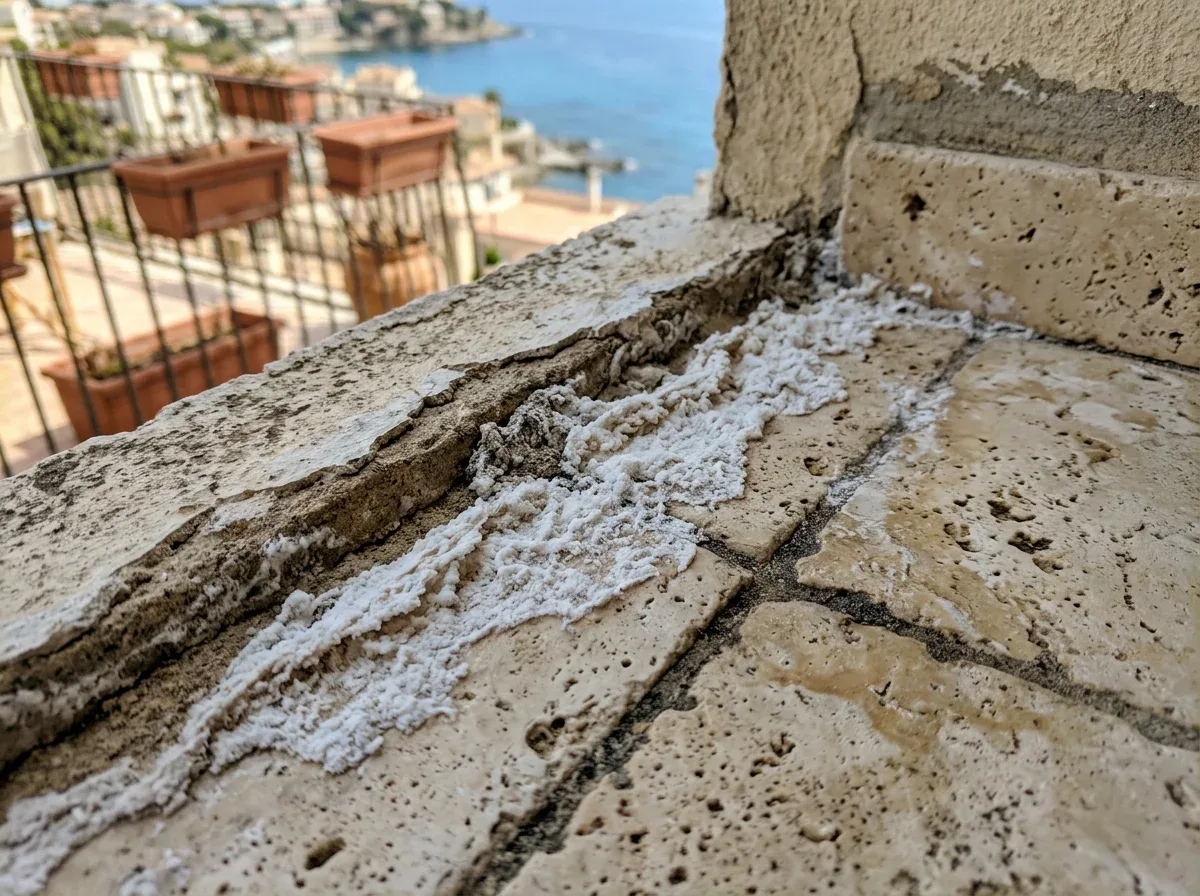
The wind blowing in from the sea carries salt particles too fine to see in the air. This salt settles on balconies, terraces, garden walls and facade stones. Rain, irrigation or washing water dissolves the salt and carries it into the pores of the stone; when the water evaporates, the salt crystallizes again inside the pores.
As the crystallizing salt grows, it presses on the pore walls from the inside. When this cycle repeats hundreds of times, the surface powders, lifts off in thin flakes and the edges become rounded, especially on travertine, limestone and soft marbles. White, crusty or cotton-like formations appear on the stone; this is called salt efflorescence (efflorescence).
Salt damage is seen most on sea-facing balconies, on stones at the edge of irrigated gardens, at the base of walls and in corners where water collects and dries slowly.
- Rinse outdoor stone with fresh water, especially after windy and stormy days.
- Remove the white marks on the surface with a dry brush first; do not use acidic descalers.
- On porous stones, reduce water and salt penetration with a breathable (vapor-permeable) impregnating sealer.
- If the marks keep coming back, find out where the water is coming from (drain, slope, irrigation).
2. Humidity and Condensation
On the coastal strip the air is humid throughout the summer. In closed and unventilated spaces, this moisture condenses on the stone. In air-conditioned interiors, when the cooled floor meets warm, humid air coming in, a thin film of water can form on the marble; the floor "sweats", becomes slippery, and dust sticks to this wetness and leaves stains.
Humidity also paves the way for:
- Mold and darkening of grout joints in bathrooms and showers,
- Stains under carpets, rugs and furniture in holiday homes that stay closed for months,
- Yellow-brown stains and yellowing in white marbles containing iron minerals,
- Dark rings at slab edges when moisture comes up from beneath the floor.
Prevention: Regular ventilation, drying wet areas after use, a dehumidifier or periodic airing in closed houses; and not leaving a wet mop on marble floors for long.
3. Sun and Temperature Variation
The strong Mediterranean sun heats outdoor stone considerably at summer noon and it cools down at night. Stone, filler and adhesive expand and contract at different rates in this cycle. The results become visible over time:
- Fillers in travertine pores crack, separate from the edges and fall out.
- Some resin fillers, polishes and surface coatings turn yellow or flake off under UV light.
- Organic stains such as leaves, flowers, fruit and bird droppings become permanent as they "burn" in the sun.
- Dark-colored stones get too hot to walk on barefoot by the pool and on the terrace.
Prevention: Choose UV-resistant filler and protective products outdoors, use a penetrating impregnating sealer instead of a polish that leaves a film on the surface, clean organic stains without waiting, and prefer light-colored stone in open areas where possible.
4. Sand
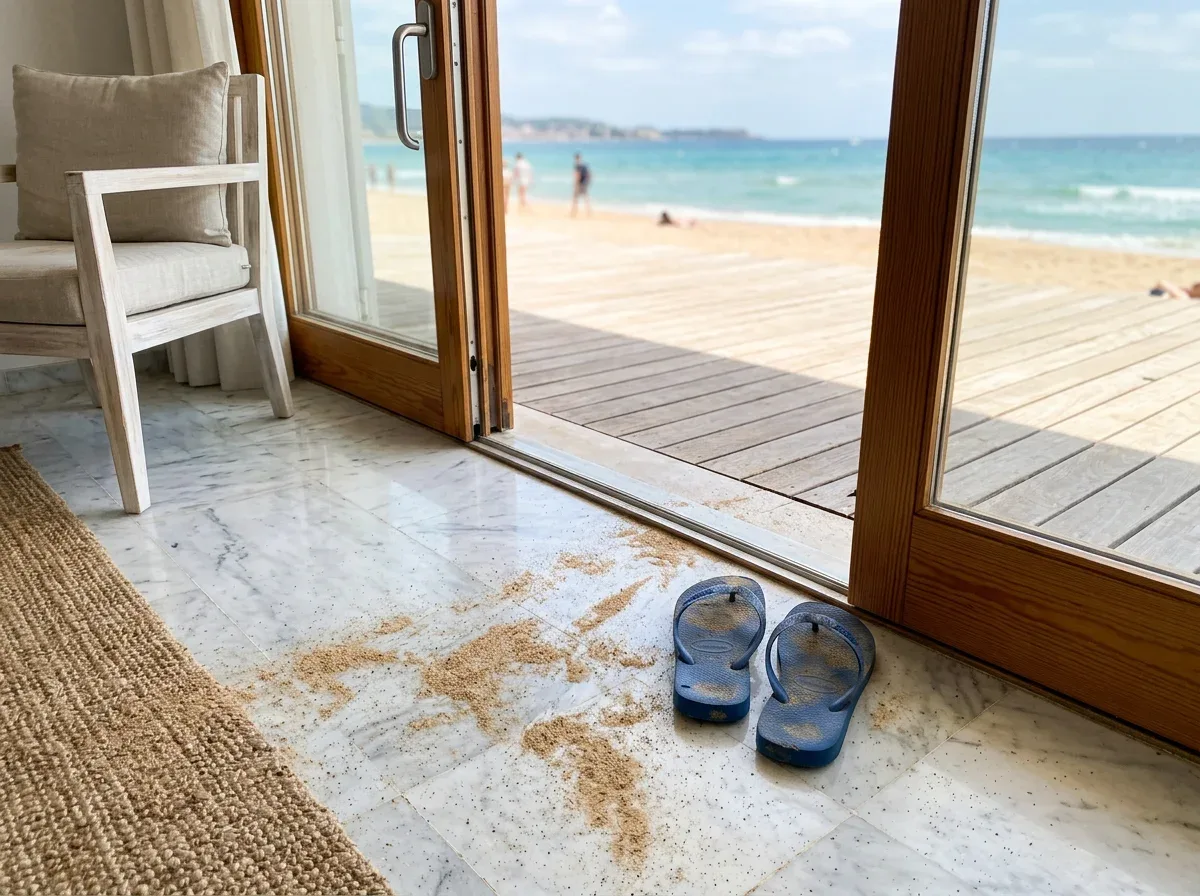
Most beach sand is quartz. Quartz has a hardness of about 7 on the hardness scale, while calcite, the main mineral of marble, is around 3. This means every grain of sand carried indoors on shoe soles, slippers or bare feet acts like a small piece of sandpaper on marble and travertine floors.
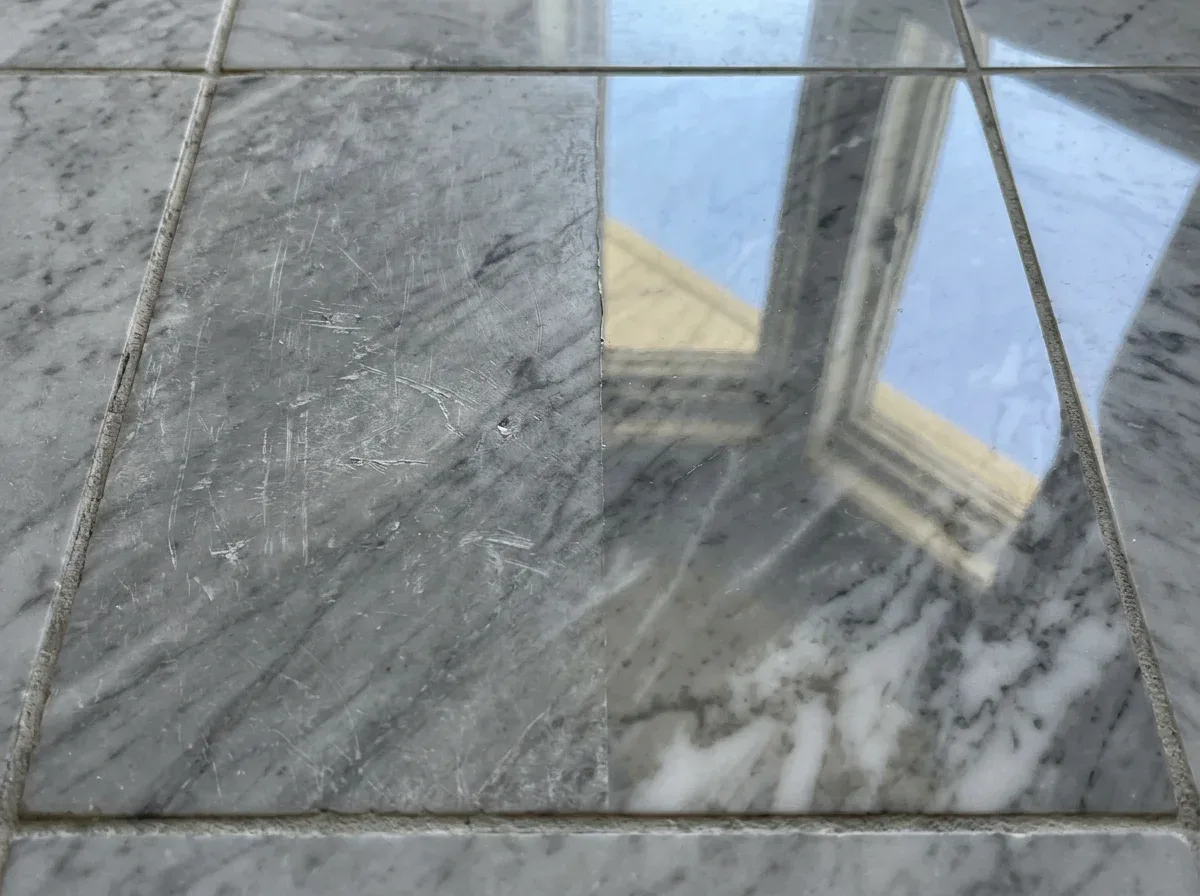
In homes and hotels in Alanya, the places where marble first turns dull are almost always the same: entrance doors, terrace and garden exits, corridors, stair nosings and the path from the pool to the room. In these areas the gloss disappears first, and then fine scratches spread across the surface like a web.
Prevention: Place doormats both outside and inside the door, sweep dry often or dust with a microfiber mop throughout the summer, always remove sand before wet mopping (a wet cloth drags sand across the surface), and put felt pads on furniture legs.
5. Pool Water
Most villas and housing complexes have a pool. Pool water carries chlorine, lime, and salt in saltwater systems; pH regulators also reach the stone. As splashed water evaporates on the stone, it leaves white limescale deposits and rings. Acidic pool chemicals strip the gloss from marble and travertine and roughen the surface.
Prevention: Rinse the pool deck regularly with fresh water, do not prepare or spill pool chemicals on the stone, choose a non-slip, easy-to-maintain finish (honed, brushed or patinato), and protect it with a suitable impregnating sealer.
6. Winter Rain, Shade and Algae
Winters in Alanya are rainy. In garden paths that get no sun, north-facing facades, areas under trees and irrigated areas, stone stays wet for a long time. Algae and mold take hold on these surfaces, and the stone darkens and becomes slippery. Polished marble steps in particular can be dangerous when wet.
Prevention: Slopes where water does not collect, drains that do not clog, cleaning products suitable for natural stone where algae take hold, and a non-slip surface treatment on outdoor steps.
7. Seasonal Use
Holiday homes are used intensively for a few months and then left empty for months. In the busy period, sand, pool water and crowds wear down the floor; in the empty period, humidity, stale air and mold do their work behind closed windows. Hotels see a similar cycle: there is no time for maintenance during the season, and at the end of the season the wear accumulated on the floor suddenly becomes visible.
Prevention: A simple maintenance routine at season opening and closing; and, if needed, grinding and polishing, filling and impregnation before the season.
What Is the Mark on the Floor Telling You?
The mark on the stone often tells you its cause as well. The table below summarizes the symptoms we encounter most often in homes in Alanya and where to look first:
| What you see | Possible cause | First step |
|---|---|---|
| White, crusty or cotton-like marks | Salt efflorescence | Dry brushing, fresh water; investigate the moisture source |
| Dullness and fine scratches at the entrance and in the corridor | Sand abrasion | Doormats and dry cleaning; grinding and polishing if it has deepened |
| White rings around the pool | Limescale and pool chemicals | Rinsing; honing and sealing for dull stains |
| Yellow-brown stains on white marble | Moisture and iron within the stone | Cutting off the moisture source; expert inspection |
| Holes opening in travertine, filler falling out | Sun and thermal expansion | Renewing the filler, followed by honing and sealing |
| Green-black darkening on stone in the shade | Algae and mold | Proper cleaning, preventing water pooling |
| Floors that get wet and slippery when the air conditioning is on | Condensation | Ventilation, air conditioning settings |
Sea Climate by Stone Type
Marble
It is the stone most sensitive to sand and acidic cleaners. Polished marble looks great indoors, but in areas where sand gets in it needs regular maintenance. Outdoors, especially around pools and on balconies, a honed or brushed finish instead of a polished one lasts longer and is also less slippery. With white marble, watch for the yellowing that comes with moisture.
Travertine
It is one of the most widely used outdoor stones in Alanya, and the one that needs the most care with regard to salt and water. Its natural pores allow salt and water to enter easily. Checking the fillers regularly, filling pores that open up in time, and renewing the sealer directly extend the life of travertine.
Granite
It is the most durable stone against salt, sun and sand, which is why it is preferred for kitchen countertops, entrance steps and hotel entrances. Even so, light-colored granites can retain grease and water stains, and polished granite is slippery when wet. For light-colored granite, sealing is recommended; for exterior steps, a flamed (thermal) or brushed finish is recommended.
What You Can Do at Home, and What to Leave to an Expert
Most of protecting a stone floor by the sea comes down to daily habits:
- Keeping sand out and dry-cleaning before wet mopping,
- Using only pH-neutral cleaning products suitable for natural stone, and avoiding lemon, vinegar and descalers,
- Rinsing outdoor areas regularly with fresh water,
- Checking the sealer once or twice a year with a water drop test.
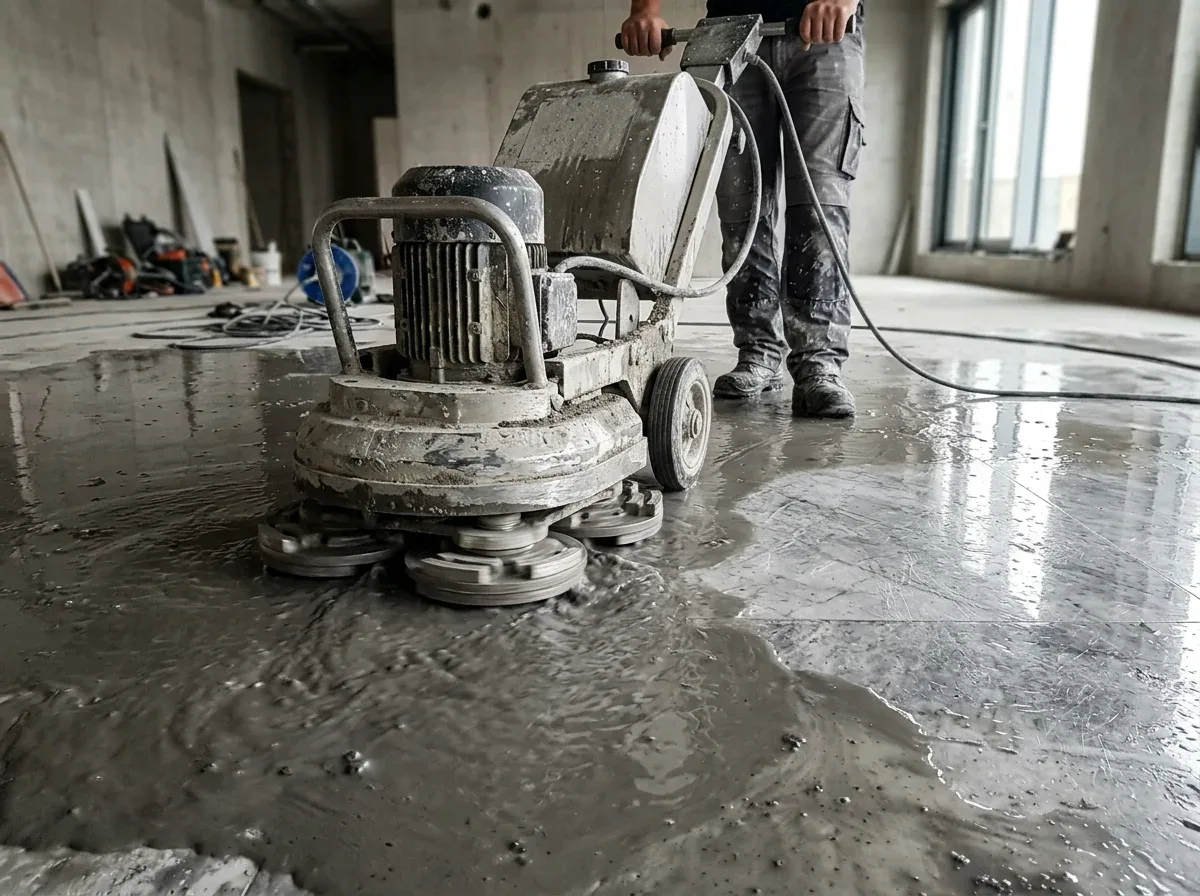
However, a dulling surface, deepening scratches, opening travertine pores, height differences between slabs and permanent stains are not problems that can be solved at home. At this point, honing with diamond abrasives suitable for the type of stone is carried out, with filling if necessary, followed by polishing or honing and sealing. Honing done at the right time removes the wear that has built up over the years and brings the stone closer to how it looked on day one.


A Practical Maintenance Calendar for Alanya

- Late spring: The best time for pre-season honing, filling, and impregnation.
- Summer: Frequent dry cleaning, rinsing around the pool edge, and quick action on spills.
- Autumn: End-of-season inspection; open joints and fillers, darkened pool edges, and worn entrances are noted.
- Winter: Ventilation and moisture checks in closed homes; algae monitoring outdoors.
Our Marble Grinding Service in Alanya

We restore marble floors that have become dull, scratched, or uneven between slabs using wet grinding, which keeps dust under control. From coarse grinding to polishing, we choose each stage according to the type of stone and, if needed, carry out crack and joint repairs as part of the same job.
We inspect your floor on site and tell you clearly whether it needs grinding or polishing only. Explore our Marble Grinding service.
There is no single cause of stone wear in seaside homes; salt, sun, moisture and sand all work together. That is why the most effective maintenance is a regular inspection at the start and end of each season: when opening joints, dulling entrances and weakening impregnation are renewed in time, the stone stays protected for years without the need for major polishing.
Frequently Asked Questions
01Which stone lasts longest by the sea?
02Can salt marks be cleaned?
03Should impregnation be renewed more often by the sea?
04Why does marble sweat in an air-conditioned home?
05When is the best time for floor honing in Alanya?
06Which surface is recommended for poolsides?
Related Articles
- Salt Efflorescence on Balconies and Terraces
- Air Conditioner Condensation and the Effect of Moisture on Marble
- Beach Sand and Shoes: The Duo That Silently Wears Down Stone Floors
- Natural Stone Care in Villas and Holiday Homes: Protecting Stone by the Sea
- The Effect of Pool Water and Chlorine on Natural Stone