Patinato and Brushing on Outdoor Stone Steps
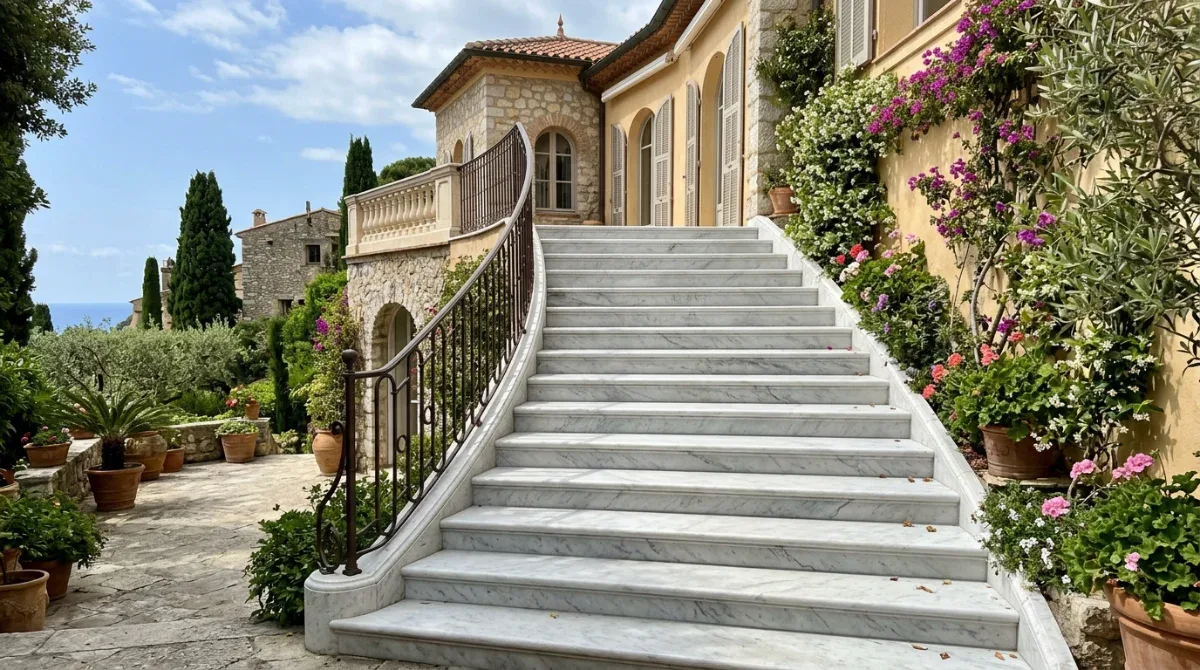
In short: Polished marble or granite steps look very elegant on the first day at building entrances, villa gardens and around pools; but in the rain, in the morning dew and under wet feet coming out of the pool, they carry a serious risk of slipping.
Patinato and brushing are methods that reduce this risk by giving the surface a texture without changing the stone. In this article, we explain how they are applied.
The Problem: Polished Stone Is Slippery Outdoors
When wet, a polished surface allows a thin film of water to form between the shoe sole and the stone. Grip decreases. On steps, this risk is greater than on flat floors, because:
- Weight falls on the nosing: When going down stairs, body weight is loaded onto the front edge of the step; if the foot slips on this narrow spot, regaining balance becomes very difficult.
- Narrow step surface: On a flat floor, a slipping foot can recover with one step, but on a step there is no room for a second step, so a slip turns directly into a fall.
- Fall height: A person who slips on a step can fall down several steps; therefore the same slip causes much more serious injuries than on a flat floor.
What Is Patinato?
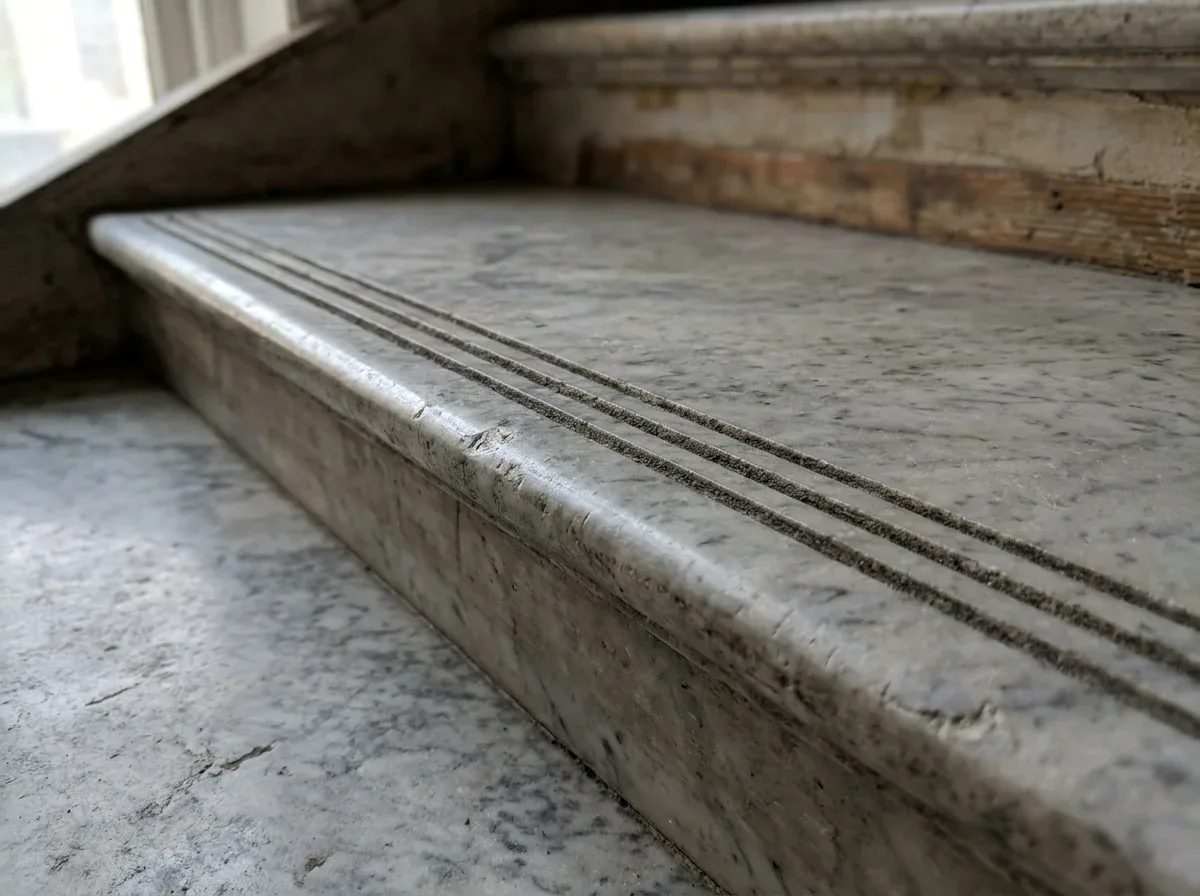
Patinato is giving the stone surface a slightly wavy, "aged" texture using special abrasive brushes and pads. The surface loses its shine but does not lose its smoothness completely; to the touch it feels silky yet provides grip.
What Is Brushing?
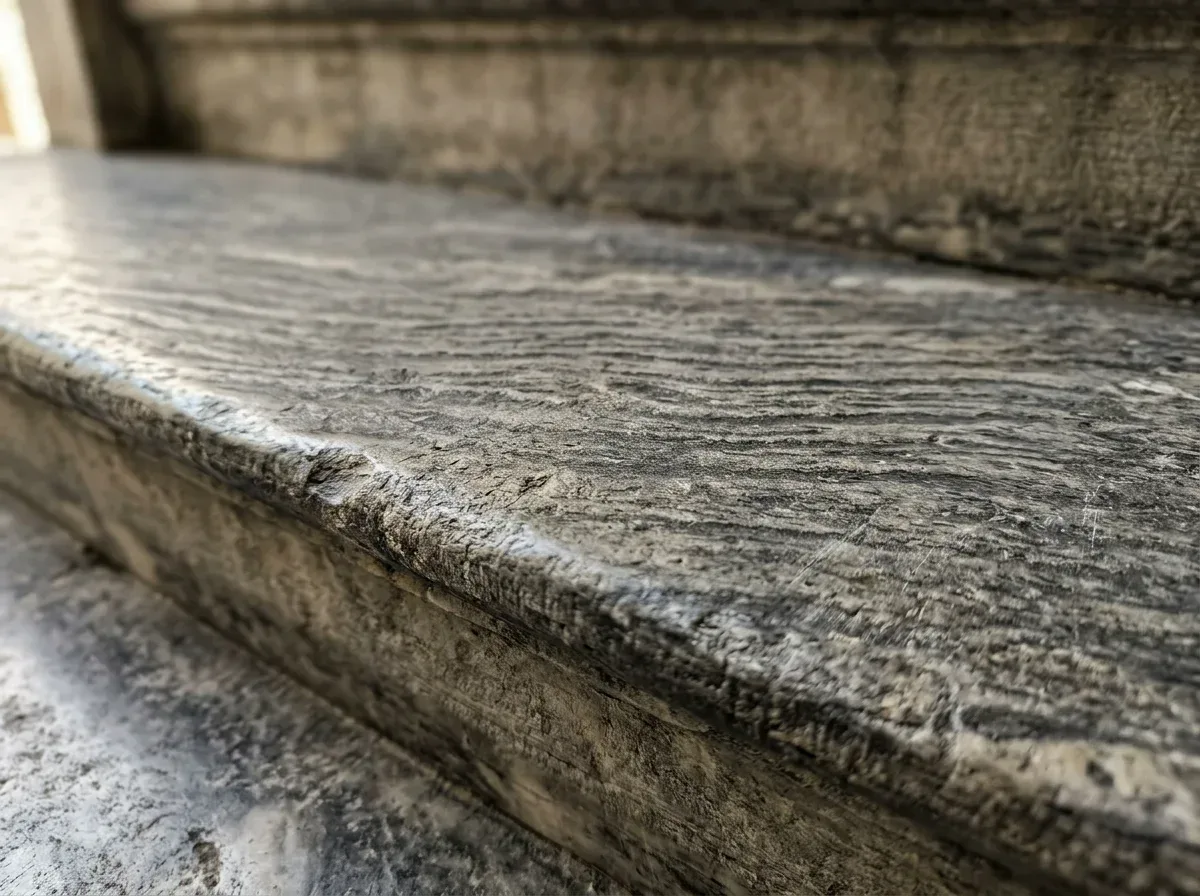
In brushing, the softer parts of the stone are worn away more with hard brushes, giving the surface a distinct texture. It provides a somewhat more pronounced roughness than patinato. It gives a very natural look on travertine and some marbles.
Patinato and brushing are terms often used together or interchangeably; the real difference is the depth of texture achieved.
Application
Patinato and brushing consist of several steps carried out in a fixed order, from cleaning to protection.
- Cleaning: First, dirt, algae and residues on the surface are removed; this way the abrasives work directly on the stone and dirt is not embedded in the texture.
- Removing the shine: After cleaning, the polished surface is broken with suitable abrasives; the brushes cannot texture the stone evenly until the glossy layer is removed.
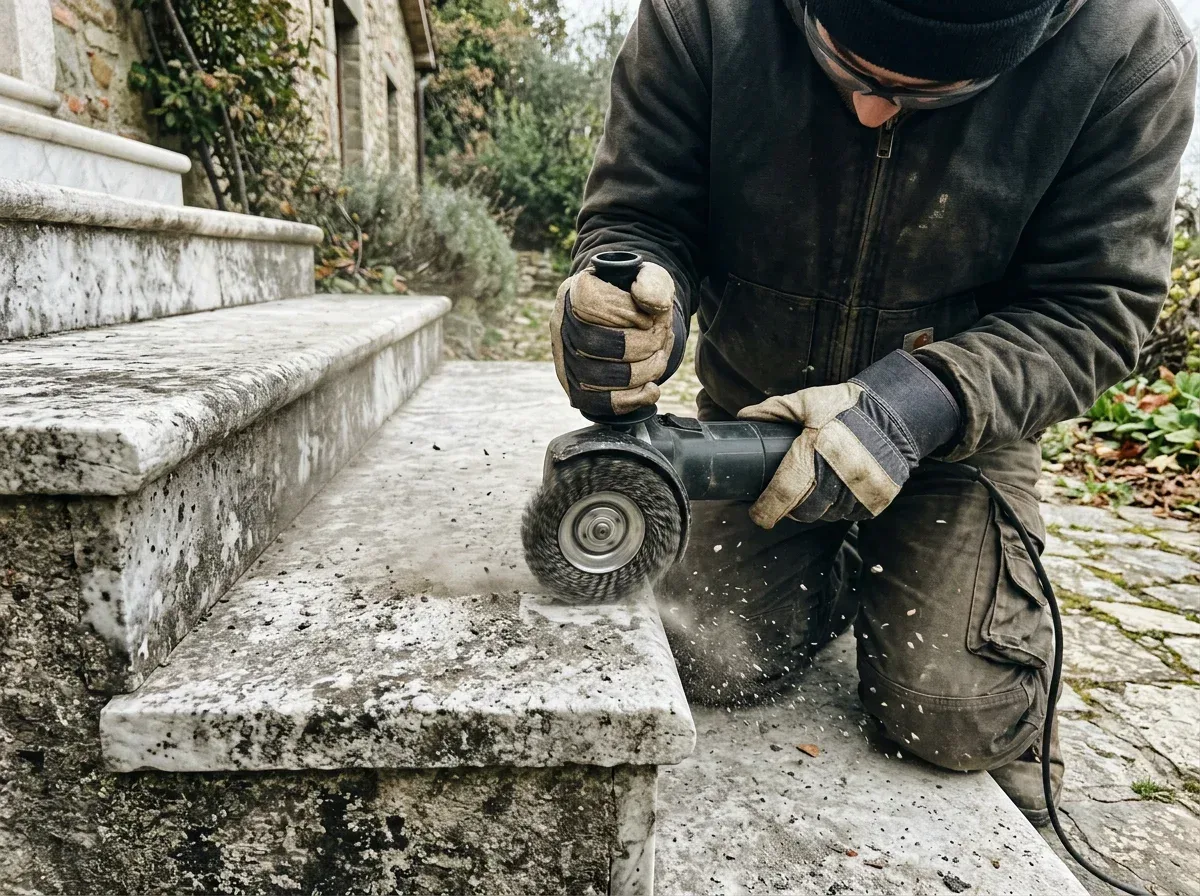
- Brushing / patinato: Then the desired texture is created with graduated brushes; as the process moves from coarse to fine, the surface gains grip while staying soft to the touch.
- Edge and nosing: The step nosing and edges are brought to the same finish; the sharpness at the nosing edge can be softened, so the most critical point of the step also becomes non-slip.
- Cleaning and drying: When the process is finished, abrasion dust and slurry are washed off, and the steps are left to dry until the water inside the stone is gone.
- Impregnation: In the final step, a UV-resistant impregnating agent suitable for outdoor use, which does not reduce slip resistance, is applied; the dry stone absorbs the product evenly into its pores.

Stairs are largely worked with hand machines.
Which Stones Is It Applied To?
Patinato and brushing can be applied to many natural stones, but the hardness and structure of the stone determine the result.
- Marble: Gives very good results; the surface takes on a natural, warm look and grips much better when wet than in its polished state.
- Travertine: Brushed travertine is already a very popular outdoor surface; the texture looks in harmony with the stone's natural porous structure.
- Granite: Because it is hard, brushing is more laborious. For slip resistance on granite, a flamed finish is more common; on existing polished granite, brushing or honing may be preferred.
- Limestones: It can be applied depending on the type; on soft and porous limestones the texture forms quickly, so a trial is first done on a small area.
Advantages
The biggest benefit of these methods is that they make steps safer and more usable without removing and replacing the existing stone.
- Slip resistance without changing the stone: Slip resistance increases without replacing the stone; without removal, new stone and installation labor, the steps are back in use in a short time.
- Natural, warm look: The textured surface with the shine removed shows the veins and colors of the stone in a soft tone; it fits better with the garden and pool surroundings.
- Scratches are less noticeable: Because light reflects diffusely on a textured surface, scratches and wear marks from use are much less noticeable than on polished stone.
- Profiles or strips may not be needed: Metal profiles screwed onto the step nosing afterwards or adhesive non-slip strips are often unnecessary, and the appearance is not spoiled.
Limitations
Patinato and brushing reduce slipping, but they do not solve every situation and they permanently change the look of the stone.
- Maintenance is still needed: Patinato and brushing increase slip resistance, but any surface can become slippery if there is ice, algae or greasy dirt; cleaning and maintenance must continue.
- It may hold more dirt: A textured surface may hold somewhat more dirt than a polished one; therefore the steps should be cleaned regularly with a brush.
- The look changes: The surface loses its shine; this method is not suitable if a polished, glossy look is desired.
Comparison of Surface Finishes
| Finish | Appearance | Wet slip resistance | Ease of cleaning |
|---|---|---|---|
| Polished | Glossy, mirror-like | Low | Very easy |
| Honed | Matte, flat | Medium | Easy |
| Patinato | Silky, slightly wavy | Good | Easy-medium |
| Brushed | Distinct texture, natural | Very good | Medium (needs brushing) |
| Flamed (granite) | Rough, lighter tone | Very good | Medium |
Test Step Before Application
The same treatment gives different results on different stones; on one marble it creates a silky, warm texture, while on another the tone may come out lighter than expected. For this reason, before starting work, a test is carried out on a hidden step or on a corner of the bottom step. The test area is wetted so that both appearance and grip are evaluated together; once approval is given, we proceed to the whole staircase.
Aftercare Following Application
Keeping a textured step both safe and clean depends on maintaining a few simple habits regularly.
- Sweep once a week: Sweep dust and leaves that collect on the textured surface with a soft brush once a week; when the buildup gets wet, it becomes slippery and leaves stains.
- Brush the shaded steps: Brush shaded steps showing algae and darkening with a pH-neutral stone cleaner; as algae spreads, both the appearance deteriorates and slipperiness increases.
- Keep the pressure under control: Use pressure washing at controlled pressure and from a distance; high pressure applied up close wears down the texture, the joints and the impregnation.
- Drop test once a year: Check the impregnation once a year with a drop test; if water quickly soaks into the stone, the protection has weakened and it is time for renewal.
- Do not use waxed polish: Do not use waxed or oily polishes; they leave a slippery layer on the surface and eliminate the slip resistance provided by the texture.
Exterior Steps in Alanya
In Alanya, the steps at villa entrances, those leading down to the pool and the stairs on hotel terraces are often laid with polished marble or granite. The rainy winter season and wet feet coming out of the pool in summer make these steps slippery for most of the year. On such steps, we increase slip resistance by applying patinato or brushing without removing the stone, and then protect it with an impregnation that withstands sea air and sun.
When Are Additional Measures Needed?

On very steep, sloped, or constantly wet steps, in addition to anti-slip treatment, you should consider:
- Anti-slip grooves behind the nosing,
- A handrail,
- Adequate lighting
.
Our Step and Stair Polishing Service in Alanya

We repair and polish worn step nosings, chipped edges and slippery stair surfaces. For entrances and outdoor stairs, we recommend anti-slip grooves or a suitable surface finish for safety.
For apartment and housing complex stairs, we plan the work section by section without interrupting foot traffic. Learn more about our Step Polishing service.
A beautiful outdoor step is one you can also walk down safely when it is wet. Gloss is the choice for indoors, texture for outdoors.