Should Countertop Honing Be Done On Site or in a Workshop?
In short: When you want to renovate your kitchen or bathroom countertop, the first question is: will the countertop be removed, or will it be processed in place?
In most cases the countertop is renovated on site, but some jobs require a workshop. In this article we compare the two methods and explain what determines the decision.
On-Site Renovation
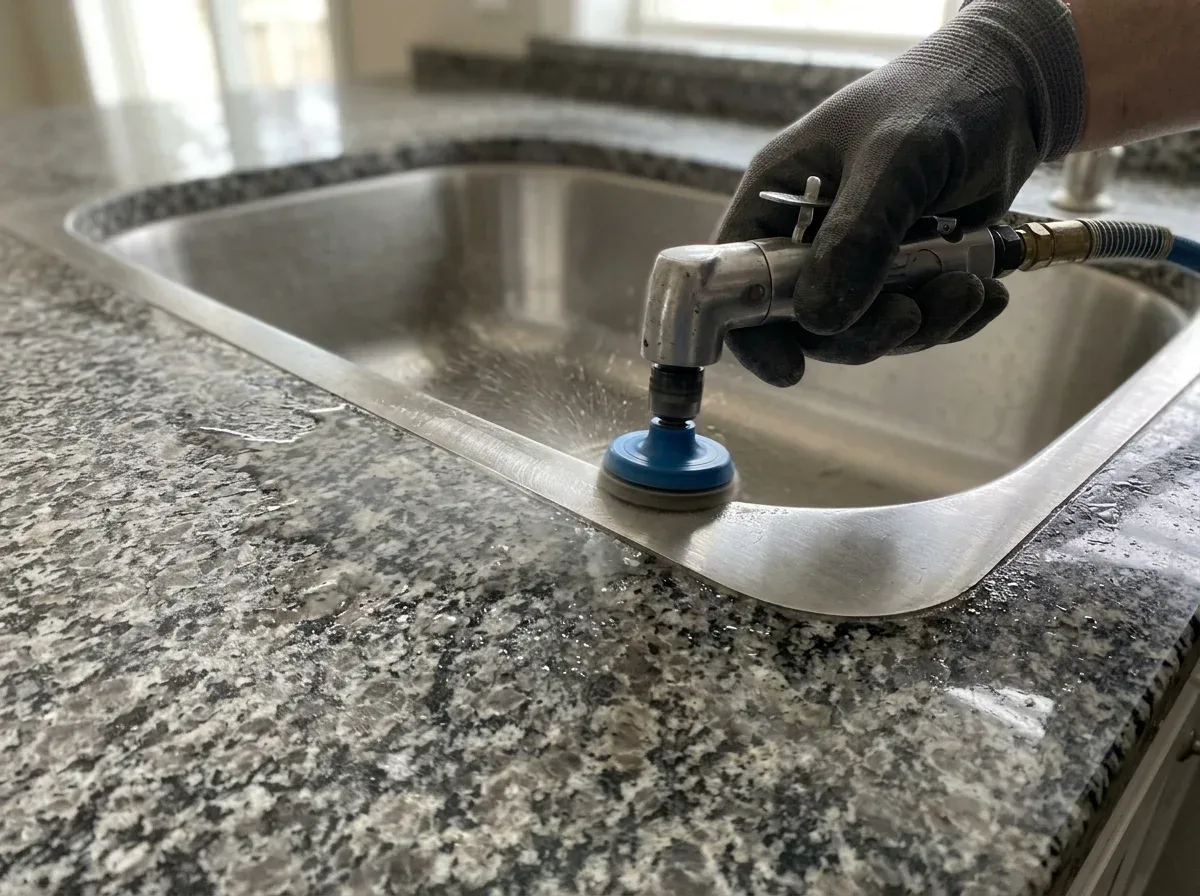
The countertop is cleaned, repaired, ground and polished where it stands, without being removed.
Advantages
Because on-site renovation does not move the countertop, it is the lowest-risk option in terms of breakage, plumbing and time.
- No removal risk: Countertop slabs are thin and long, so there is a risk of breakage during removal; with on-site work the stone is never moved, so this risk disappears.
- Plumbing untouched: The sink, hob, faucet and connections stay in place; there is no need to call a plumber or service technician, and no risk of leaks.
- Fast: It usually takes between a few hours and one day; the kitchen or bathroom can be used again after a short break.
- More economical: There are no removal, transport or reinstallation costs; the entire fee goes directly into renovating the surface.

Limitations
On-site work is carried out in a tight space where large machines cannot be used, so it requires fine craftsmanship and careful protection.
- Work with hand tools: Work is done with hand machines; large, heavy machines cannot be used, so very deep damage and large level differences can only be corrected to a limited extent on site.
- Fine workmanship in tight corners: Tight corners such as the wall edge, sink edge and area around the hob require fine workmanship; making these areas look the same as the rest of the surface takes skill.
- Protecting the surroundings: Surrounding cabinets, wall coverings and appliances must be protected; slurry and dust can reach unprotected surfaces.
- Water control: Because wooden cabinets are sensitive to water, water is used sparingly and the slurry is wiped away continuously; water seeping into the cabinets can cause swelling and damage.
Which Jobs Are Done On Site?
The vast majority of problems on the stone surface can be fixed in place, without removing the countertop.
- Dullness and polishing: A surface that has become dull with use is ground in fine stages and polished again; this is easily done on site with a hand machine.
- Surface and medium scratches: Surface and medium-depth scratches caused by knives and pots are removed by grinding, starting at the appropriate grit.
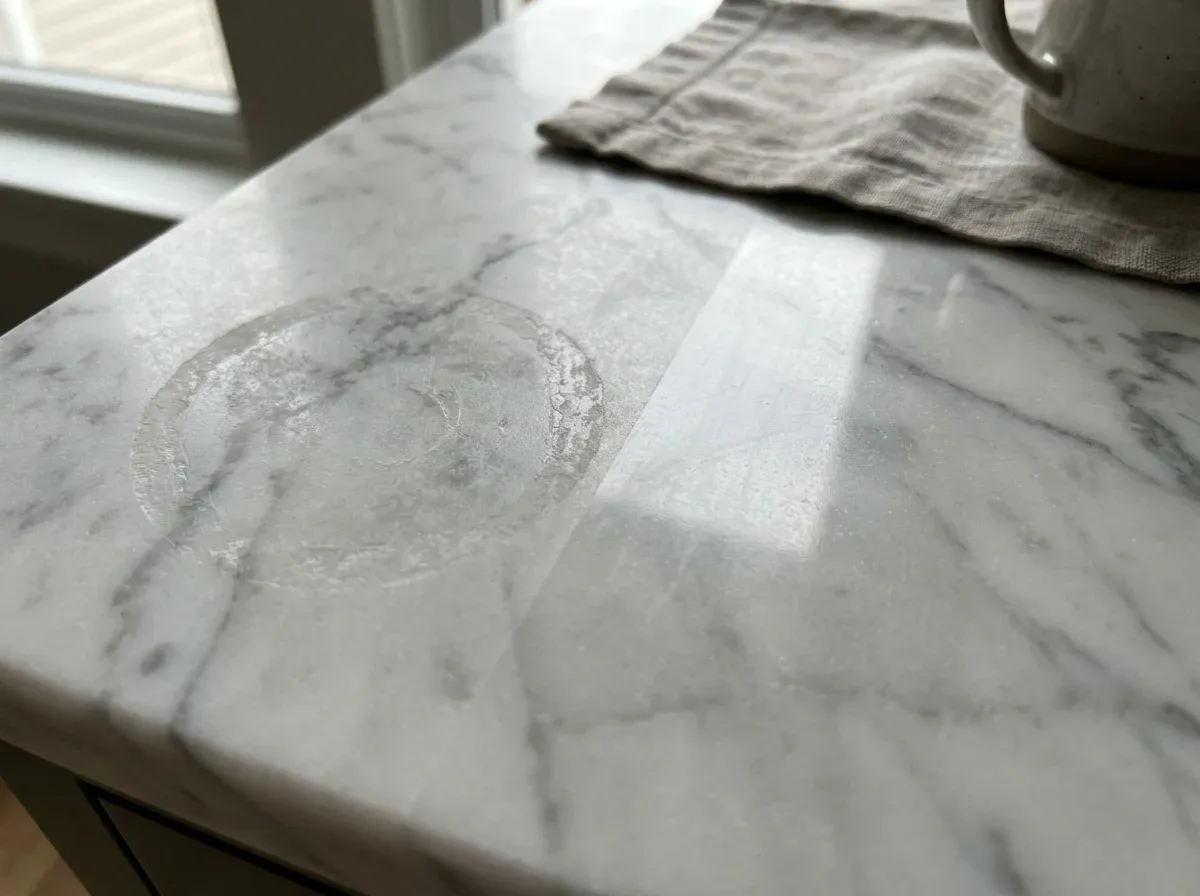
- Acid marks: The dull marks that lemon, vinegar or wine leave on marble are removed by grinding off a thin layer of the surface and polishing it.
- Stain removal: Oil and color stains that have penetrated the stone are drawn out from within using a poultice suited to the type of stain.
- Repair of edge chips: Small chips on the edge are filled with filler matched to the stone color, then ground to match the edge profile.
- Silicone and grout renewal: Darkened or moldy silicone and grout are removed and renewed; the joints where the countertop meets the wall and sink look clean again.
- Impregnation: The sealer applied after grinding reduces the stone's absorption of water and oil; it keeps the renovated surface protected from staining for longer.
Workshop Renovation
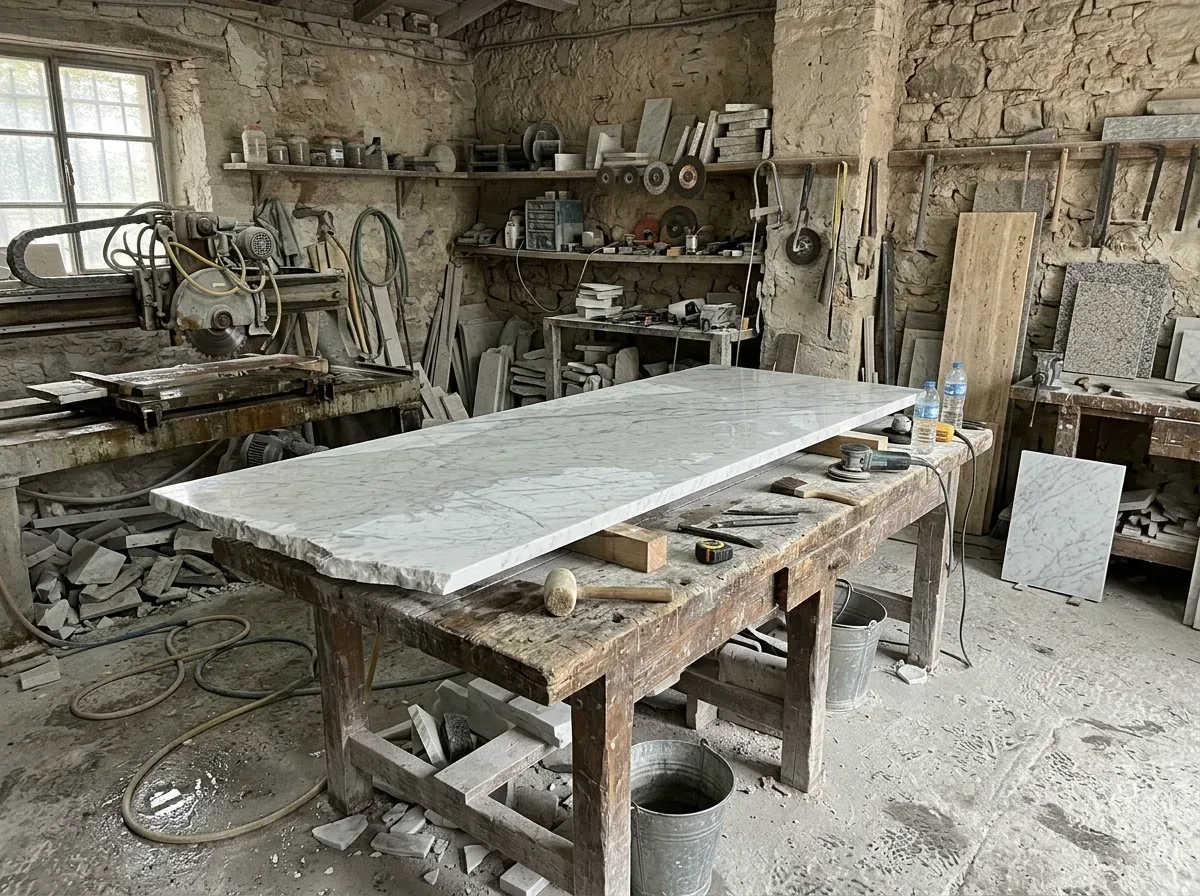
The countertop is removed, transported to the workshop, processed with large machines and reinstalled.
Advantages
The workshop environment allows large-machine work that cannot be done on site, as well as operations that change the shape of the countertop.
- Even and uniform grinding: With large machines the entire surface is processed at the same pressure; countertops with deep damage and level differences get a more even and uniform result.
- Reshaping the edge profile: The edge profile can be reworked as a bevel, half-round or flat edge; this is a job that cannot be done properly on site with a hand machine.
- Repair of a broken countertop: A broken countertop is glued together in the workshop and reinforced from underneath; because the pieces are aligned on a flat surface, the joint is less visible.
- Enlarging or changing cutouts: Enlarging or changing the sink or hob cutout is done more cleanly and in a more controlled way with the workshop's cutting machines.
Limitations
In return for the possibilities that workshop renovation offers, there are some disadvantages in terms of removal, time and cost.
- Risk of breakage: Thin, long countertop slabs can break during removal, transport and installation; the areas around the sink and hob cutouts are especially weak points.
- Kitchen out of use: While the countertop is in the workshop, the kitchen cannot be used for several days; this period must be planned for a home, rental apartment or business.
- Plumbing and appliance removal team: Sinks, faucets and built-in appliances are removed and reinstalled; this requires separate skilled labor and extra time.
- Higher cost: Because removal, transport, workshop labor and reinstallation are added, the total price is higher than for on-site restoration.
Which Jobs Are Done in the Workshop?
Jobs that change the shape, openings or structure of the countertop generally require a workshop.
- Changing the edge profile: When the edge profile is completely redone with large, fixed machines, a smooth and even line is achieved along the entire edge.
- Enlarging the sink cutout: When switching to a new sink type, the cutout is enlarged; cutting in the workshop is done to the exact measurements without cracking the countertop.
- Repair and reinforcement of a broken countertop: A broken countertop is glued together in the workshop and reinforced from underneath, so that the joint can bear loads again.
- Deep level difference or damage: A deep level difference or very deep damage cannot be corrected properly on site with a hand machine; with large machines the whole surface is processed evenly.
Questions to Help You Decide
The main factor determining the decision is whether the problem is on the surface or in the structure; a few questions quickly point to the right method.
- Location of the problem: Is the problem on the surface (dullness, stains, scratches) or in the structure (breakage, profile, cutouts)? Surface problems are solved on site, while structural problems are most often solved in the workshop.
- Soundness of the countertop: Is the countertop sound, or is it broken or loose? A loose or broken countertop must first be secured or repaired in the workshop.
- Sink and hob change: Will the sink or hob be replaced? If the new appliance requires a different cutout size, the cutting work directly affects the decision.
- Time without a kitchen: Can the kitchen be left unused for a few days? If not, the workshop option should only be chosen when it is truly necessary.
For surface problems, on-site restoration is almost always sufficient.
Comparison of On-Site and Workshop Restoration
| Subject | On site | In the workshop |
|---|---|---|
| Duration | A few hours - 1 day | A few days |
| Risk of breakage | None | Present during removal and installation |
| Plumbing | Not touched | Removed and reinstalled |
| Polishing, stains, scratches | Suitable | Suitable |
| Edge profile change | Limited | Suitable |
| Sink cutout change | Generally not possible | Suitable |
| Cost | Lower | Higher |
Protecting the Kitchen During On-Site Work
The most common question about on-site restoration is how the rest of the kitchen is protected. Before work begins, cabinet doors, wall coverings, the hob and the range hood are covered with plastic sheeting and tape; the sink and faucet are protected. Water is used in a controlled way, the slurry is wiped up continuously and kept from reaching wooden surfaces. In dry steps, hand machines with suction collect dust at the source. When the job is finished, the protection is removed and the kitchen is delivered clean.
A Short Guide to Make the Decision Easier
In most cases, which method to choose can be predicted in advance based on the type of problem on the countertop.
- Appearance problems only: If there are only appearance problems such as dullness, stains and scratches, on-site restoration is sufficient; the countertop is wiped and polished without being removed.
- Small chips on the edges: If there are a few small chips on the edges, an on-site repair is done; the chips are filled with a filler matching the stone color and wiped clean.
- Cracked in the middle but sound: If the countertop is cracked in the middle but still sits soundly in place, on-site gluing and repair is usually done, avoiding the risk of removal.
- New sink or built-in hob: If a new sink or built-in hob is to be installed, workshop or on-site cutting is considered; the choice depends on the size of the cut and the condition of the countertop.
- If the edge profile will be completely changed: If the edge profile will be completely changed, a workshop is required; large machines give a smooth and even profile along the edge.
Countertop Restoration in Alanya
Most of the countertop work we do in Alanya is restored on site; marble and granite countertops are usually handed back polished and clean the same day, without making the kitchen unusable. When a job does require the workshop, we state this clearly during the site survey and discuss the risks of removal and installation beforehand. In rental homes and hotels, we schedule the work around guest changeovers or short maintenance windows so that operations are not disrupted.
On-Site Restoration Day

- The countertop is cleared.
- Outlets, appliances, and cabinets are protected.
- Cleaning and stain removal are carried out.
- Repairs are made and left to harden.
- Progressive polishing is applied.
- Silicone seals are renewed.
- Sealer is applied.
- Reopened for use (use with care until the sealer has cured).
Our Countertop Honing Service in Alanya

We hone away etch marks, scratches and stubborn stains on marble and granite kitchen and bathroom countertops, usually on-site without removing the countertop. We take care to protect your cabinets and walls, and we usually finish the job the same day.
After honing, we also apply a sealer suited to the type of stone in your countertop. Explore our Countertop Honing service.
Some jobs, such as enlarging a cooktop cutout, can also be done on site with the right equipment, but the risks and dust control must be assessed. — Expert Note