Solution for Permanent Stains on Marble Countertops
In short: Marble countertops look very elegant in the kitchen and bathroom, but they are sensitive to acids and colored liquids.
Lemon juice, wine, coffee, oil and cosmetic products can leave marks that look permanent in a short time. In this article, we explain how to tell the types of stains on a marble countertop apart and which solution applies to each.
Diagnosis First: Stain or Etch Mark?
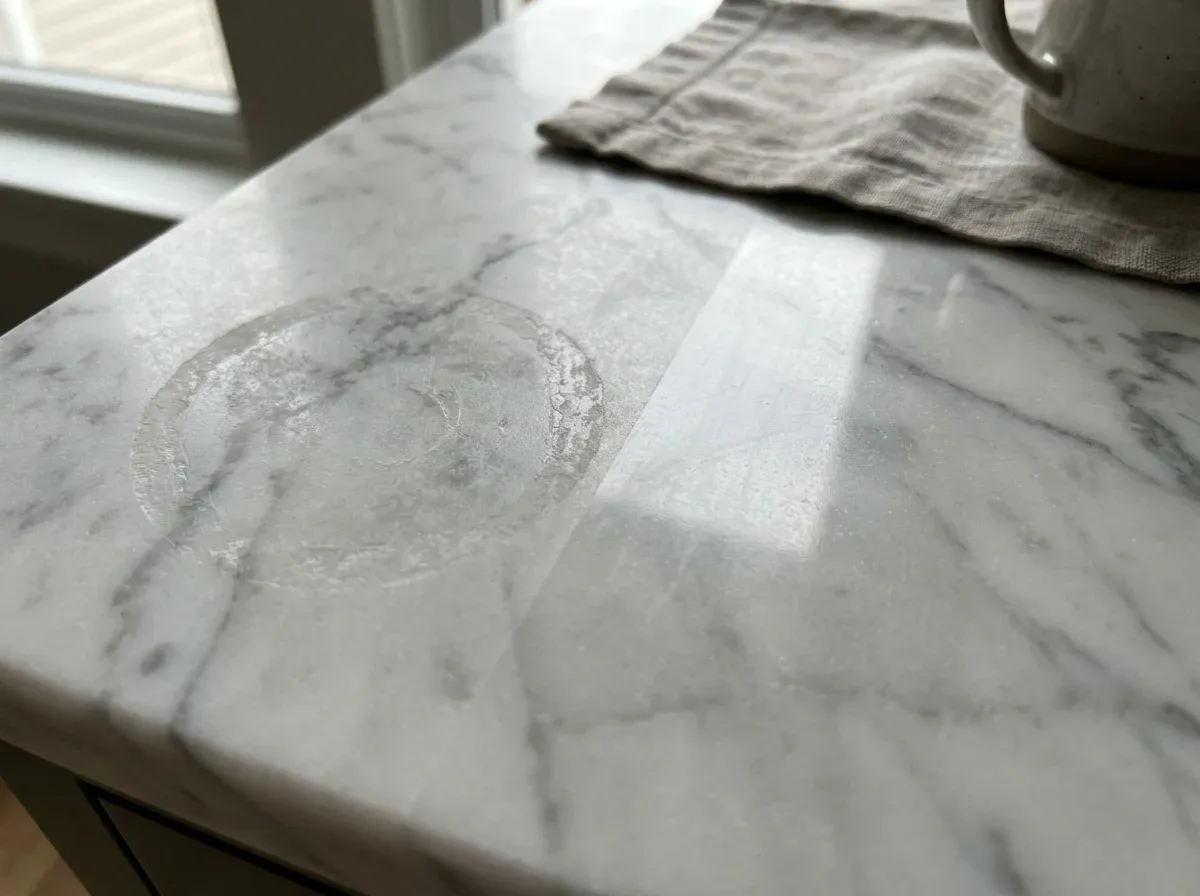
Two different problems are often confused on marble countertops. You can see the difference between them in the image below.
Acid Etch (Erosion)
An acid etch is not a stain; it is erosion caused by acid dissolving the polished surface of the marble.
- Where the acidic substance touched: It forms where lemon, vinegar, wine, cola, tomato sauce or a descaler has touched the surface, and it often takes the shape of the spill.
- Loss of shine, not color: There is little or no change in color; the real difference is that the area has lost its shine compared with its surroundings.
- A dull area visible in angled light: It is hard to spot when looking straight down, but when you look across the countertop against the light, it stands out as a dull area in the middle of the glossy surface.
- Poultice does not remove it: Since there is nothing inside the stone to draw out, a poultice is useless; the surface is restored with polishing powder or fine-grit honing.
Solution: The surface is restored with polishing powders or fine-grit honing.
Color Stain (Absorption)
A color stain occurs when liquid is absorbed into the pores of the marble and stays inside the stone.
- Liquids absorbed by the stone: Coffee, tea, wine, fruit juice, oil and cosmetic products penetrate the pores of the marble and cannot be removed by wiping the surface.
- Darkening or taking on color: The stone has darkened or taken on the color of the liquid where the stain is; this difference is easier to see on light-colored marble.
- Shine may be preserved: Since the surface is not eroded, the shine often remains intact; this is an easy way to distinguish a color stain from an acid etch.
Solution: A poultice to draw the stain out of the stone.
Some stains involve both: for example, wine can leave both an acid etch and a color stain. In this case, a poultice is applied first, followed by polishing.
Approach by Stain Type
Organic Stains (Coffee, Tea, Wine, Fruit)
Organic stains such as coffee, tea, wine and fruit juice remain as brown or pink tones on light-colored marble. These stains are usually drawn out with a stone-safe, hydrogen peroxide-based poultice. The poultice is applied over the stain, covered, and left until it dries; as it dries, the stain transfers into the poultice. Fresh stains often come out in a single application, while the process may be repeated several times for older stains. On dark-colored marble, peroxide can lighten the tone of the stone, so it should first be tested in an inconspicuous corner.
Oil Stains
They are drawn out with a degreasing poultice. Old oil stains may require more than one application.
Cosmetic Stains (Bathroom Countertop)
Lipstick, makeup products, nail polish, hair dye and perfume can leave both color and solvent effects. A suitable poultice is used depending on the stain's content, followed by polishing if necessary.
Rust Stains
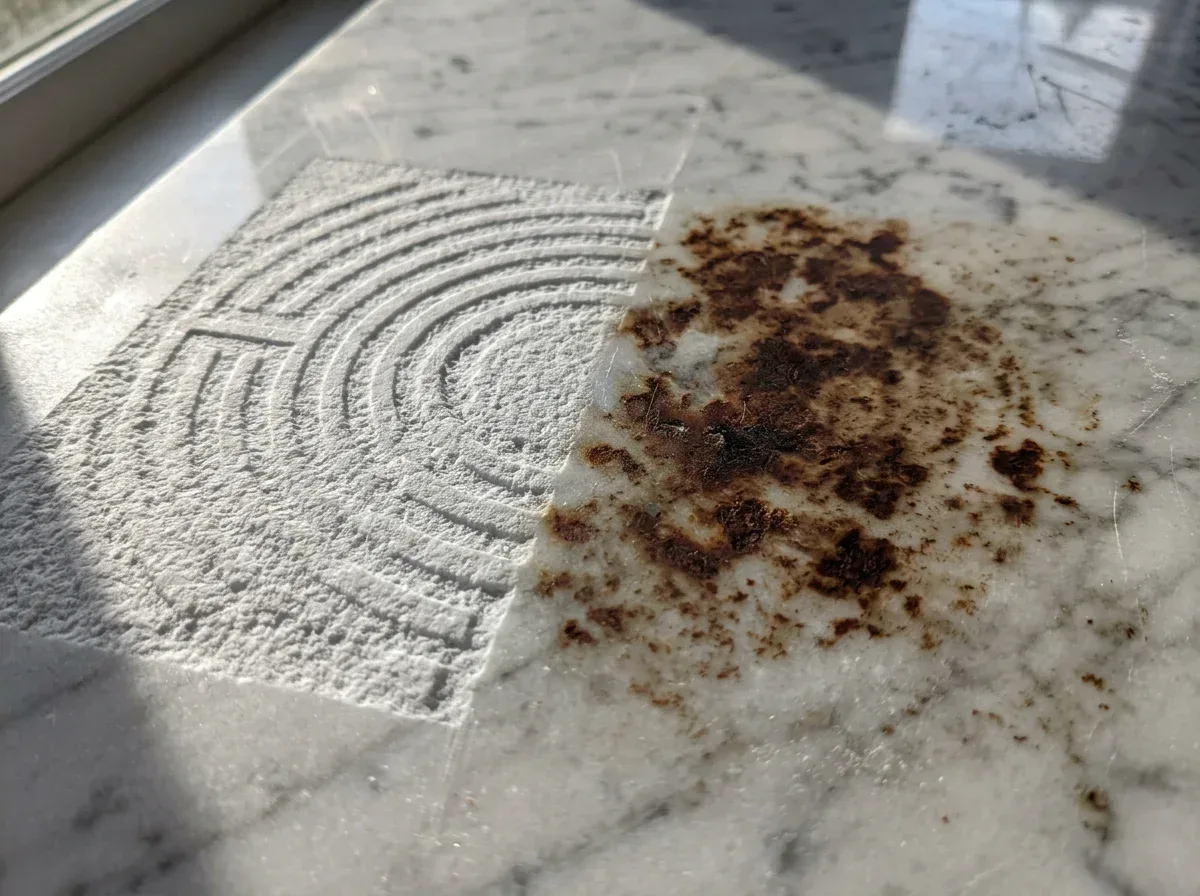
Orange rings left by metal cans, razors and shaving foam cans. They are lightened with acid-free rust removers; deep rust may not come out completely.
Water Rings
Limescale rings are treated with a stone-safe product and light polishing; absorbed water goes away with waiting (it disappears once dry).
Poultice Application in Brief
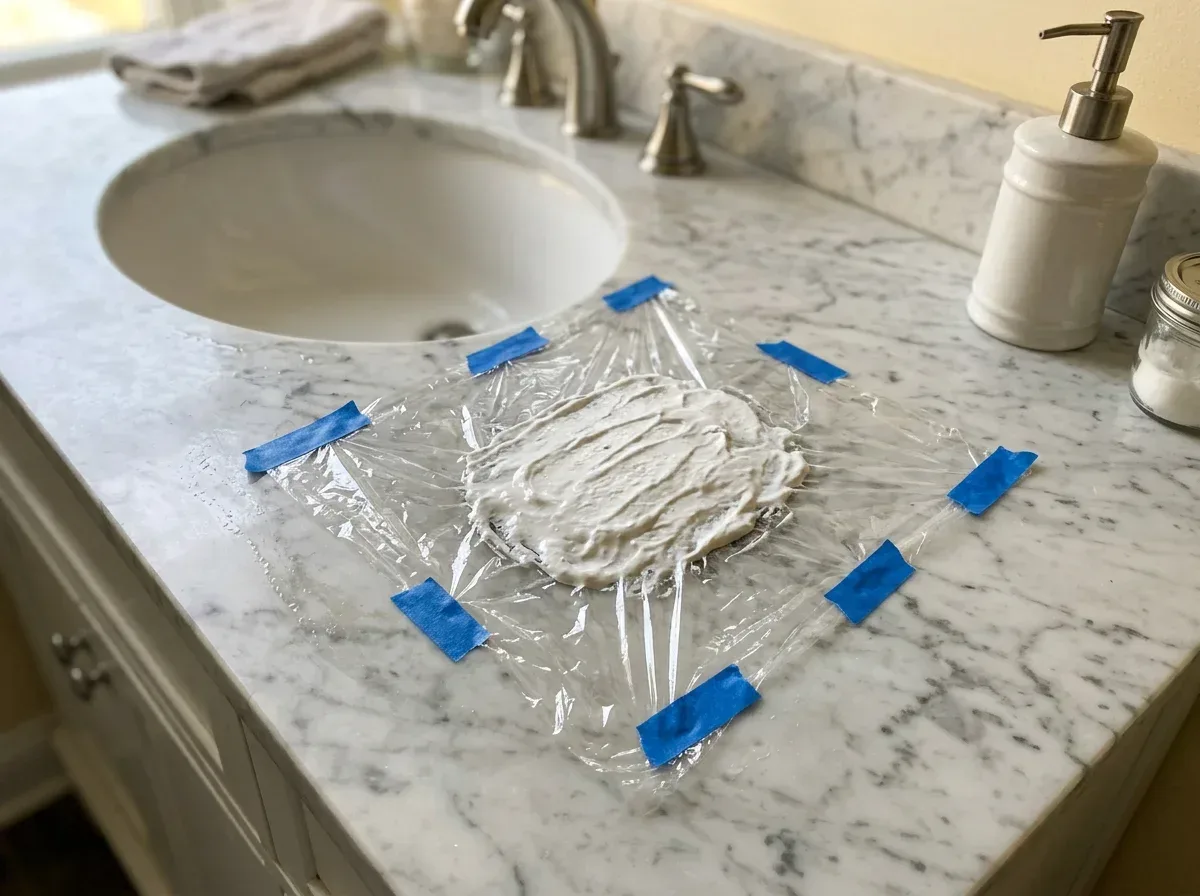
A poultice is an absorbent paste that draws a stain absorbed into the stone out of it as it dries.
- Powder and liquid are mixed: First, an absorbent powder suited to the stain type is mixed with a liquid that will dissolve the stain to prepare a spreadable paste.
- A thick layer is applied: The prepared poultice is spread over the stain in a thick layer, extending slightly past its edges.
- Covered and left to sit: It is then covered and left for a set time; during this time the liquid penetrates the stone and dissolves the stain.
- Uncovered and left to dry: Next, the cover is removed and the poultice is left to dry; as the moisture evaporates, the dissolved stain is drawn out of the stone into the poultice.
- Removed and cleaned: Once the poultice is completely dry, it is removed, and the surface is wiped with clean water and dried to avoid leaving any residue.
- Repeated if necessary: If the stain has not fully lifted, the process is repeated from the start; old and deep stains may require several applications.

If the surface remains dull after the poultice, polishing is done.
When Is Honing Needed?
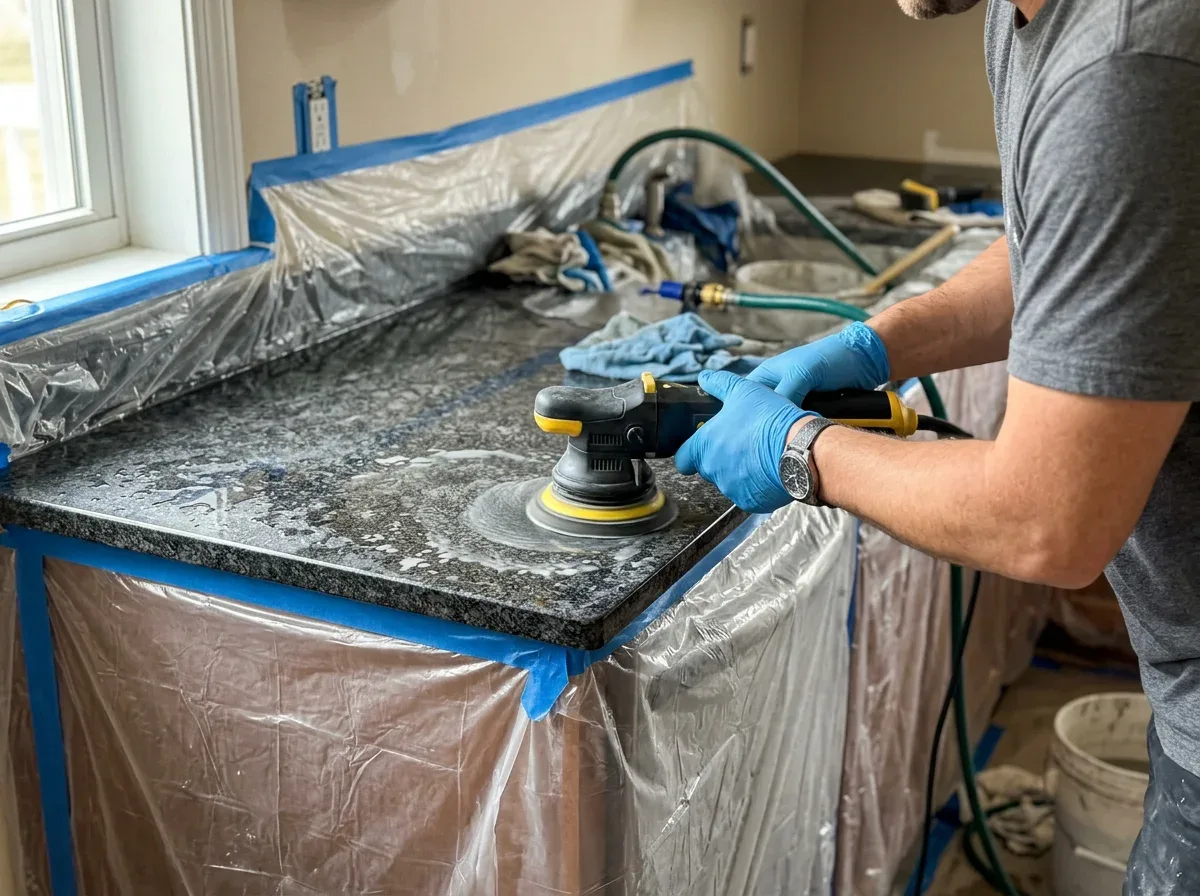
When poultice and spot polishing are not enough, the entire countertop is honed with fine grits to even out the surface.
- Widespread acid etching and dullness: If there is acid etching and dullness across the countertop, polishing spot by spot leaves differences in tone; treating the whole surface together gives a more even result.
- Many scratches: Many scratches left by cutting, pots and everyday objects can be removed only by taking a thin layer off the surface.
- Leveling after stain removal: If the treated area looks different from its surroundings after poulticing and polishing, honing gives the whole countertop the same surface.
In these cases, the entire countertop is honed through fine grit stages and polished.
Stain Types and Solution Summary
| Stain | Type | Solution |
|---|---|---|
| Lemon, vinegar, cola | Acid etching | Polishing powder or fine-grit honing |
| Coffee, tea, fruit juice | Organic color stain | Peroxide-based poultice |
| Wine | Acid etching and color stain | Poultice first, then polishing |
| Oil | Absorption | Oil-dissolving poultice, repeated |
| Rust | Metal oxide | Acid-free rust remover |
| Limescale ring | Mineral buildup | Stone-safe product, light polishing |
What to Do Right After a Spill
Responding correctly in the first few minutes greatly prevents the stain or etch mark from setting deeper.
- Blot, don't wipe: Blot up the liquid with an absorbent paper towel; wiping spreads the stain over a wider area and pushes more liquid into the stone.
- Dampen and dry: Dampen the area with clean water and dry it again; this dilutes the liquid left on the surface so it can be removed before the stone absorbs it.
- Act fast with acidic spills: Acidic spills such as lemon and vinegar can leave a mark within just a few minutes, so act without delay.
- Don't apply chemicals: Applying vinegar, lemon or a general-purpose cleaning spray to a stain can add an etch mark on top of the color stain.
- Note what the stain is: If a stain remains, note what was spilled; the poultice used for coffee, oil or cosmetics is different for each.
Living with a Marble Countertop
A marble countertop is a living material that gains small marks and tone variations over time. Some homeowners love this "lived-in" look as part of marble's character, while others always want a flawless surface. In the latter case, choosing a honed (matte) finish makes etch marks much less noticeable. With proper sealing and simple habits such as using cutting boards and coasters, a marble countertop can stay beautiful in the kitchen for many years.
Countertop Stain Solutions in Alanya
In villas and holiday apartments in Alanya, the most common problems on marble countertops are lemon and citrus marks, wine and coffee stains, and cosmetic stains on bathroom vanities. During our on-site inspection, we identify the type of stain, first treating those that can be drawn out with a poultice, then removing etch marks and dullness by polishing. If necessary, we hone and seal the entire countertop to give the surface a uniform finish.
Protection

- Use acidic ingredients such as lemon and vinegar on a cutting board or tray, not directly on the countertop.
- Place coasters under glasses and bottles.
- Keep cosmetics on a tray on the bathroom countertop.
- Wipe up spills immediately.
- Have the surface sealed, but keep in mind that sealing does not prevent acid marks (etching).
Our Countertop Honing Service in Alanya

We hone away etch marks, scratches and stubborn stains on marble and granite kitchen and bathroom countertops, usually on site without removing the countertop. We protect your cabinets and walls while we work, and we usually finish the job the same day.
After honing, we also apply a suitable sealer, chosen for the type of stone your countertop is made of. Explore our Countertop Honing service.
A suitable poultice is applied for organic stains. Some organic stains may also fade on their own over time and with exposure to light once the source has been removed. — Expert Note