Removing Scratches and Stains from Granite Kitchen Countertops
In short: Granite countertops are among the most durable options in the kitchen, but over the years limescale can appear around the sink, grease next to the stove, scratches on the cutting area and chips along the edges.
In this article we explain the most common problems with granite countertops and how they are restored in place, without removal.
Common Problems with Granite Countertops
Dullness
The most heavily used areas of the countertop lose their shine over time. In most cases this is caused less by wear on the stone than by a layer of detergent, grease and limescale built up on the surface.
Scratches
Because granite is hard, knives usually do not leave marks on it; however, the bottoms of ceramic plates, sand and other stone particles can leave fine scratches.
Grease Stains
On light-colored granite, dark stains with soft edges around the stove and along the countertop edges.
Water Rings and Limescale
Limescale deposits around the sink and under the faucet; rings left by glasses and bottles.
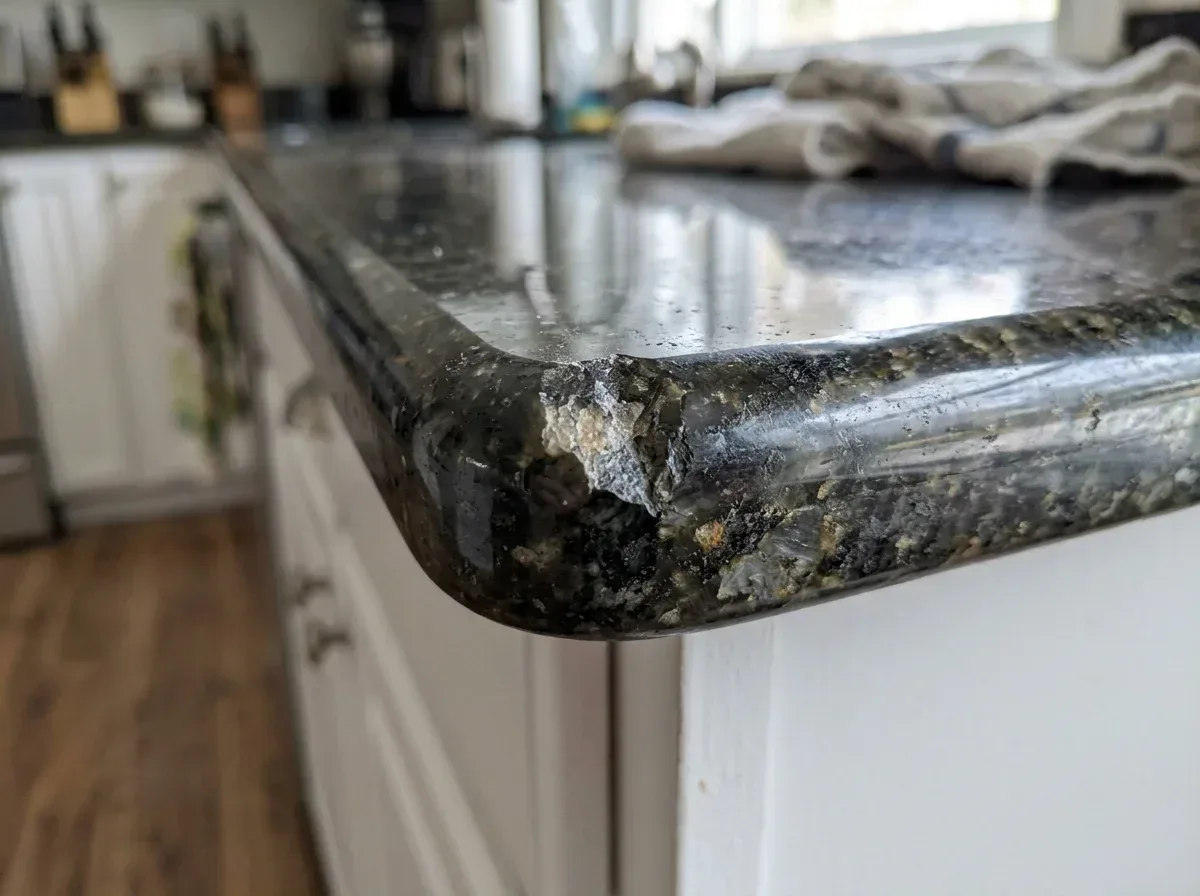
Edge Chips
Pots and plates that knock against the front of the countertop and the sink edge can cause small chips along the edges.
Grout and Silicone Problems
The silicone at countertop joints, along wall edges and around the sink darkens over time, grows mold and leaks water.
In-Place Restoration Steps
1. Deep Cleaning
The countertop is cleared of the detergent film, grease and limescale layer that has built up on the surface. For this, granite-safe, non-filming alkaline cleaners and soft pads are used. In many cases this step alone restores the shine to the areas of the countertop that seemed dull, because the problem is not in the stone but in the layer on top of it. After deep cleaning, the real scratches, stains and wear become clearly visible, and the next steps are planned accordingly.
2. Stain Removal
A poultice is applied to grease and organic stains. For old and deep stains, the process can be repeated.
3. Limescale Removal
Limescale around the sink is removed with products that will not harm the stone or the sealer, or with light mechanical methods.
4. Edge Repair
Chipped edges are filled with color-matched resin, shaped and polished.
5. Polishing
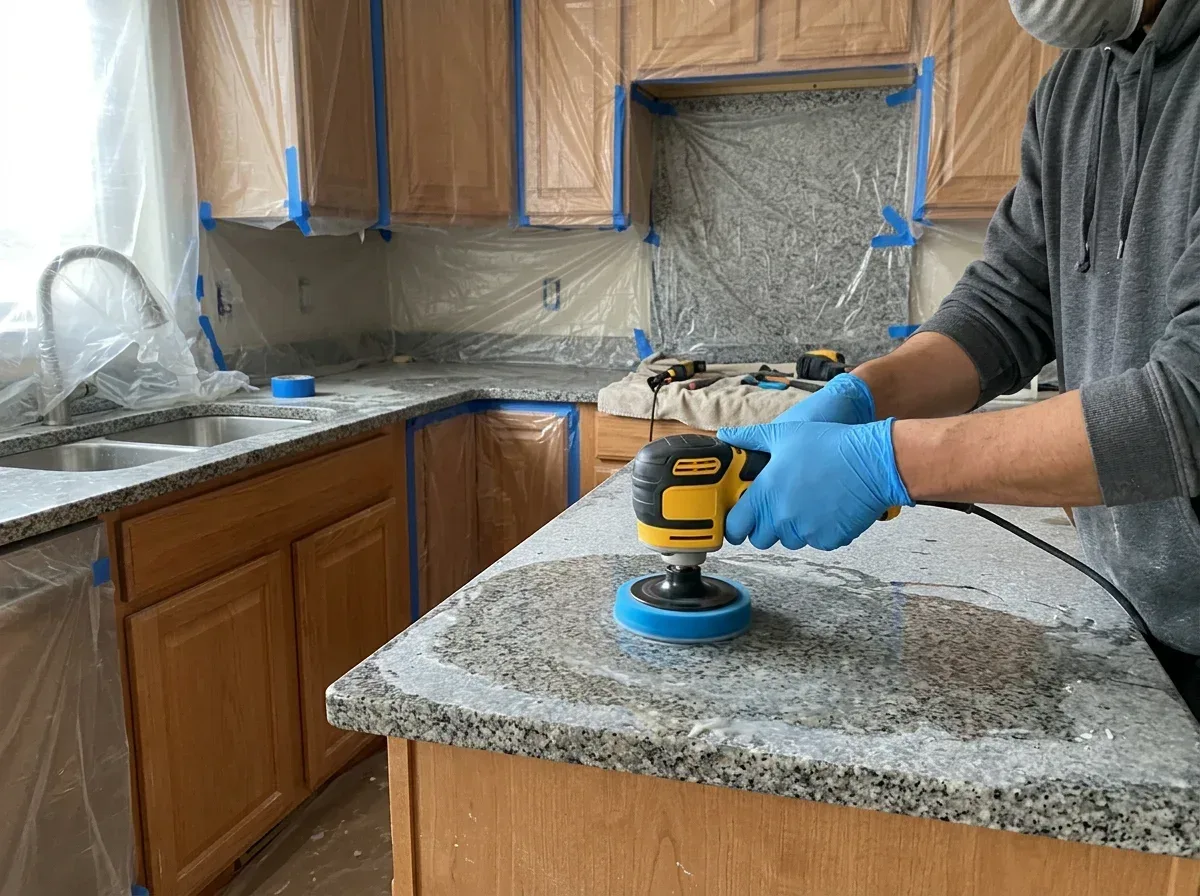
Dulled areas are polished in place with fine diamond pads and polishing powders suitable for granite. Hand-held machines and water control are used on countertops; surrounding cabinets, walls and appliances are protected.
6. Silicone Replacement
The old silicone is removed and replaced with mold-resistant silicone.
7. Sealing
If needed according to the water drop test, a sealer is applied. In the kitchen, products stated to be suitable for food contact should be preferred.
How Is Countertop Restoration Planned?
When a countertop is restored in place, the real job is protecting the surroundings; cabinets, appliances and walls are kept away from water and dust.
- Items are removed: Items on the countertop are removed so that the machine can easily reach every point of the surface, the corners and the area around the sink.
- Appliances and outlets are protected: Electrical appliances and outlets are protected; since water is used during the work, the outlets are switched off and appliances are covered or removed.
- Cabinets and walls are covered with plastic sheeting: Wooden cabinet doors and wall coverings are protected with plastic sheeting; splashing water and stone slurry can swell and stain the wood.
- A few hours to a day: The job usually takes between a few hours and a day; the time varies depending on the size of the countertop, the stains and whether edge repair is needed.
- Care during the curing period: Wet use of the countertop is limited until the sealer has cured; water and grease that come into contact too early can prevent the sealer from fully penetrating the stone.

Problem and Solution Table
| Problem | Solution | Note |
|---|---|---|
| Dullness | Deep cleaning, polishing if necessary | Often it is just a surface film |
| Fine scratches | Local polishing with diamond pads | For deep scratches, start with a coarser grit |
| Grease stain | Poultice application | Several repetitions may be needed |
| Limescale and rings | Suitable limescale cleaning | Acidic products damage the sealer |
| Chipped edge | Color-matched resin filling | Shaped and polished |
| Darkened silicone | Removal and renewal | Mold-resistant silicone |
Everyday Use of a Granite Countertop
Daily habits matter if a granite countertop is to look like new for many years. The countertop should be wiped with a pH-neutral cleaner or one suitable for granite and then dried with a dry cloth; not leaving water standing, especially around the sink, prevents limescale buildup. Oil and colored liquids should be wiped up without delay. Hot pots generally do not damage granite, but using a trivet is a good habit so that a sudden temperature difference does not create stress on thin edges.
What to Avoid
Most of the things that damage a granite countertop are wrong cleaning and usage habits adopted with good intentions.
- Bleach and limescale remover: Wiping the countertop with bleach or limescale remover damages the sealer and, on some granites, can also affect the surface's shine and color.
- The abrasive side of the sponge: Scrubbing with the abrasive side of a dish sponge creates fine scratches on the polished surface and, over time, dulls the most frequently used areas.
- Polishes that leave a film: Using furniture polish or polishing spray that leaves a film on the surface clouds the stone; this layer traps dirt and fingerprints and looks like dullness.
- Sitting on the edge: Sitting on the countertop edge or putting weight on it can cause the stone to crack, especially around the sink cutout and on overhanging edges.
- Cutting directly with a knife: Cutting directly on the countertop with a knife both dulls the knife and can leave fine scratches; always use a cutting board for cutting.
Countertop Renewal in Alanya
Granite kitchen countertops are very common in villas and holiday apartments in Alanya; in rental homes, limescale, grease stains and chipped edges are seen more often because of heavy use. We carry out countertop renewal on site, without removing the countertop and with the kitchen protected, and we often finish the same day. For rental homes, we also offer a quick refresh option between guest changeovers.
Preventive Tips

- Use a cutting board,
- Do not place hot pots directly on the stone (sudden temperature change),
- Wipe up spilled oil and colored liquids immediately,
- Dry the area around the sink after use,
- Clean with pH-neutral products,
- Perform the drop test regularly.
Our Granite Grinding and Polishing Service in Alanya

Granite is a hard stone, and its shine is restored not with polish but by honing with the right diamond grits. We re-polish dulled indoor granite, and clean outdoor surfaces and steps while preserving their slip-resistant finish.
We determine on site which treatment your granite floor needs, based on its condition. Explore our Granite Grinding and Polishing service.
The layer of grease and detergent on the surface is removed with suitable products. In most cases, this step alone makes a noticeable difference to the countertop's shine. — Expert Note