Cleaning Travertine Wall Cladding
In short: Travertine is used not only on floors but also on living room walls, fireplace surrounds, garden walls, and building facades.
Wall cladding wears less than flooring, but over time it looks neglected because of dirt, algae, salt, and water marks. In this article, we explain how to clean travertine walls.
On Interior Walls
Most of the dirt on interior travertine walls comes from specific sources such as hand contact, fireplaces, and flower pots, and it can be cleaned with gentle methods.
- Dust and cobwebs: Remove them with a soft brush or a vacuum cleaner attachment; this way, the dust that accumulates in the pores of the travertine is cleaned without scratching the surface.
- Handprints and grease: These build up around fireplaces, stairs, and outlets; wipe them with a neutral cleaner. If grease has penetrated the stone, localized stain removal may be needed.
- Fireplace soot: Clean it with suitable cleaners and, if necessary, a poultice; since soot penetrates the pores, simply wiping it is often not enough.
- Water marks: These are caused by water splashing or seeping onto the wall from flower pots and vases; when the water dries, it leaves limescale and ring marks on the stone surface.

On interior walls, wiping with a neutral cleaner and, when necessary, localized stain removal is usually enough.
On Exterior Walls and Facades
Because exterior walls and facades are directly exposed to sun, rain, wind, and sea air, they face very different kinds of dirt.
- Dirt and dust: Dirt and dust carried by traffic and wind settle into the pores of the facade; over time, the stone turns gray and its color becomes dull.
- Algae and black stains: These form on shaded, damp surfaces that receive no sunlight; if not cleaned, they settle into the pores of the stone and spread.
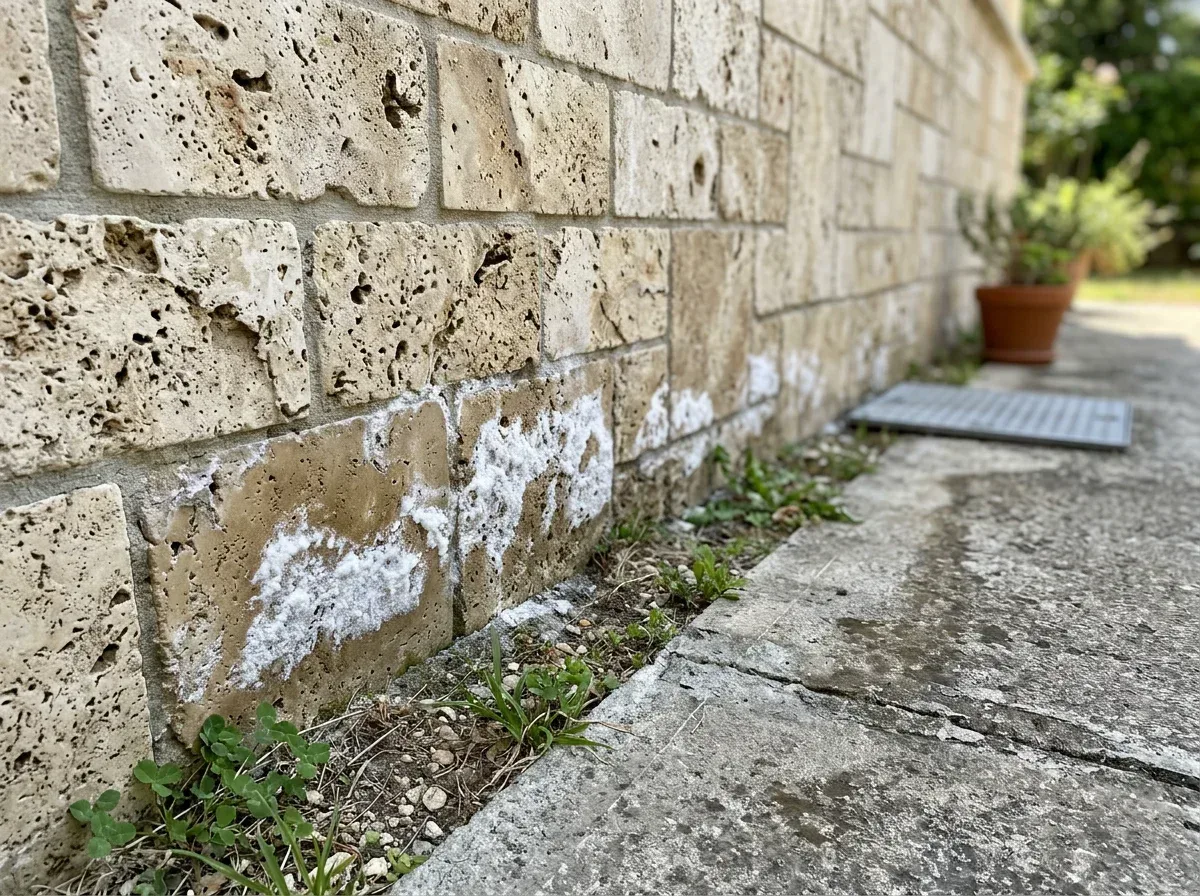
- Salt efflorescence: Salts carried to the surface by moisture inside the wall appear as white, powdery crystals; if the source of moisture is not eliminated, they form again.
- Rust: Rust running down from metal fittings and railings leaves orange-brown marks on the stone; these stains do not come out with ordinary washing.
- Water runoff marks: Because rainwater always flows along the same line beneath windowsills and on parapets, dark streaks carrying dirt form.
Method
Low-Pressure Washing
Exterior travertine walls are washed with controlled, low-pressure water. High pressure and a narrow nozzle can wear down the soft surface of travertine and empty out the pore fillers and joints. Washing is done from top to bottom; the lower sections are rinsed again afterward so that the dirt running down does not re-soil the areas already cleaned. If a suitable product is first applied to algae-covered and stained areas and left to act for a while, far better results are obtained with low pressure.
Brushing
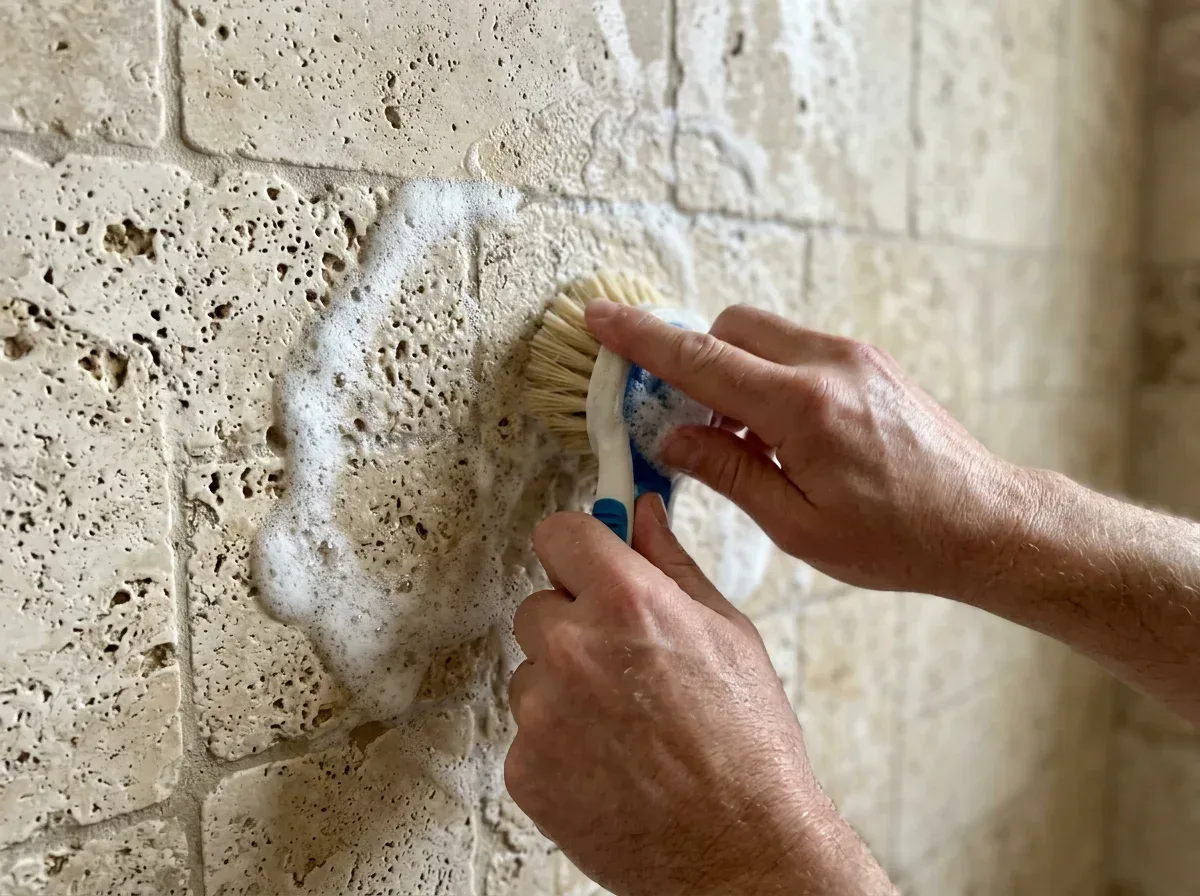
Soft and medium-stiff brushes are used; wire brushes are never used.
Suitable Cleaners
Because travertine is a stone that is sensitive to acids, choosing the right product is just as decisive as the method itself when cleaning walls.
- Neutral, stone-safe products: For general dirt, neutral products suitable for natural stone are used; they dissolve the dirt without damaging the stone's surface and fillers.
- Suitable products for algae: Products made specifically for this purpose are applied to algae-covered surfaces and left to act for a while; this way, the algae is dissolved at the root and easily removed with a brush.
- No acidic facade cleaners: Acidic facade cleaners are avoided; they dissolve the surface of the travertine, lighten its color, and make the stone more porous.
Poultice
For localized and stubborn stains.
Salt Efflorescence
Salt is carried to the surface by moisture coming from inside the wall. It is removed with a dry brush, but it will return if the source of moisture (roof, parapet, ground moisture) is not eliminated.
Impregnation
A breathable impregnating sealer applied after cleaning and drying:
- Water and dirt absorption decrease: The sealer penetrates the pores of the stone and reduces water and dirt absorption; rain and dust stay on the surface and do not get into the stone.
- Algae growth slows: Because the stone retains less moisture, algae formation slows down; this difference is especially noticeable on shaded exterior faces.
- Later cleaning becomes easier: Because dirt does not cling to the surface, the next cleaning is done with lighter methods and in less time.
Cleaning by Type of Dirt
| Dirt | Method |
|---|---|
| Dust and cobwebs | Soft brush, vacuum cleaner attachment |
| Handprints, grease | Neutral cleaner, poultice if necessary |
| Fireplace soot | Suitable work cleaner, poultice |
| Algae and black stains | Suitable product, brushing, low pressure |
| Salt efflorescence | Dry brushing, resolving the moisture source |
| Rust | Rust-removing poultice |
| Water runoff marks | Cleaning, checking sills and parapets |
Working on High Facades
Cleaning facades higher than two storeys requires scaffolding, a platform, or other suitable access equipment, and must be carried out with occupational safety measures in place. Before work begins, windows, doors, and the gardens or terraces below are protected; the wash water and chemicals must not reach plants or the pool. The condition of metal fixings and joints on the facade is also checked; if a plate has come loose, it needs to be secured first.
To Keep the Wall Clean
Keeping the wall clean depends largely on controlling how water reaches the stone.
- Check the drip edges: Make sure the drip edges on sills and parapets are working; a drip edge that does not work lets rainwater run straight down the wall and leave marks.
- Keep irrigation away from the wall: Make sure irrigation systems do not wet the wall; on constantly wet stone, algae, limescale, and salt marks form quickly.
- Do not pile soil against the wall: Do not pile pots or soil at the base of walls; soil passes moisture into the stone, which leads to salt efflorescence and staining.
- Renew the impregnation: Check the impregnation every few years and renew it; once its protection weakens, the stone starts absorbing water and dirt again.
Travertine Walls in Alanya
In Alanya, travertine cladding is very common on villa garden walls, hotel facades, and interior fireplace surrounds. Sea air, intense sun, and winter rains speed up algae, salt, and water marks on exterior walls. On these walls, we apply low-pressure washing, brushing with suitable products, and localized poultice, and we finish the job with a breathable impregnation.

Our Travertine Grinding Service in Alanya

We grind travertine floors that have open pores, have darkened or have worn down, and fill the voids with color-matched filler. For outdoor areas such as pool surrounds, terraces and gardens, we apply honed or brushed finishes that prioritize slip resistance over gloss.
After grinding, we also recommend a suitable impregnating sealer to protect the travertine against stains. Explore our Travertine Grinding service.
High pressure can open up the pores of travertine, strip out fillers, and force water into the joints. Using the right distance and pressure setting is important. — Expert Note