Salt and Moisture Rising Through Concrete Floors
In short: White salt marks and damp patches, common on basement floors, enclosed car parks and ground-floor concrete in contact with the soil, show that moisture is being carried through the concrete to the surface.
In Alanya, areas with high groundwater and buildings close to the sea experience this problem more often. In this article, we explain the causes and how it relates to grinding.
How Does It Form?
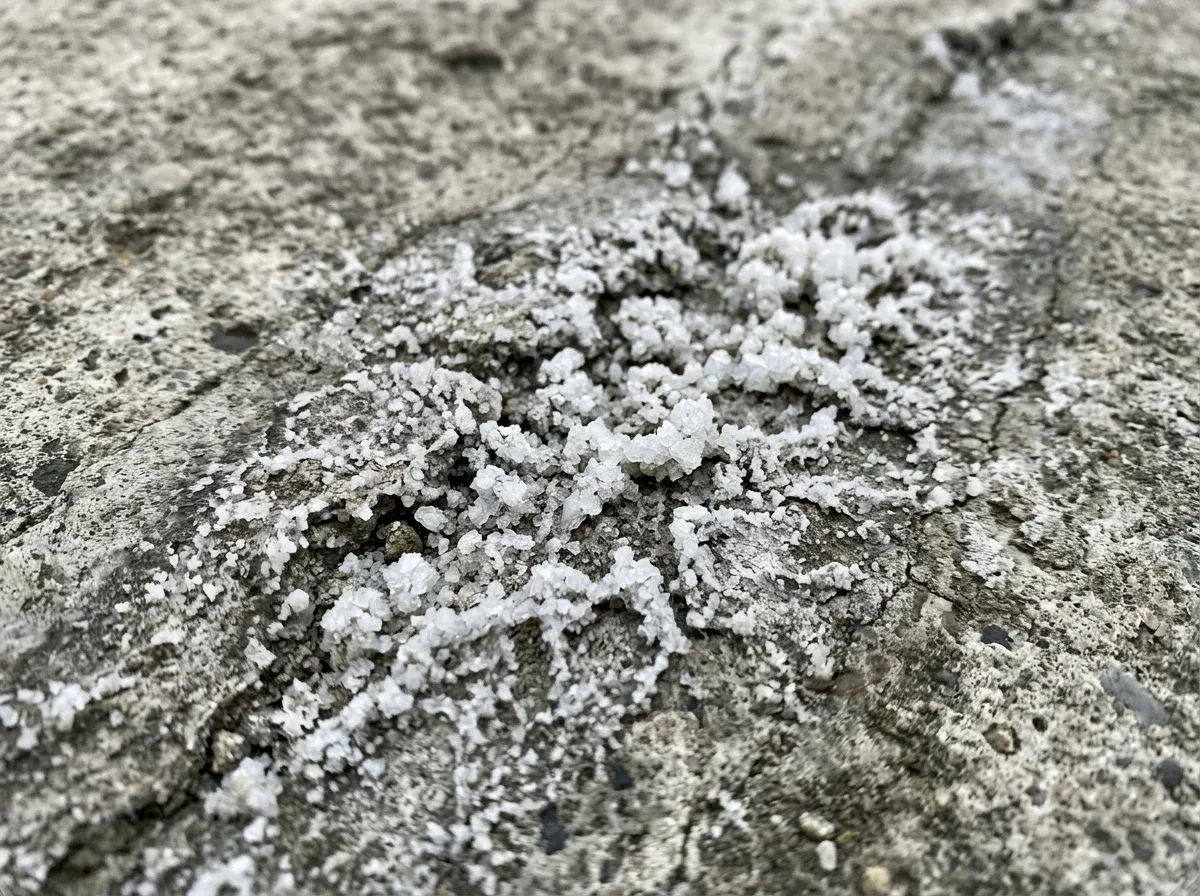
Moisture in the soil or beneath the concrete rises upward through capillary pores. When the moisture reaches the surface and evaporates, it leaves behind the salts it carries. This process leaves three distinct signs on the floor.
- White salt marks: As moisture evaporates at the surface, it leaves its salts behind; white, powdery or crusty marks form on the floor and reappear after being wiped away.
- Dark, wet patches: In areas where moisture constantly reaches the surface, the concrete does not dry; these spots look darker and wetter than their surroundings.
- Blistering of the coating: If the floor has a coating or paint, moisture and salt coming from below accumulate under the layer, causing blistering and peeling.
Sources of Moisture
To stop salt efflorescence permanently, you first need to find out where the moisture in the concrete is coming from.
- Groundwater and soil moisture: In floors in contact with the soil, groundwater and soil moisture are continuously drawn upward through the capillary pores of the concrete.
- Failed waterproofing: Inadequate or deteriorated waterproofing allows water to reach the underside and the interior of the concrete, especially in basements and ground floors.
- Water seeping through exterior walls: Rainwater seeping through exterior walls passes from the base of the walls into the floor; salt marks are often seen first along the edges of the walls.
- Plumbing leaks: Leaks in water pipes running under the floor or inside the walls cause constant moisture and salt efflorescence in a specific area.
- Condensation: When a cold floor meets humid air, water condenses on the surface; even if no water comes from outside, the floor may look wet and stained.
Grinding and Moisture
Concrete grinding is less problematic on damp floors than a coating, but it does not eliminate the source of the moisture.
- A surface that does not trap moisture: Concrete grinding does not add a new coating, so it does not trap moisture; it leaves a breathable surface.
- Excess moisture prevents the protective product from working: However, for hardeners and sealers to work properly, the concrete must not be excessively damp; the product does not penetrate wet concrete adequately.
- Salt can reappear after grinding: If moisture-related salt efflorescence continues, salt may still appear on the surface after grinding; for this reason, the moisture source is resolved first.
Therefore, on floors with a serious moisture problem, the source of the moisture should be investigated first.
Cleaning
Cleaning salt marks from the surface improves the appearance, but as long as the moisture source remains, the salt will reappear. The aim of cleaning is to remove the salt from the surface without dissolving it again and sending it back into the concrete.
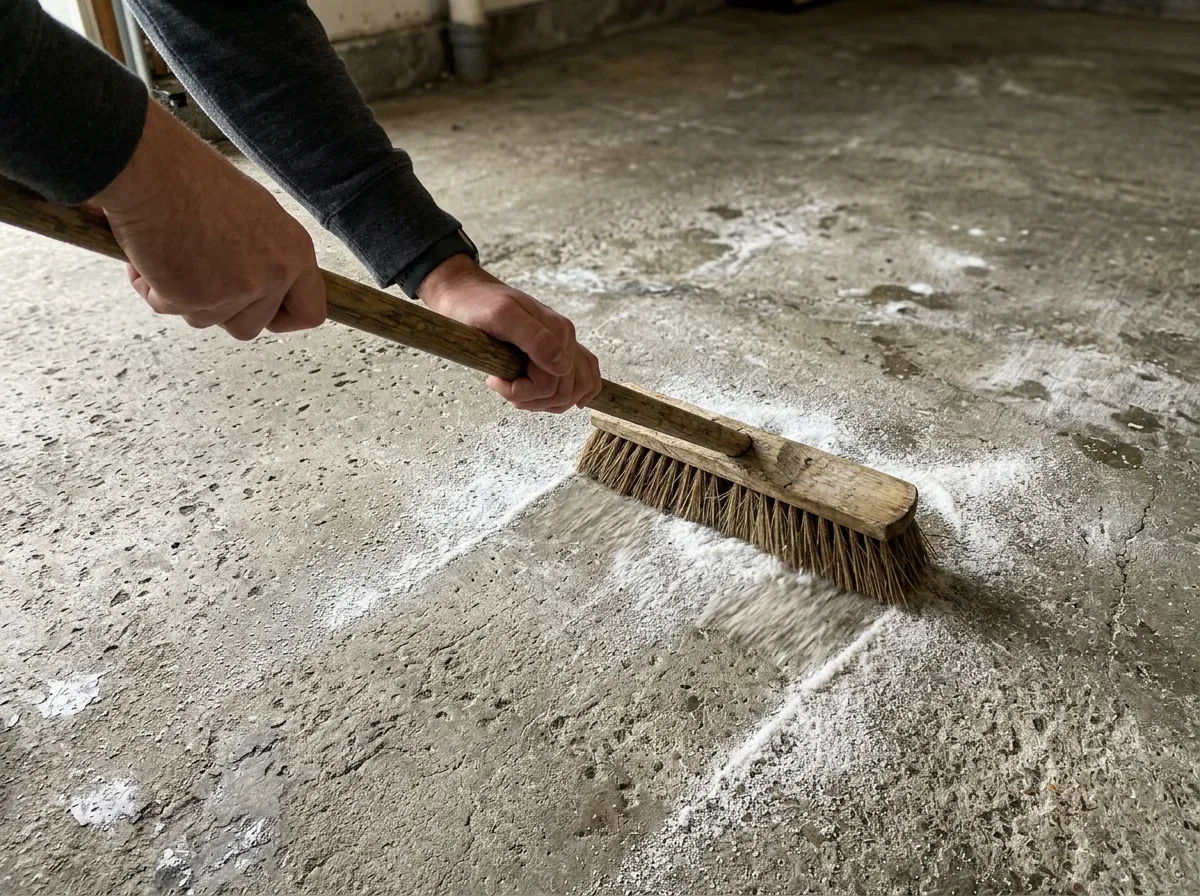
- Dry brushing: Salt marks are removed dry first; this way, the salt is collected from the surface without being dissolved by water and drawn back into the concrete.
- Washing with water: It dissolves the salt but it can be reabsorbed; do it carefully with a small amount of water and collect the remaining water immediately.
- Suitable cleaners: Salt cleaners suitable for concrete can be used; choose products compatible with concrete rather than acidic products that erode the surface.

Solution by Moisture Source
| Source | Sign | Solution |
|---|---|---|
| Groundwater, soil moisture | Across the whole floor, constant | Waterproofing assessment, drainage |
| Failed waterproofing | In specific areas, worsening after rain | Waterproofing repair |
| Seepage from exterior wall | At the base of walls | Facade and wall waterproofing |
| Plumbing leak | At a single point, constantly wet | Plumbing repair |
| Condensation | Seasonal, varies with ventilation | Ventilation, dehumidification |
Moisture Measurement
When planning concrete grinding or the application of a protective coating, it is important to know the moisture condition of the floor. Surface moisture meters and simple cover tests give an idea of how much moisture the concrete holds. In the cover test, a piece of plastic sheeting is taped down to the floor along its edges, and after a day or two the underside is checked for condensation or darkening. If there is noticeable moisture, the application of the protective coating is postponed and the source is investigated first.
What Should Not Be Done?
When dealing with salt and moisture problems, wrong interventions often make the problem worse instead of solving it.
- Sealed coating over damp concrete: Applying a non-breathable coating over damp concrete leads to blistering and peeling because of the moisture and salt that build up underneath.
- Washing with plenty of water: Washing off salt marks with plenty of water and keeping the concrete constantly wet dissolves the salt again and drives it back inside, so the white marks reappear.
- Using acidic products: Cleaning salt with acidic products erodes the concrete surface; even if the salt disappears for a short time, the surface becomes rough and weakened.
- Treating only the surface: Treating only the surface without investigating the source of moisture gives temporary results; as long as the source persists, salt and moisture will come back to the surface.
Moisture and Salt Problems in Alanya
In Alanya, salt efflorescence is common in basement car parks and storage areas, especially in areas close to the sea and where the groundwater level is high. Before concrete grinding work, we assess the moisture condition of these floors, and if there is a serious moisture source, we recommend consulting a waterproofing specialist. If the moisture is under control, we achieve a breathable, durable surface with grinding and hardener.
Prevention and Solution

- Fixing insulation and drainage problems,
- Repairing plumbing leaks,
- Reducing condensation through ventilation,
- Breathable surface treatments,
- Concrete sanding and hardener once the moisture source has been eliminated.
Our Concrete Grinding Service in Alanya

We grind concrete floors in warehouses, factories, car parks, shops and homes, then strengthen them with a hardener to create a dust-free, easy-to-clean surface. Depending on the look you want, we apply a matte, satin or glossy finish.
We inspect the age and condition of your floor on site and decide on the right method together with you. Explore our Concrete Grinding service.
Efflorescence is a symptom, not a disease. The real problem is the moisture rising up through the concrete; any cleaning done without solving that will have to be repeated after a while.