Diamond Abrasives and Moisture Control in Granite Grinding
In short: Granite is one of the hardest floor stones to grind.
In this article, we explain the types of diamond abrasives used in granite grinding, how the amount of water and the machine settings affect the result, and how problems such as overheating, slipping, and differences in gloss are prevented. The aim is to help homeowners and property managers tell whether a crew is working correctly.
Why Is Granite Hard to Grind?
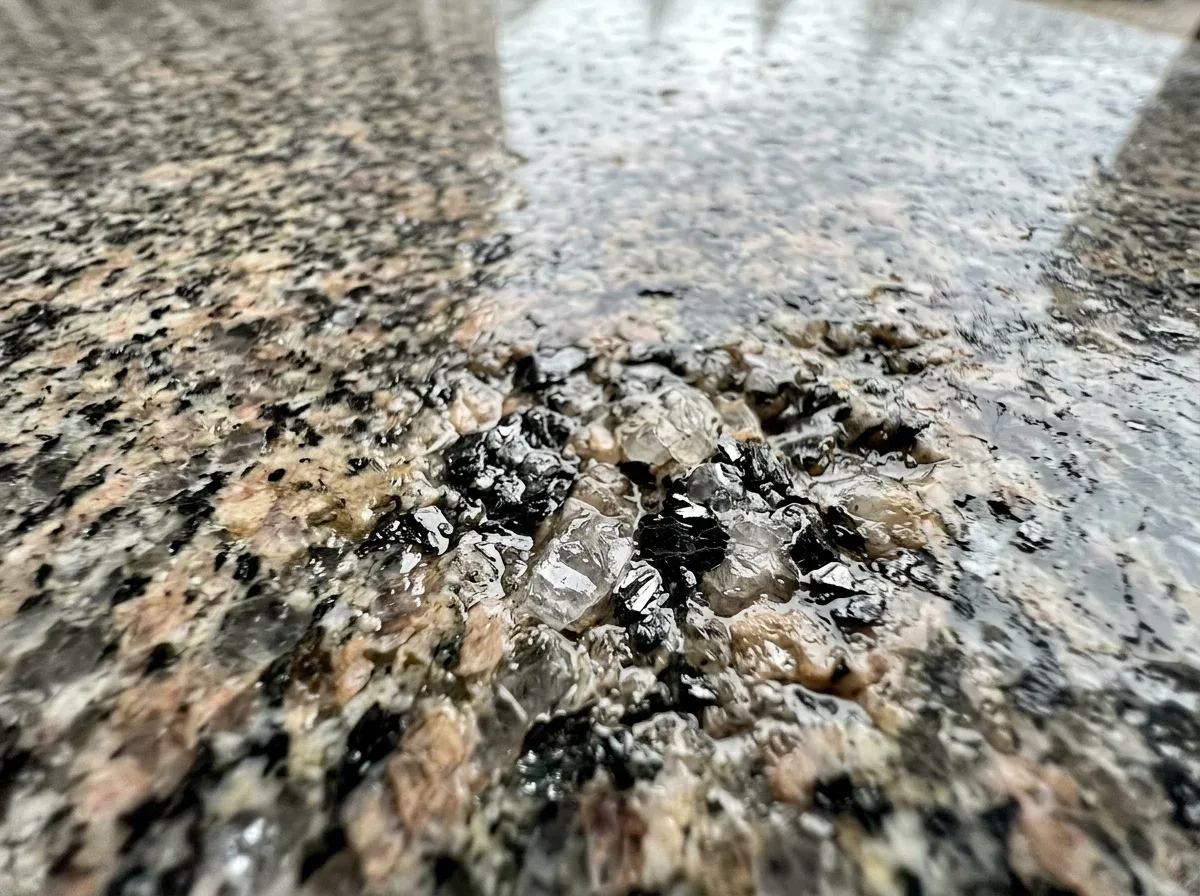
Granite contains quartz grains that are harder than steel. The abrasive has to cut through these grains. A step that progresses in a few passes on marble requires many more passes on granite, and the abrasive also wears out faster.
In addition, granite is a mixture of minerals of different hardness. Soft minerals wear quickly, hard ones slowly. With the wrong grit steps, this can leave microscopic "bumps" on the surface.
Types of Diamond Abrasives
Metal-Bond Segments
The diamond grains are embedded in a metal binder. They are very aggressive and remove level differences, deep scratches, and old coatings. In granite, they are used in the coarse grinding stage.
Note for granite: The hardness of the metal bond must be chosen to suit the stone. A bond that is too hard "glazes over" on hard stone, meaning the diamonds wear down but new diamonds are not exposed; the abrasive slides and does not cut.
Resin-Bond Pads
The diamond grains are embedded in a flexible resin. They remove the scratches left by the metal segments and polish the surface step by step. They are used from the medium grits up to the finest grits. On granite, resin pads wear out faster than on marble and are more sensitive to heat; for this reason, the amount of water and the machine speed must be adjusted carefully. If a honed granite surface is desired, grinding is stopped at the medium-grit resin pads.
Hybrid (Transition) Pads
They combine the properties of metal and resin. They are used after the metal segments to remove the scratches from coarse grinding.
Polishing Powders
These are powders containing fine abrasives, applied to the surface in the final stage. Those suitable for granite are different from those used on marble.
The Role of Water
In wet grinding, water does three important jobs and is indispensable for the steps to work correctly.
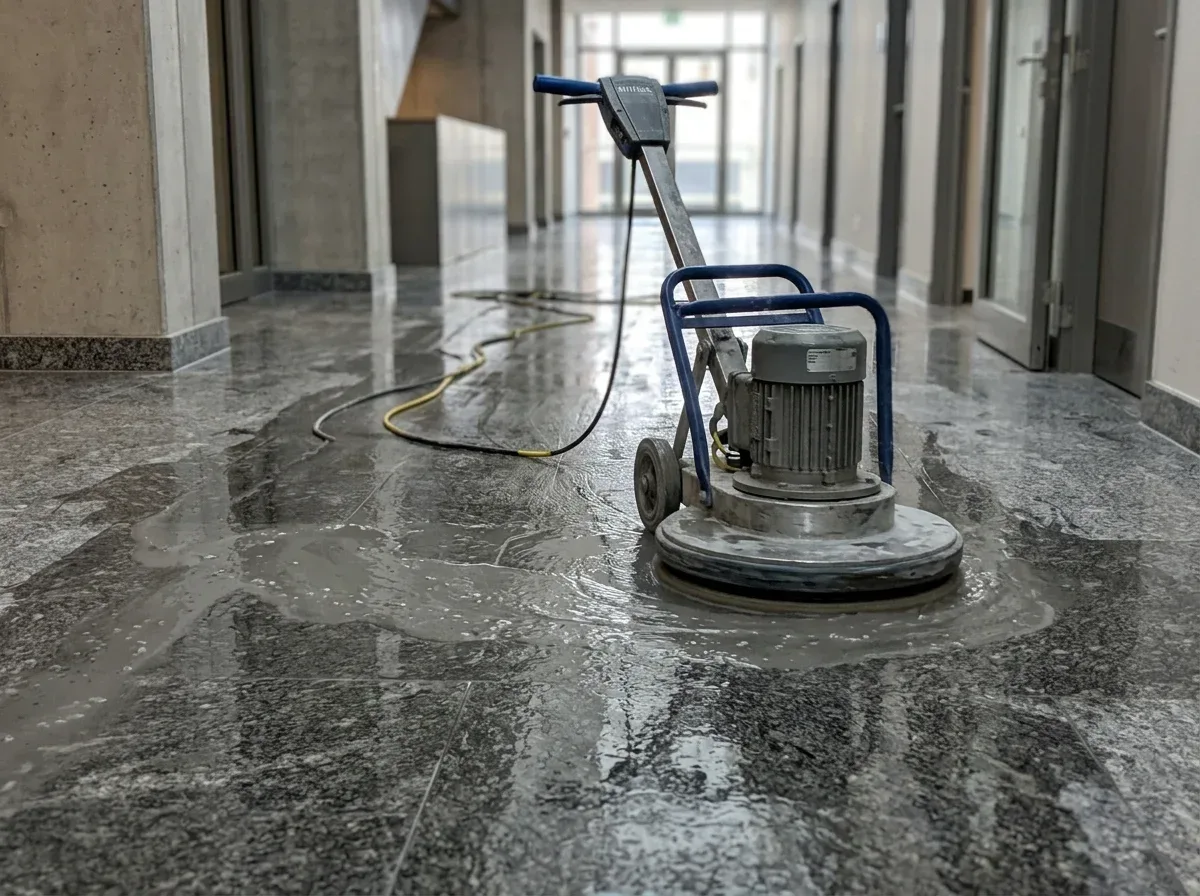
- Cooling: First, water prevents the abrasive and the stone from overheating; an overheated resin pad is ruined, and burn marks can also form on the stone surface.
- Dust binding: Then it binds the stone dust; the dust turns into slurry without becoming airborne and can be collected with a wet vacuum.
- Lubrication and cleaning: Finally, it removes the grains in front of the abrasive and keeps the cutting surface open; this way, the diamonds keep cutting without clogging.

Too Little Water
When too little water is supplied, cooling and cleaning are insufficient; problems appear both on the abrasive and on the stone surface.
- Overheated abrasive: The abrasive heats up and resin pads can be ruined; a damaged pad does not cut properly, leaves marks on the surface, and wears out quickly.
- Burn marks and gloss stains: Burn marks or unwanted gloss stains can form on the stone surface; these areas look different from the rest of the floor.
- Thickening slurry: As the water decreases, the slurry thickens; hard stone grains dragged under the abrasive can leave scratches on the surface.
Too Much Water
Too much water also causes problems; the abrasive cannot grip the stone, and the surrounding surfaces can be damaged by the water.
- Slipping abrasive: The abrasive glides over the surface like a sled and does not cut; the number of passes increases but the scratches of the previous step do not go away.
- Delayed gloss: In the fine steps, too much water delays the formation of gloss; because the pad does not make enough contact with the surface, the shine never comes.
- Overflowing water: Water spills into the surroundings; it can damage surfaces that need to be protected, such as wooden baseboards, door frames, and furniture.
The right amount of water varies by step: more water is used in the coarse steps, less in the polishing stages. Some polishing powders work almost dry, only on a damp surface.
Machine Settings
The same abrasive gives very different results on granite depending on the machine's weight, speed, and movement pattern.
- Weight: Heavy-bodied machines press the abrasive evenly onto the surface; on granite, weight directly affects cutting efficiency.
- Speed: Lower speed may be preferred in the coarse steps and higher speed in polishing; but excessive speed causes overheating.
- Pass pattern: The machine is moved in an orderly manner so that each pass overlaps the previous one; random movement leaves differences in gloss.
Checking Between Steps
After each step, a good crew:
- Cleans and dries: First, it completely cleans and dries the surface; scratches remaining on a wet, muddy surface are not visible, and the check becomes misleading.
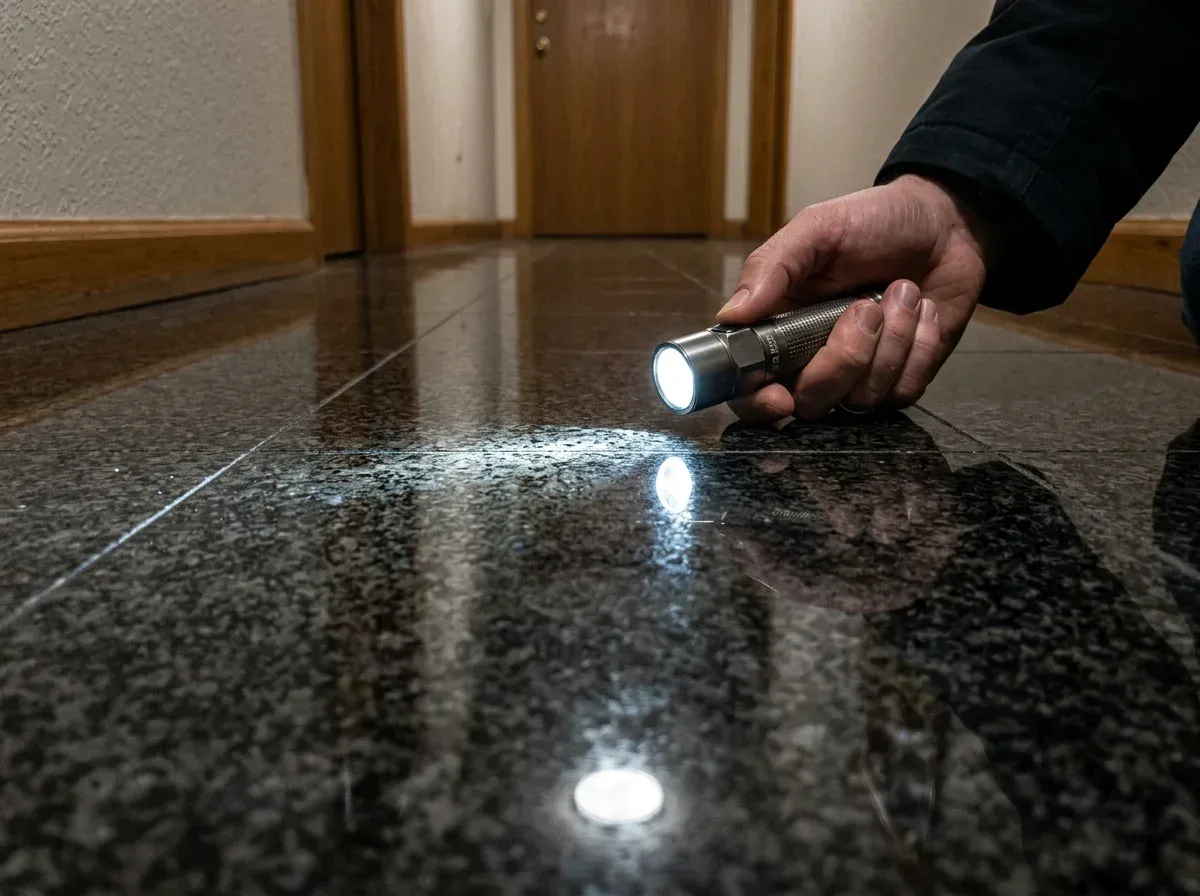
- Checks with light: Then it shines a light across the surface from the side to see whether the scratches of the previous step are gone; a remaining scratch will not be removed in the next step.
- Repeats the step: If necessary, it applies the same step once more; it does not move on to the finer step until the scratches are completely gone.
Rushing a step on granite comes back as a hazy image in the final polish.
Common Problems
| Problem | Likely cause |
|---|---|
| Hazy polish | A step was skipped or not applied thoroughly enough |
| Circular scratches | Scratches from the previous step were not removed, slurry was not cleaned up sufficiently |
| Uneven shine in places | Irregular machine movement, varying water amount |
| Abrasive is not cutting | Bond is unsuitable for the stone, glazing (dulling) of the abrasive |
| Burn marks | Too little water, high speed, staying too long in the same spot |
Moisture Control: What Happens After Grinding?
In wet grinding, some water gets into the stone. Granite absorbs less water than marble; however, in light-colored and coarse-grained granites this water evaporates slowly over a few days. During this process, slightly dark areas may appear on the surface, or rings along the slab edges. These disappear as the stone dries. Impregnation should only be applied once the stone has dried completely; impregnator applied to damp stone does not penetrate the pores and can leave whitening and stickiness on the surface.
- Removing water and slurry: When grinding is finished, excess water and slurry are removed completely with a wet vacuum; slurry that dries on the surface can leave stains and fine scratches.
- Ventilation: The space is ventilated; in a closed and humid environment drying takes longer, and the water inside the stone can take days to evaporate.
- Hold off on rugs and covers: Rugs and covers are not laid down until drying is complete; moisture trapped beneath them cannot evaporate and leaves dark areas on the stone.
- Second drying at edges and joints: If necessary, a second drying is carried out for water that collects at slab edges and joints; these are the places where edge rings are most commonly seen.
How Can You Tell a Crew Is Working Correctly?
Because granite grinding is a lengthy and costly job, as a homeowner or manager, observing a few points lets you gauge the quality of the result in advance:
- Checks between steps: Is the floor cleaned and checked with light between steps? If this check is not done, scratches from the previous step remain as haziness in the final polish.
- Necessity of the coarse step: Is the coarse step really needed, or is it being used unnecessarily on a flat floor? Unnecessary coarse grinding removes material from the stone for nothing and prolongs the job.
- Slurry collection: Is the slurry being collected continuously, or is it drying on the floor and leaving scratches? The hard grains in dried slurry scratch the surface under the machine.
- Edges and corners: Are edges and corners brought to the same shine as the floor with a hand machine? Since the large machine cannot reach the base of the walls, these areas must be worked separately.
- Final inspection: At the end of the job, is the floor viewed from a low angle and against the light? Differences in shine and remaining scratches are best seen from this angle.
Granite Grinding in Alanya
In Alanya, granite grinding is most often done in hotel lobbies, residential complex entrances, elevator landings and stairs. These areas are often in constant use; therefore the work is planned section by section and generally during hours of low traffic. Because humid sea air slows drying, the schedule for post-grinding impregnation and final cleaning is adjusted accordingly. Our team starts every granite job with a small test area; the step plan is not finalized until we see how the stone reacts to the abrasive.
Moisture Control and Drying

Granite generally absorbs little water, but light-colored and porous granites can take in water during honing and may look darker for a while. If a sealer is to be applied, the stone must be allowed to dry completely; sealer applied to damp stone does not hold well.
Our Granite Grinding and Polishing Service in Alanya

Granite is a hard stone, and its shine is restored not with polish but by honing with the right diamond grits. We re-polish dulled interior granite and clean exterior surfaces and steps while preserving their non-slip finish.
We determine on site which treatment your granite flooring needs, based on its condition. Explore our Granite Grinding and Polishing service.
The diamonds are embedded in resin. It is more flexible and gradually thins the surface as it polishes. It is used in the medium and fine grit stages. — Expert Note