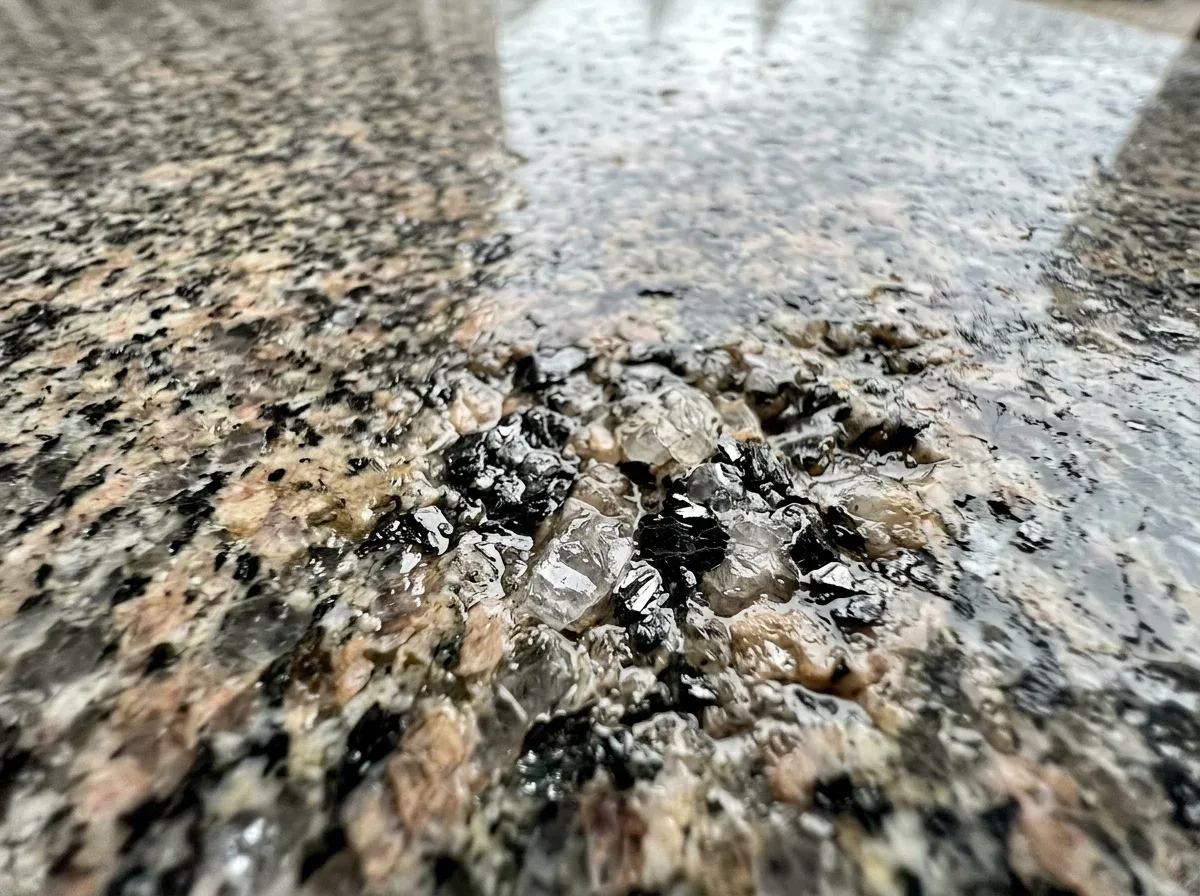
Removing Scratches from Granite Floors: Can Deep Scratches Be Removed by Grinding?
In short: Granite is a very hard stone and does not scratch easily; but when it does get scratched, removing the scratch takes far more effort than with marble.
In this article, we explain how scratches form on granite floors, which method is used depending on scratch depth, and how honing and filling are used together on deep scratches.
Why Does Granite Scratch?
The quartz grains in granite are harder than steel and glass. For this reason, most objects in the home cannot leave a mark on granite. The main causes of scratches on granite are:
- Sand and hard mineral grains: Quartz sand carried in on shoes, especially from outdoor areas, parking lots and construction sites, opens fine lines on the surface because it is as hard as granite.
- Another piece of stone: When pieces of marble, granite or ceramic that are being moved are dragged across the floor or dropped, their hard edges can leave noticeable marks.
- Diamond or carbide tools: Cutting discs that slip during renovation work are harder than granite, so they cut the deepest and longest scratches in the surface.
- Heavy, sharp metal objects falling: This kind of impact leaves chips and cracks rather than scratches; these marks are usually repaired with resin filler before honing.

Types of Scratches
Surface Dullness and Fine Hairline Scratches
This is a slight dullness that develops over time in heavy-traffic walkways, entrance doors and steps. It is caused by the accumulation of very fine scratches in the polished layer of the granite.
Solution: After surface residues are cleaned, polishing through the fine grit stages, or polishing powders suitable for granite.
Visible Scratches
Lines that can be felt with a fingernail and are clearly visible in the light.
Solution: Spot honing, starting from medium or coarse grit stages depending on the depth of the scratch. The honed area is polished step by step so that it blends with its surroundings.
Deep Scratches and Pits
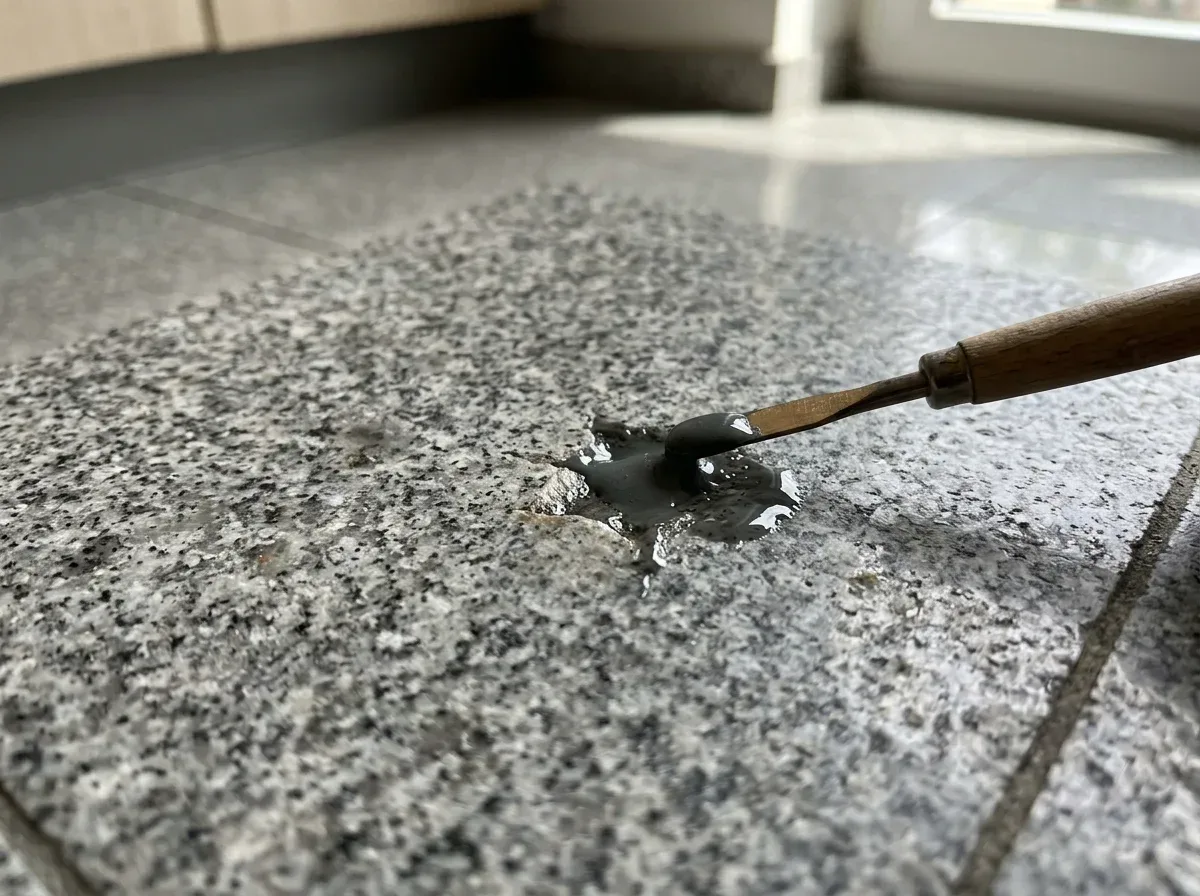
Cutting tool marks, pits left by a dropped object, or long, deep channels.
Solution: To remove a deep scratch with honing alone, too much material has to be taken off the surface, which creates a depression and light refraction around it. For this reason, deep pits are first filled with color-matched resin, and once it has hardened, the surface is honed to level and polished.
Broken Edges and Chips
Breakage on stair nosings, slab edges and corners.
Solution: Reshaping with resin filler, followed by honing and polishing. For large breaks, gluing the piece back may be necessary.
Why Does Honing Take Longer on Granite?
The hardness of granite makes it resistant to scratching, but the same hardness makes every stage of honing slower and more laborious.
- Stages requiring more passes: Because granite is hard, each diamond stage needs more passes over the same area to fully remove the marks of the previous one.
- Abrasives that wear out quickly: Diamond pads working on a hard surface wear out faster than on marble and are replaced frequently during the job.
- Machine weight and speed setting: If the machine's weight and speed are not set correctly, the surface overheats or the abrasive slides over the surface without polishing it and does no work.
- Heat and moisture control: With incorrect heat and water settings, unwanted differences in gloss can appear on the surface of some granites; therefore both are monitored throughout the work.
For this reason, honing granite requires more time and more experienced workmanship than marble.
Spot Honing or the Whole Floor?
If the scratches are in a specific area, spot honing can be done. However:
- Gloss matching the surroundings: The gloss of the honed area must match its surroundings; otherwise the repaired spot looks like a separate patch under light.
- The new area looking shinier: The freshly honed area may look shinier than the old surface that has been in use for years; this difference becomes especially noticeable in light coming from the side.
- Evening out the whole floor: If there are scratches over wide areas or in several places, evening out the whole floor with a light polish gives a more consistent result.
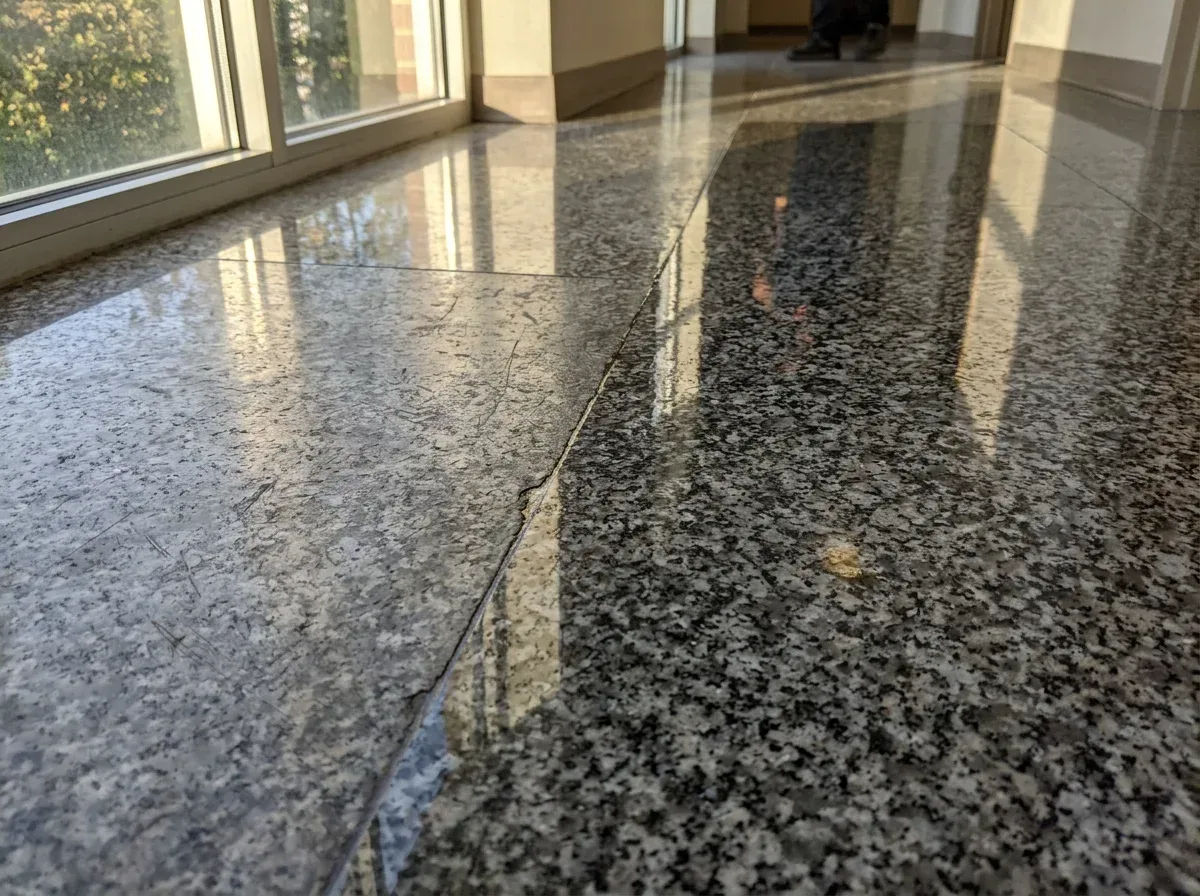
Visibility of the Filler
Granite is not a single-colored stone; black, white, gray and pink mineral grains sit side by side. For this reason, it is often not possible for the filler to "disappear" completely; the goal is for the filler to blend in so well that it does not catch the eye. The resin is tinted to match the dominant background color of the stone; if needed, fine stone dust or colored grains are mixed in to imitate the stone's speckled structure. A filler that is tinted correctly and honed level with the surface is not noticeable from a normal viewing distance; when looked at very closely and against the light, a slight difference in texture may be visible. This expectation should be discussed before work begins.
Quick Guide by Scratch Type
| Scratch | How to tell? | Method | Result |
|---|---|---|---|
| Hairline scratch, dullness | Visible only against the light | Fine-grit polishing | Disappears completely |
| Visible scratch | Catches a fingernail | Localized honing | Disappears completely |
| Deep gouge, channel | Pit clearly visible to the eye | Resin filling + honing | Becomes inconspicuous |
| Broken edge, chip | Chipping at the edge | Shaping with filler | Profile is restored |
How to Protect Granite After Honing
After honing, most new scratches can be prevented with simple habits that keep sand, renovation work and friction under control.
- Put down a grit-trapping mat: A mat placed at the entrance and on the paths coming from the parking lot keeps outside quartz sand, which causes most scratches on granite, at the door.
- Cover the floor during renovation: Rigid cardboard or a protective board stops the marks from cutting discs and stone fragments, which cause the deepest scratches, from reaching the floor.
- Do not drag heavy items: Dragged furniture and transport carts with stones stuck in their wheels leave long lines; check the wheels before using them.
- Use a soft pad: When cleaning machines use a soft pad instead of an abrasive one, fine scratches that build up on the surface with each cleaning and cause dullness do not form.
- Check the impact points: If small chips at impact points such as stair nosings are repaired before they grow, the chipping does not spread and the repair stays small.
Scratches on Granite Floors in Alanya
In Alanya, granite is used most often at residential complex entrances, in front of elevators, in hotel lobbies and on stairs. These areas face both heavy traffic and sand and gravel carried in from outside. In newly built buildings, a significant share of scratches occurs during renovation and moving. For this reason, scratch removal on granite is often less about a single spot and more about marks spread along particular routes; the right plan is to restore these routes in harmony with their surroundings.
Preventing Scratches

- Place doormats both inside and outside entrance doors.
- During construction and renovation, cover the floor with cardboard and rigid protective sheets.
- Do not drag stone or ceramic pieces across the floor.
- Place protective pads on the floor when moving heavy metal items.
Our Granite Grinding and Polishing Service in Alanya

Granite is a hard stone, and its shine is restored not with polish but through grinding with the right diamond grit stages. We re-polish dulled interior granite, and clean exterior surfaces and steps while preserving their slip-resistant finish.
We determine on site which treatment your granite floor needs, based on its condition. Explore our Granite Grinding and Polishing service.
Granite's grainy structure makes it difficult to match the color of the filler exactly. With a good color match, the repair is not noticeable from a distance, but a slight difference may be visible up close. This is the nature of repair work and should be discussed during the assessment. — Expert Note