Oil and Water Stains on Granite Surfaces: Causes and Solutions
In short: The belief that "granite doesn't stain" is widespread, but light-colored granites in particular can absorb oil and water and darken.
In this article, we explain what causes staining in granite, how to tell a temporary water mark from a permanent oil stain, and the methods used to draw a stain out of the stone.
Not All Granite Is the Same
Granite is formed when different minerals come together. In some granites the grains are tightly interlocked, and water and oil are hardly absorbed at all. In some light-colored granites, especially beige, cream and pink tones, there are micro-voids between the grains and the stone can absorb liquid.
That is why, in the same kitchen with the same use, one of two different granite countertops may never stain while the other darkens quickly.
Water Stain or Oil Stain?
Temporary Water Mark
What it looks like: A dark area left by a wet glass, a flowerpot or spilled water.
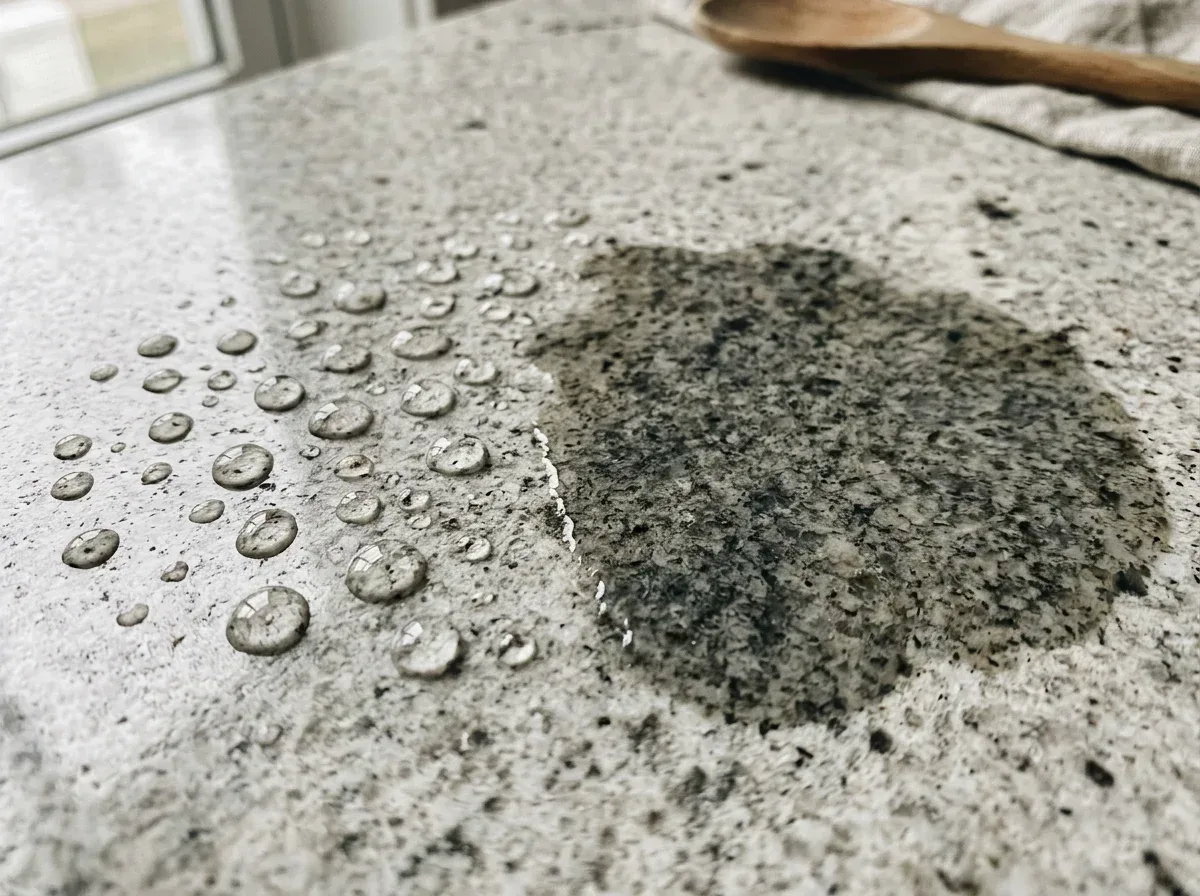
Distinguishing feature: It disappears within hours or a few days as the stone dries.
What to do: Wait. Do not apply any product on it; let it dry. The fact that it is not permanent shows that the stone absorbs liquid and may need impregnation.
Limescale and Mineral Rings
What it looks like: Whitish rings with distinct edges left after the water dries.
What to do: They are removed with acid-free limescale removers suitable for stone or with light polishing.
Oil Stain
What it looks like: A dark stain with soft edges left by frying oil, olive oil, cream or cosmetic products.
Distinguishing feature: It does not dry, may spread over time and becomes permanent.
What to do: The oil must be drawn out from inside the stone.

How to Remove an Oil Stain
First Response
As soon as oil is spilled, blot it up by pressing with an absorbent paper; do not spread it by wiping. Then gently clean the area with a pH-neutral detergent.
Poultice Application
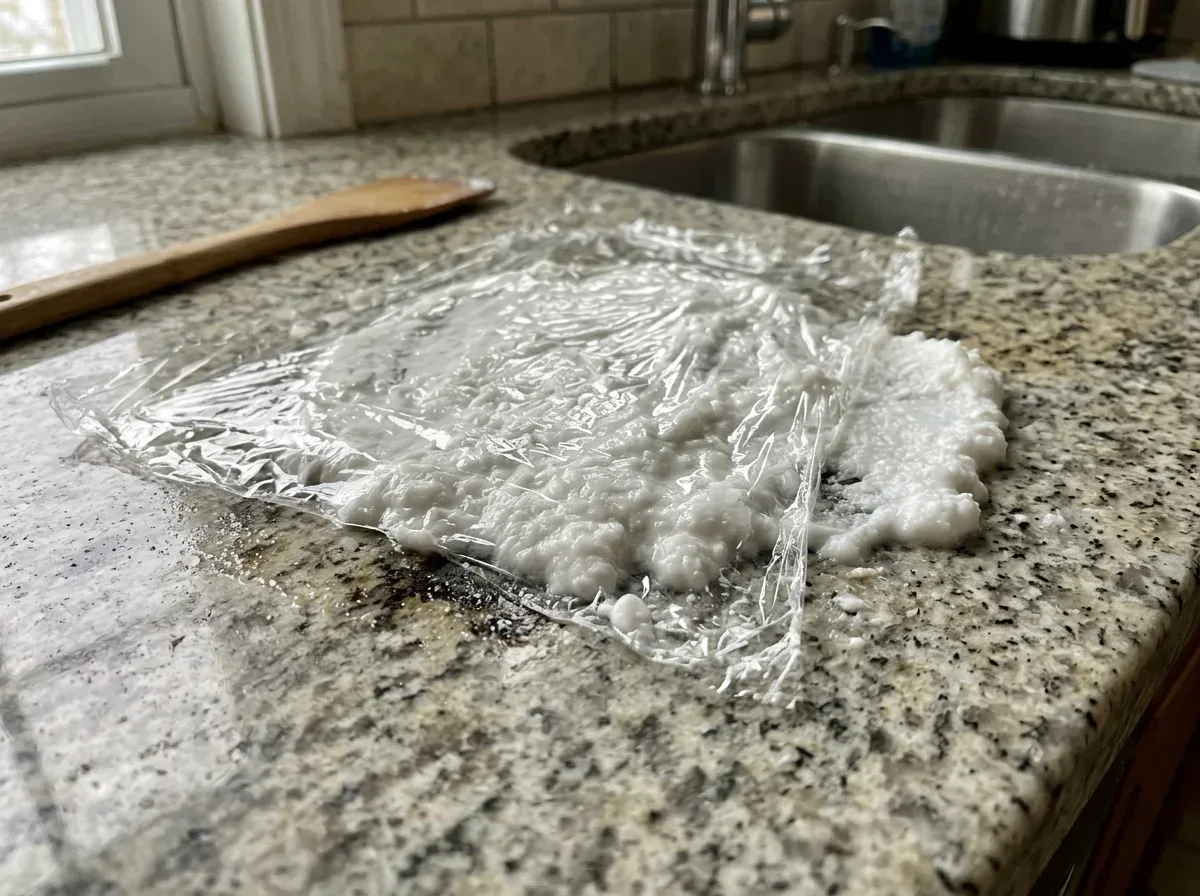
The method used for set-in oil stains is the poultice:
- Prepare the poultice: An absorbent powder (for example, poultice powders made for stone) is mixed with a suitable oil-dissolving liquid to a paste consistency.
- Apply it thickly: Then the poultice is applied thickly over the stain, extending slightly beyond its edges, so that the spread-out edges of the stain are covered as well.
- Cover it: It is covered in a way that makes it airtight and left to dry; slow drying gives the solvent time to dissolve the oil inside the stone.
- Drawing out the oil: As the poultice dries, it pulls the dissolved oil out of the stone; the stain moves from the stone to the poultice.
- Remove and clean: Once dry, the poultice is removed and the area is cleaned; if the stain has lightened but not gone, the stone is dried and the application is repeated.
For oil stains, a poultice often does not give results in a single application. If the stain has lightened but not completely disappeared after the poultice is removed, the stone is left to dry for a few days and the application is repeated. Old and deep stains may require three or four applications. If the stain lightens a little more after each attempt, it shows you are on the right track. If nothing changes at all, the stain may come from another source rather than oil.
When Is Polishing Needed?
A poultice draws oil out from inside the stone, while polishing renews the surface. If dullness or scratches remain on the surface after the oil stain is gone, polishing is done. Polishing alone does not remove oil that has penetrated deeply.
Preventing Stains: Impregnation
For granite that stains, the most effective measure is impregnation:
- Penetrates the pores: Impregnation penetrates the pores of the stone, making it harder for water and oil to get in; spilled liquid gives you more time to wipe it up.
- Does not change the appearance: It does not change the appearance of the stone (except for color-enhancing products); since it does not form a film on the surface, the gloss and texture stay the same.
- Not needed for every granite: It is not necessary for every granite; the drop test decides, and tightly structured granites that absorb neither water nor oil have no pores for the impregnation to work in.
Drop test: Place a few drops of water on the granite and a few drops of oil in a separate spot. If the stone darkens within a few minutes, impregnation is recommended.
Impregnation is not permanent; depending on use it weakens over time and needs to be renewed.
Quick Guide by Stain Type
| Stain | Appearance | What to do? | Avoid |
|---|---|---|---|
| Water mark | Dark, disappears as it dries | Wait, then impregnate | Applying product on top |
| Limescale ring | Whitish, with a distinct edge | Acid-free limescale remover, light polishing | Strong acids |
| Fresh oil | Dark, wet-looking | Blot with absorbent paper and clean with a neutral detergent | Wiping it around |
| Set-in oil | Permanent, with soft edges | Degreasing poultice, repeated if necessary | Dealing with the stain only by polishing |
| Cosmetics and creams | Dark stain on the bathroom countertop | Poultice, followed by impregnating sealer | Bleach |
Habits That Prevent Stains in the Kitchen
The granite countertop is the hardest-working surface in the kitchen. A few simple habits greatly reduce the need to deal with stains:
- Put the oil bottle on a coaster: Do not place the oil bottle and cooking oil containers directly on the stone; put them on a tray or coaster, as oil that collects at the bottom of the bottle eventually leaves a ring.
- Wipe up splattered oil right away: Wipe up oil splattered around the stove as soon as you finish cooking, not after the meal; oil left sitting penetrates the pores of light-colored granite.
- Use a cutting board: Use a cutting board; this prevents both scratches and stains left by meat and vegetable juices.
- Do not leave wet items on the surface: Do not leave a wet sponge or a bottle of dish soap on the countertop; the moisture and detergent left underneath leave a ring-shaped mark.
- Dry the surface at the end of the day: Wipe the countertop with a dry cloth at the end of the day; since no water remains on the surface, water marks and limescale rings do not form.
Restaurant and Hotel Kitchens
In hotel and restaurant kitchens in Alanya, granite countertops and granite floors face far more grease and heat than home kitchens. In these areas, oil stains do not appear one by one but spread along service lines and in front of stoves. The effective solution here is proper impregnating sealer, a cleaning routine with a degreaser that leaves no film, and deep cleaning with poultice applications before the season. In busy kitchens, the sealer needs to be checked more often than in home kitchens.
Things to Keep in Mind in Daily Use

- Do not place oil bottles or cosmetic products directly on the stone; use a coaster or tray.
- Wipe up any spilled liquid immediately.
- Rinse off soap and detergent residue regularly.
- Avoid acidic and oil-based "polishing" products; some leave a film and stains on the surface.
Our Granite Grinding and Polishing Service in Alanya

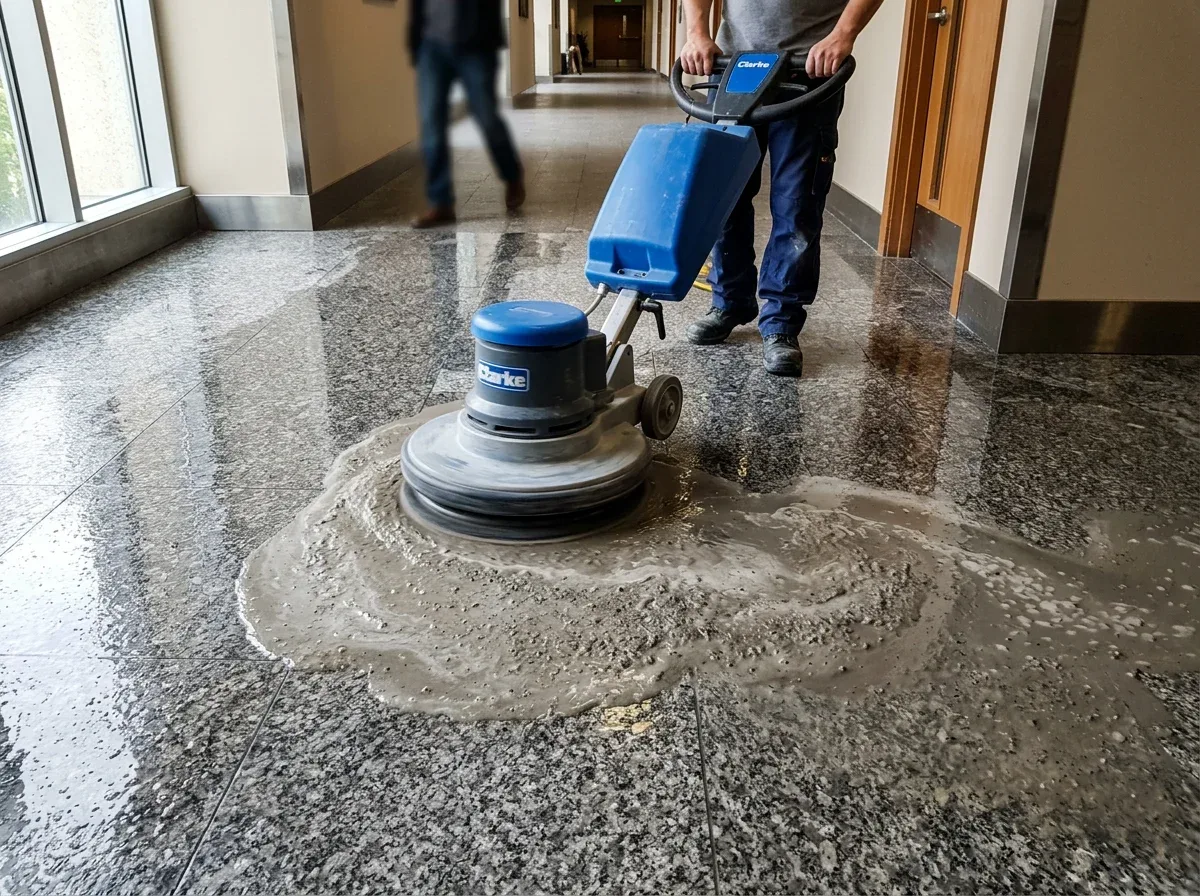
Granite is a hard stone, and its shine is restored not with polish but by honing with the right diamond grits. We re-polish dulled indoor granite, and clean outdoor surfaces and steps while preserving their slip-resistant finish.
We determine on site which treatment your granite flooring needs, based on its condition. Explore our Granite Grinding and Polishing service.
For old and deep stains, this process may need to be repeated several times. Since choosing the wrong solvent can leave a color difference on some granites, it should first be tested on an inconspicuous area. — Expert Note