The Formation and History of Travertine: Stone Born from Spring Water
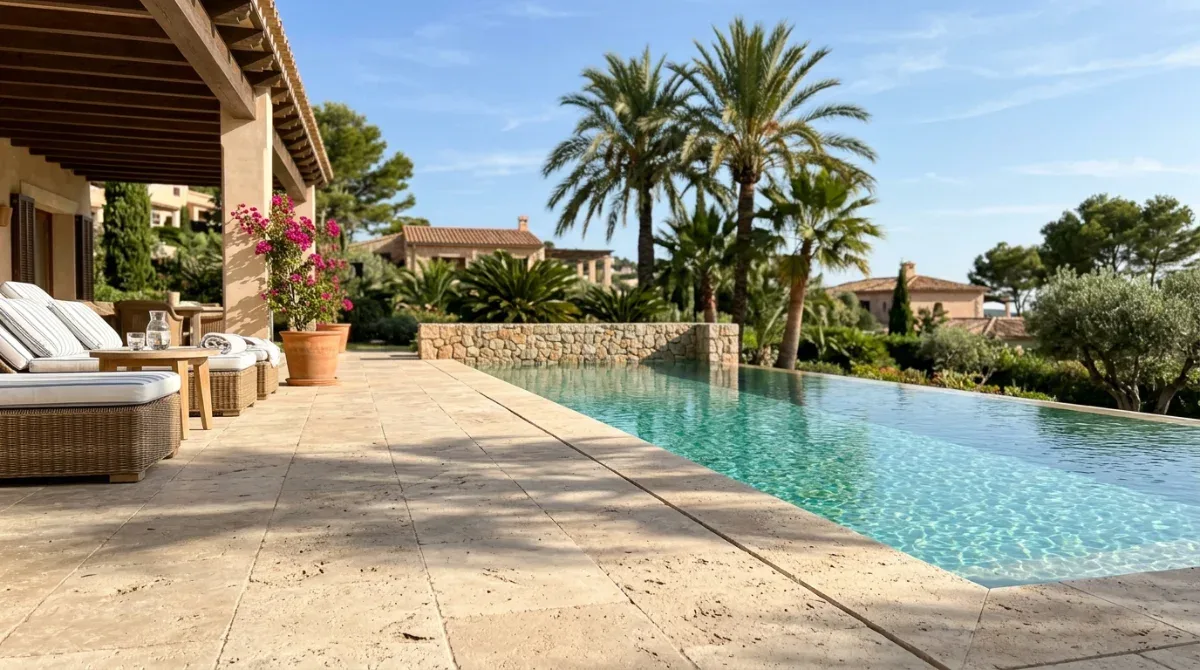
Travertine is the stone most often seen around pools, on garden paths and on terraces of villas in Alanya. Its warm beige tones, its texture full of holes and the fact that it does not overheat in the sun make it an indispensable stone of the Mediterranean. But those same holes trap dirt, pool water dulls the surface, and over the years voids open up. Knowing how travertine forms is the easiest way to understand why these problems appear and how to solve them. In this article, we go step by step through the story of this stone born from spring water, its history, and what it tells us about its care.
In short: Travertine is made of calcium carbonate that precipitates when lime-saturated spring waters reach the surface and lose their carbon dioxide. Gas bubbles and plant remains leave natural voids inside the stone; for this reason, travertine must be protected with filling, impregnation and the right choice of surface finish.
Lime-Rich Water from Underground
As rainwater seeps into the soil, it absorbs carbon dioxide from the air and the soil and becomes slightly acidic. As this water passes through limestone layers, it dissolves lime and carries it along. In some places, this water is heated deep underground and rises to the surface as a spring, hot and saturated with lime.
When the water reaches the surface, the pressure drops, the temperature changes, and the carbon dioxide in it escapes into the air. Once the water has lost its carbon dioxide, it can no longer carry the lime; calcium carbonate begins to precipitate. Layer upon layer of lime accumulates around the spring, along the flow and at the edges of pools. These layers, built up over many years, harden and turn into travertine.
That is why travertine is not a stone that has been metamorphosed deep underground, like marble; it is a sedimentary rock.

Where Do the Pores Come From?
The most familiar feature of travertine is the voids and holes on its surface. These voids have several sources:
- Gas bubbles: Carbon dioxide bubbles escaping from the water during precipitation leave voids inside the stone.
- Plants and algae: Reeds, algae and plant roots around the spring become coated with lime; when the plant decays, a cavity is left in its place.
- Irregular deposition: Lime does not accumulate at the same rate or in the same way every season; thin gaps form between the layers.
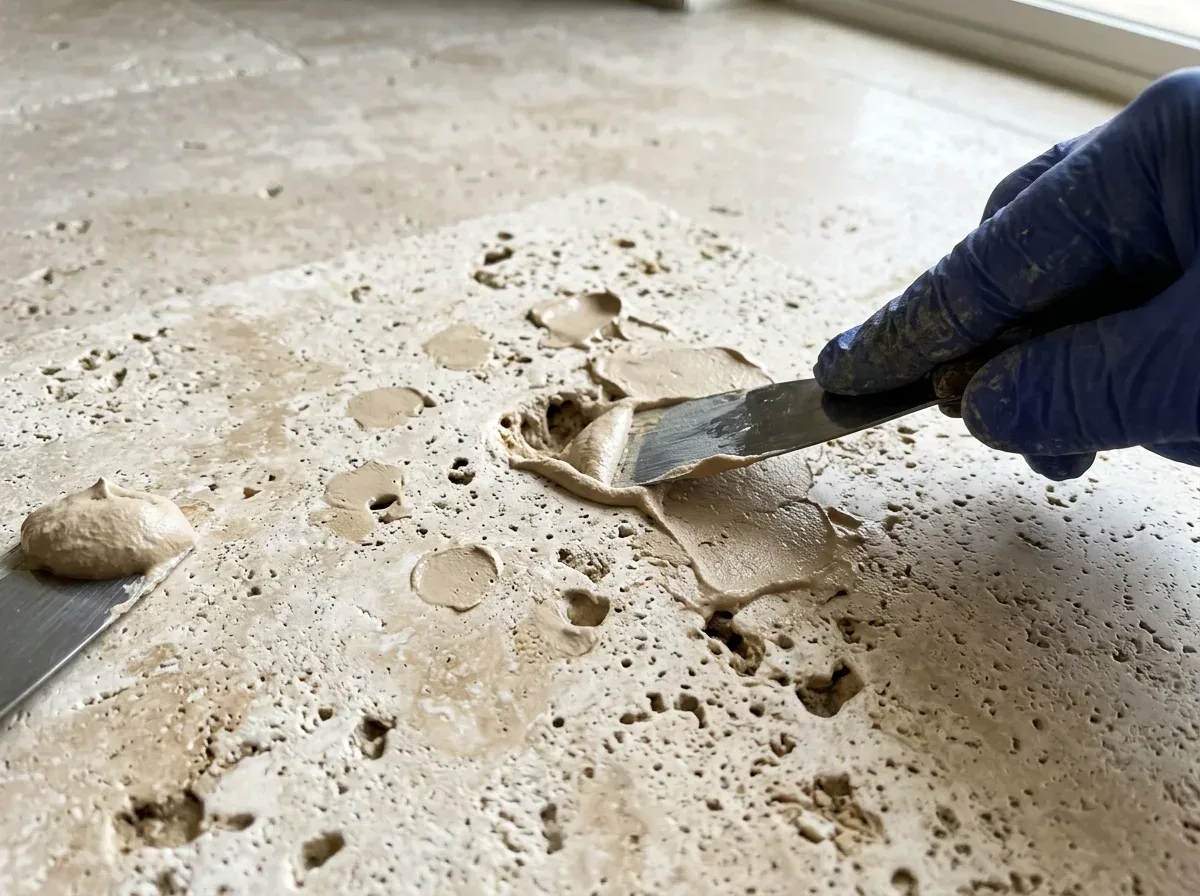
These pores give travertine a natural, warm look. They also determine how it is maintained. Open pores trap dirt, water and algae; their thin edges break over time and the hole gets bigger. For this reason, the voids in travertine used on floors and countertops are usually sealed with filler.
Filled and unfilled travertine
Travertine slabs that leave the factory are mostly supplied filled. The holes are filled with a cement-based or resin-based filler, and then the surface is honed. On outdoor stones that are antiqued and brushed, however, the holes may be deliberately left open. Which one to choose depends on where the stone will be used.
Color and Veining: What the Water Carried
Travertine is mostly seen in beige, cream, light brown and ivory tones. Iron and other minerals carried by the water shift the tones toward yellow, red or walnut. Trade names such as "Noce" (walnut), "Classic" (light beige) and "Silver" (gray-toned) describe these differences.
Layered, parallel lines are common in travertine. When the block is cut parallel to these layers, a cloudy, mottled pattern emerges; when it is cut across them, a striped pattern appears.
| Cut and surface | Appearance | Where is it suitable? | Maintenance note |
|---|---|---|---|
| Cross-cut (striped) | Parallel, regular lines | Modern interiors, walls | Tone differences may be visible along the direction of the lines |
| Vein-cut (cloudy) | Mottled, wavy pattern | Flooring, terraces | Pattern variation between slabs is natural |
| Honed (matte) | Silky, reflects little light | Bathrooms, living rooms, kitchens | Less slippery than a polished surface |
| Antiqued, brushed | Soft-edged, textured | Poolside, garden | Pores should be cleaned with a brush |
| Polished | Glossy, close to marble | Dry interiors | Can be slippery in wet areas |
Where Does the Name Come From?
The name "travertine" comes from the Italian word travertino which derives from Tibur, the ancient name of the city of Tivoli near Rome. The Romans called this stone lapis tiburtinus meaning "Tibur stone." The outer facade of the Colosseum in Rome was built largely from travertine quarried in this region.
Travertine in Anatolia and the Mediterranean
Turkey is one of the world's major travertine regions.
- Pamukkale (Denizli): Its white travertine terraces, which are still forming today, let you see with your own eyes how this stone is born. Travertine was also used in the structures of the ancient city of Hierapolis.
- Denizli and its surroundings: It is one of the centers of commercial travertine production; beige, walnut and silver-toned travertines are shipped from here all over the world.
- Antalya: A significant part of the city of Antalya is built on a wide travertine plateau left behind by ancient spring waters. The coastal cliffs where the Düden waterfall pours into the sea are also part of this stone.
In the Mediterranean climate, travertine has been a favored material both throughout history and today. It does not heat up much in the sun, its warm tones blend in with the sea and the plants, and with its honed or antiqued finish it is comfortable to use around pools and in gardens.
What Does This Story Tell Us About Travertine Care?
- It is calcium carbonate: Like marble, travertine is sensitive to acids. Lemon, vinegar and limescale removers dull the surface and weaken the fillers.
- The pores must be sealed: Open holes in the floor collect dirt and pave the way for breakage. When the holes open up over time, they need to be refilled.
- It lives with water but needs protection: Travertine used around pools and in bathrooms picks up limescale, algae and mold stains if it is not protected with an impregnating sealer.
- Surface choice matters: In wet areas, polished travertine becomes slippery; honed, brushed or antiqued surfaces are safer.
Travertine is used in many villas, gardens and poolsides in Alanya. Travertine that dulls, develops open holes or darkens over the years under the sun, salty air and pool water can be restored with filling, sanding and impregnation. As long as the stone is sound, there is no need to remove it.
What to Do When Holes Appear

Over time, the filler wears away or the thin stone shell beneath it breaks, and new holes appear in the floor. These holes collect dirt and can also cause shoes to catch when walking. The solution is to fill the voids again with a filler that matches the tone of the stone.
Once the filler has hardened, the surface is wiped clean; the filler and the stone come to the same level, and the floor looks like a single piece. Resin is preferred indoors, while cement-based fillers are generally preferred outdoors.
Travertine Around the Pool

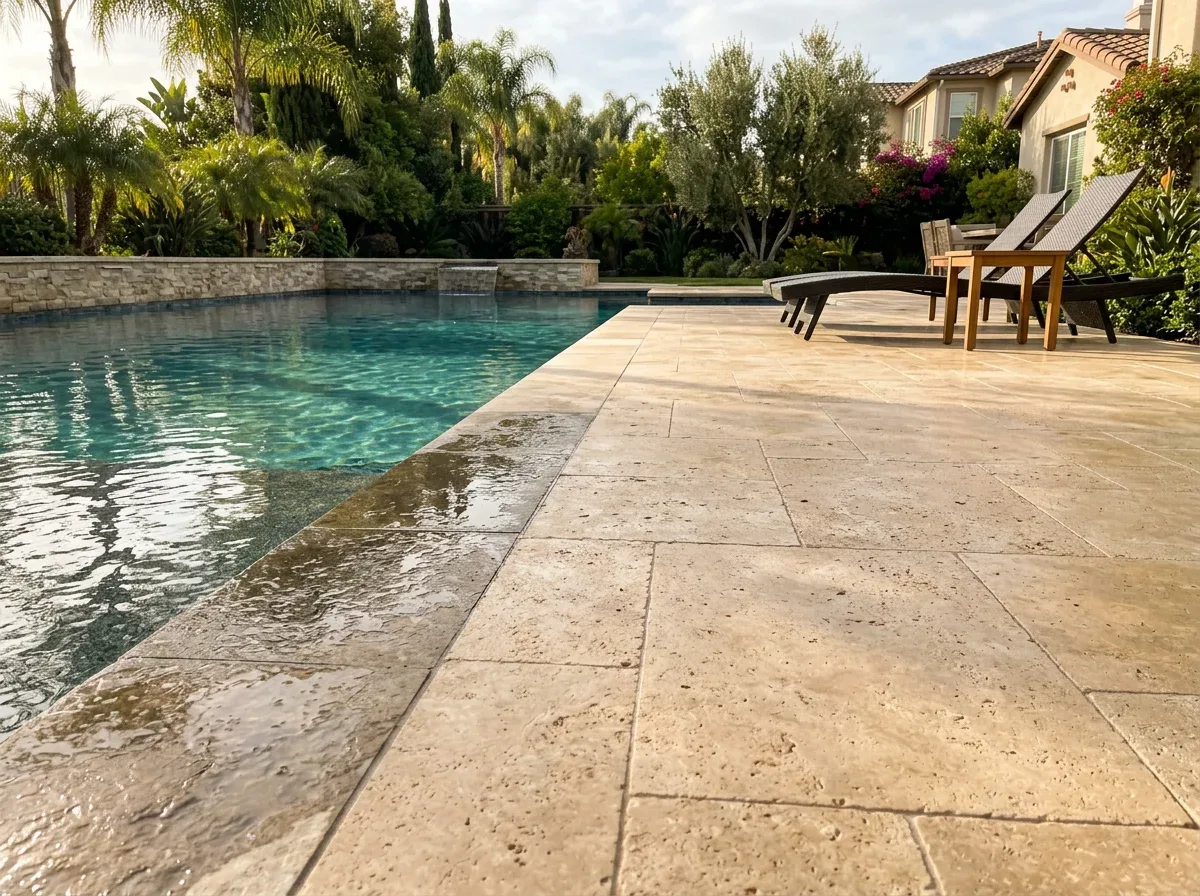
The poolside is the toughest test for travertine. Chlorinated water, sun, constant wetting and drying, and barefoot traffic wear the surface down quickly. Limescale deposits and algae are also most common in this area.
Because a polished surface becomes slippery around the pool, a honed or brushed finish is preferred. The impregnation applied after grinding and polishing reduces water penetration into the stone, preventing staining and darkening.
Antiqued and Brushed Finishes

On garden paths and terraces, an antiqued or brushed travertine finish gives a non-slip texture and also brings out the natural character of the stone. On these surfaces, some of the pores can be deliberately left open.
Open-pore surfaces should be cleaned regularly with a stiff brush and checked once a year. Brushing can also revive outdoor travertine that has become worn.
Travertine is a stone born of water, yet it needs protection from water. With its pores filled and its surface impregnated, travertine stays trouble-free for many years, whether in the Alanya sun or by the pool. — Expert Note