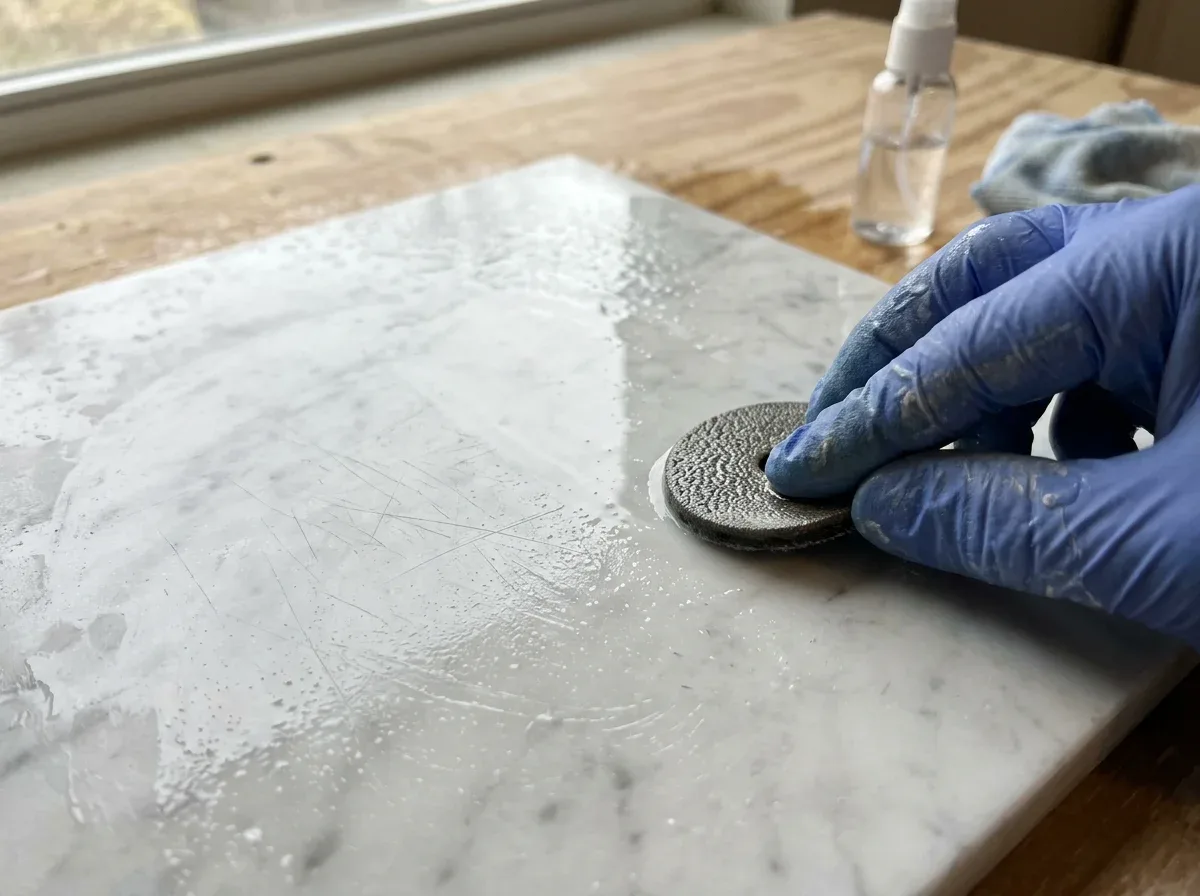
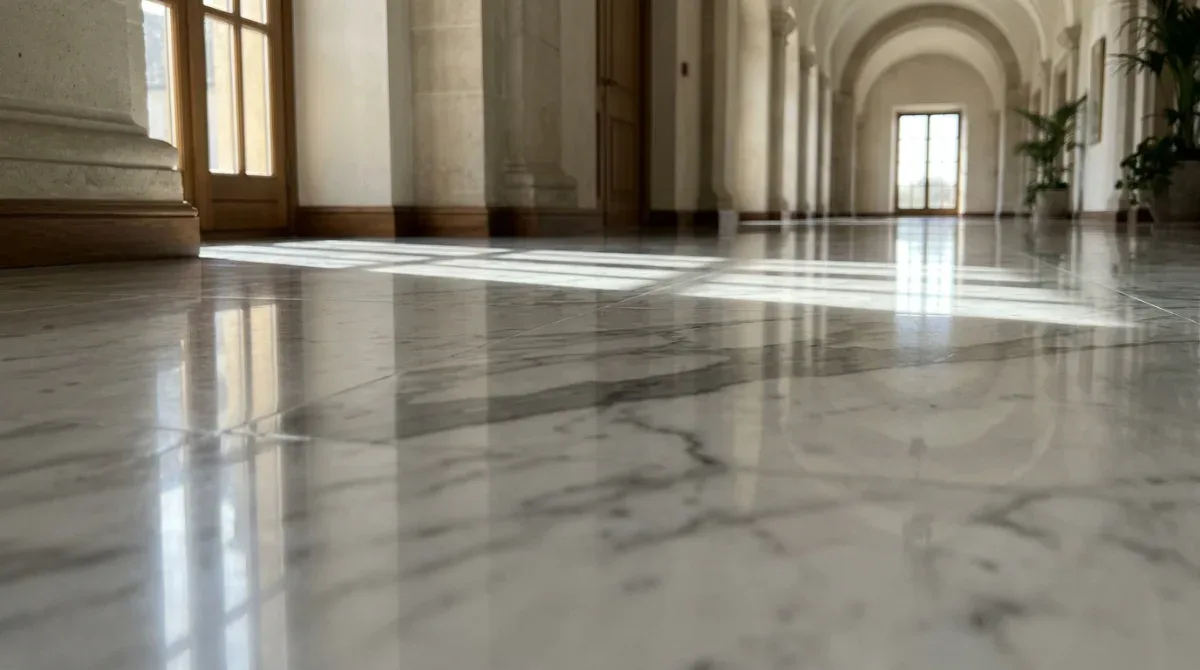
White Marks and Rings on Dark Marble
In short: Black, dark brown or green marbles look very elegant, but they show every mark.
A glass ring on the table, white stains on the countertop, whitish clouds on the floor… These marks don't all have the same cause, and they aren't removed with the same method. In this article, we explain how to tell white marks on dark marble apart and which solution is right.
Why Are They More Visible on Dark Marble?
Every light-colored mark on a dark surface creates high contrast. The same mark is almost invisible on light-colored marble, but stands out immediately on dark marble.
Types of White Marks
1. Acid Marks (Etching)
Lemon, vinegar, wine, cola or an acidic cleaner dissolves the surface. On dark marble, this area looks whitish and matte because the roughened surface scatters light.
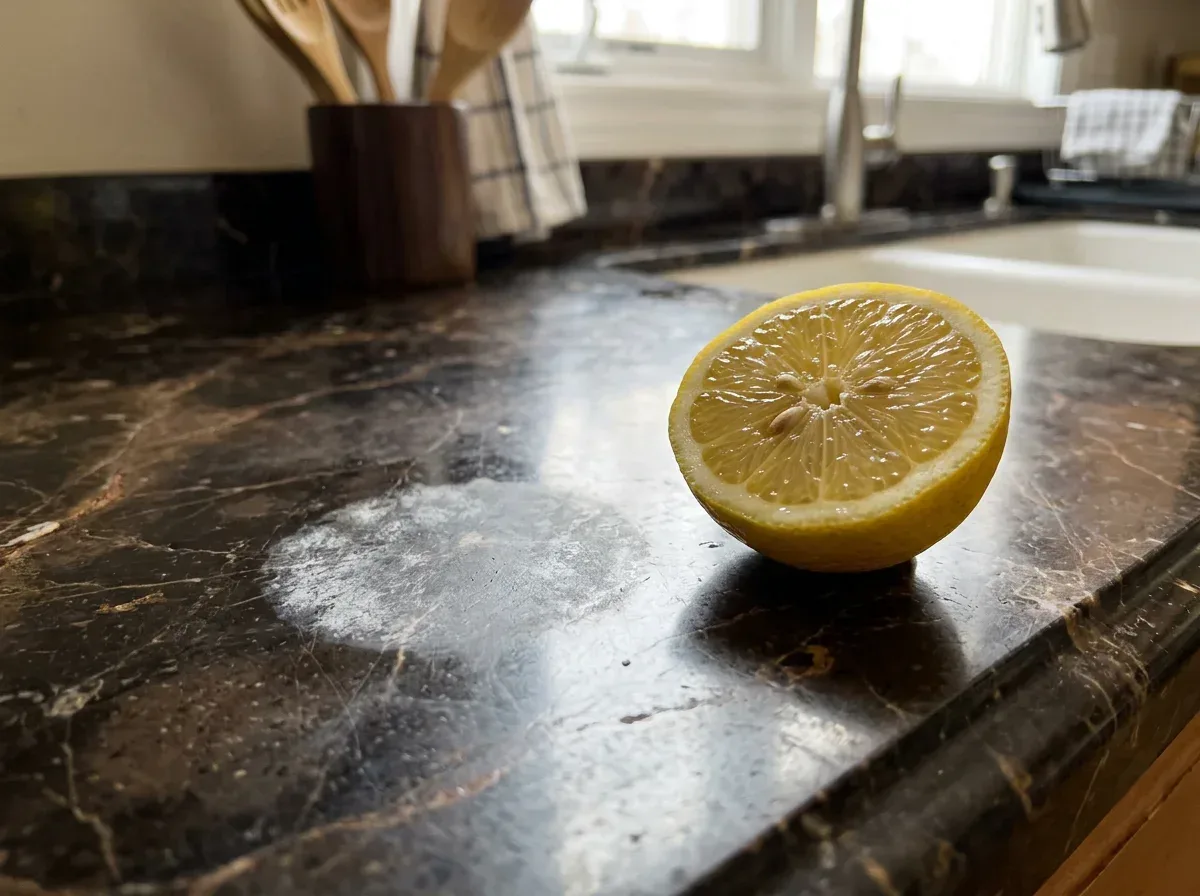
- Slightly rough feel: Because the acid dissolves the surface, the mark may feel slightly rough to the touch compared with its surroundings; this indicates that the surface has been etched.
- Does not wipe off: An acid mark is not dirt on the surface but etching in the stone itself; therefore it cannot be removed by wiping with a cloth or cleaner.
- Solution: Polishing or fine-grit honing is performed; once the etched layer is removed and the surface is re-polished, the whitish matte appearance disappears.

2. Limescale and Water Stains
When a water drop dries, the minerals in it leave a white ring on the surface.
- On top of the surface: Limescale does not etch the stone; it builds up on it, so when lightly scraped with a fingernail, the white layer may come off in places.
- Solution: Stone-safe, acid-free limescale removers and a plastic spatula are used; acidic products are not used, because they create a new acid mark.
3. Detergent and Polish Residue
Wrong products or excessive use of detergent leave a whitish, cloudy film.
- Spreads with a cloth, leaves a streak: When the film is wiped with a cloth, it spreads locally but does not come off completely; a cloudy, streaky mark remains.
- Solution: Rinsing with plenty of water and deep cleaning with a neutral cleaner are carried out; once the film is completely removed, the true color of the dark marble returns.
4. Efflorescence (Salt Bloom)
Salts carried to the surface by moisture coming from inside the stone leave white, powdery crystals. It is seen outdoors and on damp floors.
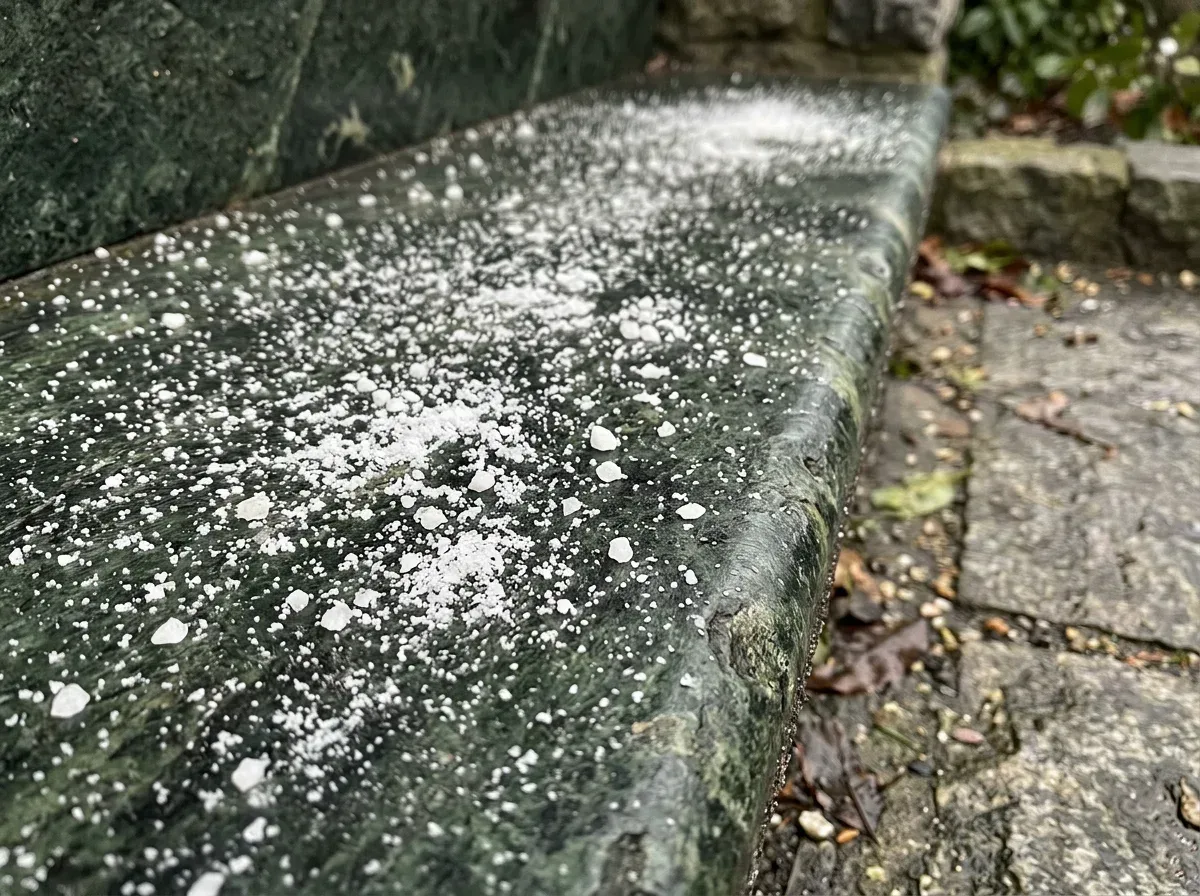
- Wipes off but comes back: The crystals on the surface are easily wiped away, but as long as moisture keeps coming from inside the stone, the salt is carried to the surface again.
- Solution: First the source of moisture is found, then dry brushing and appropriate cleaning are done; if the source is not stopped, the efflorescence recurs.
5. Scratches
Fine scratches also appear as white lines on dark marble.
- Solution: Polishing or honing is performed depending on the depth of the scratch; superficial scratches are removed by polishing, and deep scratches that catch a fingernail are removed by progressive honing.
Simple Identification
The type of white mark on dark marble can be identified on site with a few simple tests, and the right solution is chosen accordingly.
- Drip some water: If the water spreads over the mark and the mark darkens briefly, the surface may be roughened and absorbing water; this is an acid mark.
- Scrape with a fingernail: If something white comes off when scraped with a fingernail, the mark is a deposit; it may be limescale or detergent residue.
- Wipe with a dry cloth: Powdery crystals that come off easily when wiped with a dry cloth are salt and point to moisture coming from inside the stone.
Summary of White Marks
| Type of mark | How to identify it | Solution |
|---|---|---|
| Acid mark | Matte, does not wipe off, slightly rough | Polishing or fine honing |
| Limescale ring | Can be scraped with a fingernail | Acid-free limescale remover, plastic spatula |
| Detergent film | Cloudy, spreads with a cloth | Plenty of rinsing, deep cleaning |
| Efflorescence | Powdery crystals, comes back | Moisture source, dry brushing |
| Scratch | Fine white lines | Polishing or wiping |
Polishing Dark Marble Takes Skill
When spot polishing dark marble, it is very important that the polished area has the same gloss as the surrounding surface; otherwise the polished area looks shinier or duller than its surroundings and a new "mark" appears. That is why, on dark stones, instead of concentrating on a single stain, the area is worked over a wider surface with soft transitions. Because crystallization products can leave whitish residues on some dark marbles, a test is first done on a small area.
Daily Tips for Dark Marble
Most white marks on dark marble come from daily use and can be largely prevented with a few simple habits.
- Use coasters: Water and beverage residues on the bottom of glasses and bottles leave white rings on dark stone; a coaster completely eliminates this contact.
- Dry the countertop: If the countertop is dried with a dry cloth after wiping, water droplets evaporate without leaving minerals, and no water rings remain.
- Use little detergent: Too much detergent leaves a whitish film on the surface; cleaning with a small amount of product and rinsing with plenty of water prevents this film from forming.
- Use a cutting board: If acidic foods such as lemon, tomato and vinegar are prepared on a cutting board rather than on the countertop, no acid marks form on the surface.
- Honed surface in the kitchen: Because light reflects diffusely on a honed surface, acid marks and limescale rings are much less noticeable than on a polished surface.
Dark Marble Care in Alanya
In Alanya, especially in modern villas and apartments, black and dark-colored marble countertops, bathroom vanities and steps are increasingly preferred. The use of hard water and citrus fruits causes white rings and dull marks to appear frequently on these surfaces. During our on-site inspection, we identify the type of mark, clean limescale and detergent residues, and remove acid marks and scratches with soft-transition polishing.
Care for Dark Marble

- Use only pH-neutral products,
- Use a microfiber cloth and change the water often,
- Do not leave the surface wet; dry it,
- Use coasters and trays,
- Reduce water absorption with impregnation.
Our Scratch and Stain Removal Service in Alanya

On marble, granite, and travertine surfaces, we remove scratches, acid marks, and stains that have penetrated the stone using honing, poultice, or spot repair, depending on the type. We never start work without identifying the source of the stain.
We tell you honestly, on site, which stains can be removed and which are permanent. Explore our Scratch Removal service.
Dark marble shows every mark, but not every mark is the same. Trying to dissolve limescale with acid, or an acid mark with detergent, ends in a new white stain on dark stone.
Frequently Asked Questions
01Is a black marble countertop suitable for the kitchen?
02Can I remove a glass ring mark at home?
03Does impregnation (sealing) prevent white marks?
04Does grinding lighten the color of dark marble?
05Are scratches more visible on black marble?
06Can crystallization be applied to a dark marble countertop?
Related Articles
- Types of Scratches and Stains on Marble: Which Ones Can Be Removed by Honing?
- Acidic Cleaner Damage on Marble Floors: Lemon, Vinegar, Limescale Remover
- Salt Efflorescence on Balconies and Terraces
- Solution for Permanent Stains on Marble Countertops
- How to Remove Yellow Stains, Rust Stains, and Water Marks from Marble