Moisture and Stains Coming from Beneath the Floor
In short: Some stains come from below, not from above.
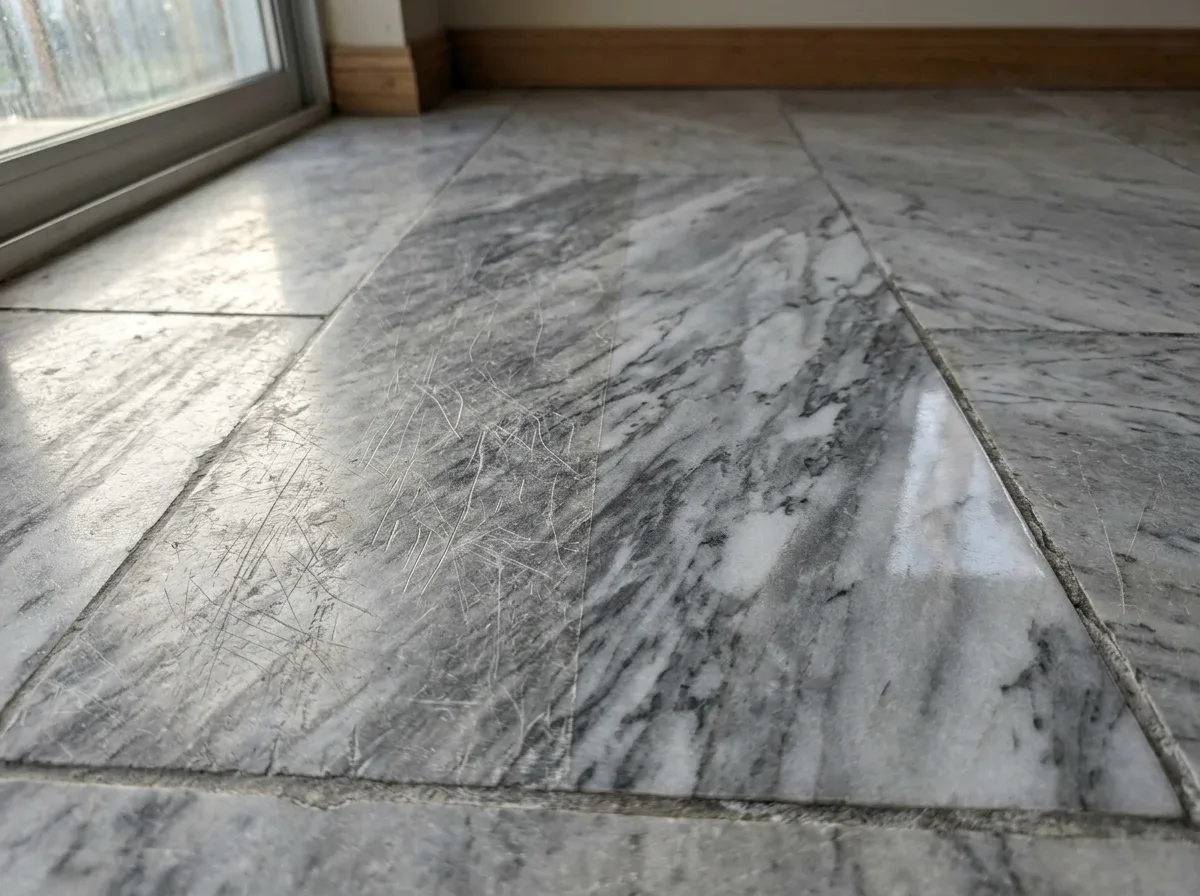
Dark borders around the edges of marble or travertine slabs, wet-looking clouds in the center, or yellow stains that spread over time are most often signs of moisture under the stone. These stains cannot be solved by cleaning or honing alone; the source of the moisture must be found first.
Symptoms
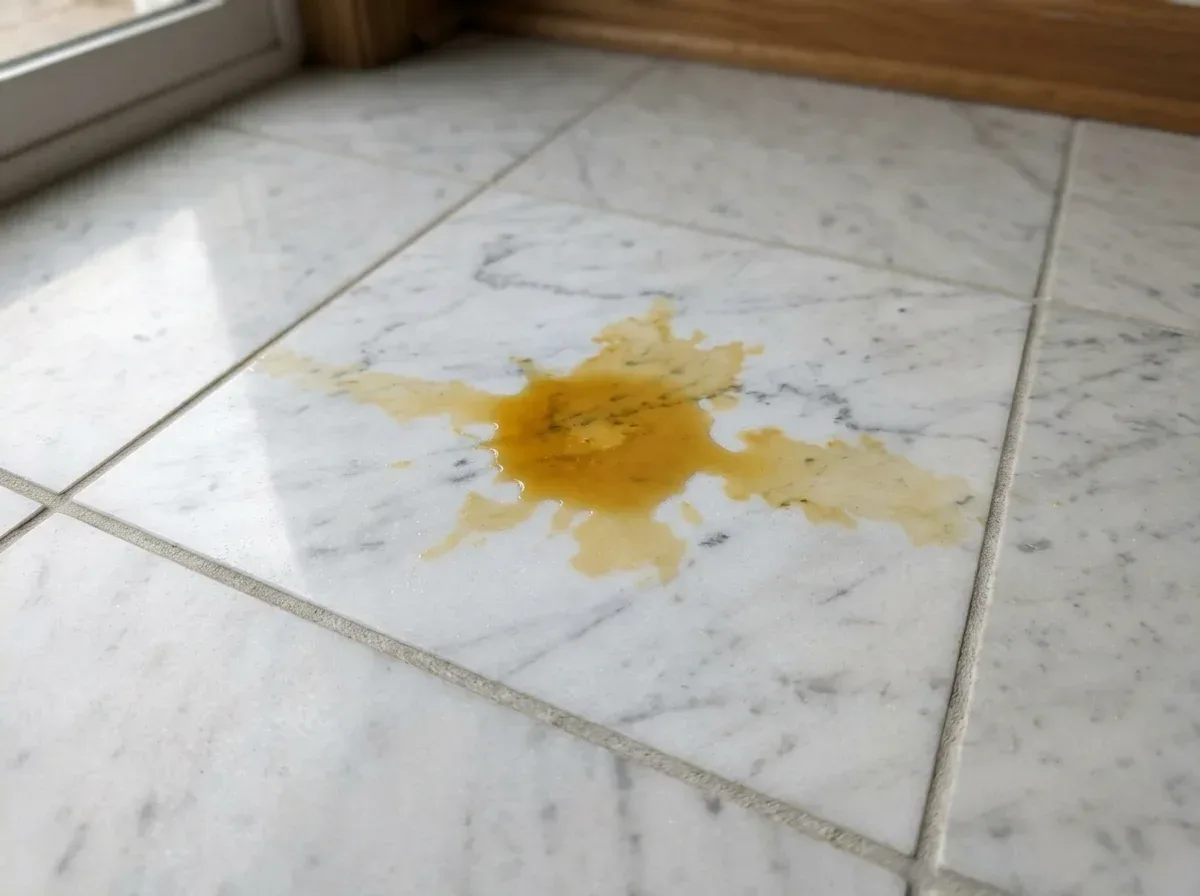
Moisture rising from below leaves distinctive marks on the surface of the stone, and these marks show that the stain comes from underneath rather than from above.
- Dark border around the slab edges: Moisture rises through the joint and enters the stone from the edges; as a result, the center of the slab stays light while the edges look like a dark frame.
- Wet-looking area in the center: A wet-looking area in the middle of the slab that does not dry, or that dries and then reappears, suggests there is a constant source of moisture underneath.
- Yellowing and brown stains: Minerals in the stone or components of the adhesive are carried to the surface by moisture; as the water evaporates, these substances remain as yellow and brown stains.
- White salt marks: White salt marks that appear on the joints and edges form when water coming from the mortar and screed evaporates at the surface and leaves dissolved salts behind.
- Darkening joints and mold: Joints that stay constantly damp darken and develop mold; if they darken again shortly after being cleaned, it is a sign that moisture is coming from below.

Sources of Moisture
Moisture under the stone can come from several different sources, and the right source must be found first for a lasting solution.
- Plumbing leak: A leak in water or heating pipes running under the floor continuously feeds water into the screed; the stain usually spreads along the line where the pipe runs.
- Bathroom and shower leakage: Water seeping from wet areas with damaged waterproofing travels to neighboring floors; stains appear in rooms and corridors adjacent to the bathroom.
- Ground moisture: On ground floors and in basements, moisture rising from the soil passes through the screed if the insulation is inadequate, reaches the underside of the stone and causes widespread stains.
- Newly laid floor: In a newly laid floor, the mortar and screed have not yet dried; as the water inside them rises to the surface, the slabs temporarily look dark.
- Water entering from outdoors: Rainwater entering through the balcony door, threshold and the base of the wall seeps under the floor; stains mostly start near these points.
Diagnosis
Observing when the stain grows and how it changes is the most practical way to work out the source of the moisture.
- Growth after rain or showers: If the stain grows after rain, water entering from outdoors is the first suspect; if it grows after showering, the bathroom waterproofing is.
- Stain shrinking on a new floor: If the stain appeared on a newly laid floor and is shrinking over time, it is most likely temporary moisture from the drying mortar and screed.
- Unexplained increase in the water bill: If there is an unexplained increase in the water bill, a leak in the plumbing under the floor should be suspected and a plumber should be asked to check it.
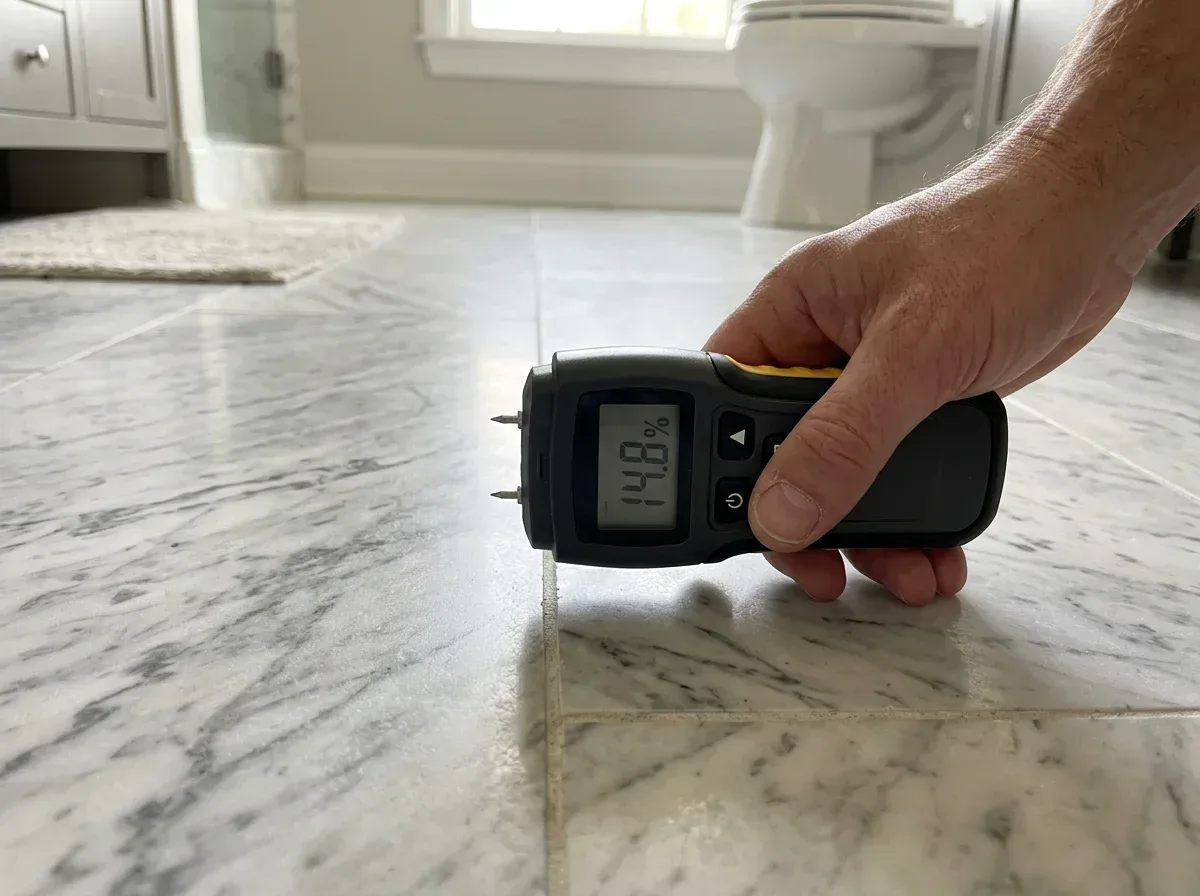
- Measurement with a moisture meter: The floor can be measured with a moisture meter; by comparing readings at different points, you can see where the moisture is concentrated and in which direction it is spreading.
If a plumbing leak is suspected, help should be sought from a plumber.
Waiting on a New Floor
In newly laid floors, moisture comes to the surface as the mortar and screed under the slabs dry; the slabs may look dark and stained. In most cases this passes on its own over time. During this period, impregnation could block the escape of moisture, so you wait for drying to finish.
Stain Type and Likely Source
| Appearance | Likely source | First step |
|---|---|---|
| Dark border around slab edges | Moisture rising from the joint | Investigating the moisture source |
| Spreading wet area | Plumbing leak | Plumber inspection |
| Stain next to the bathroom | Wet area waterproofing | Checking the bathroom waterproofing |
| Overall darkness on a new floor | Undried mortar | Waiting |
| Stain in front of the balcony door | Water entering from outdoors | Threshold and door check |
After the Source Is Fixed
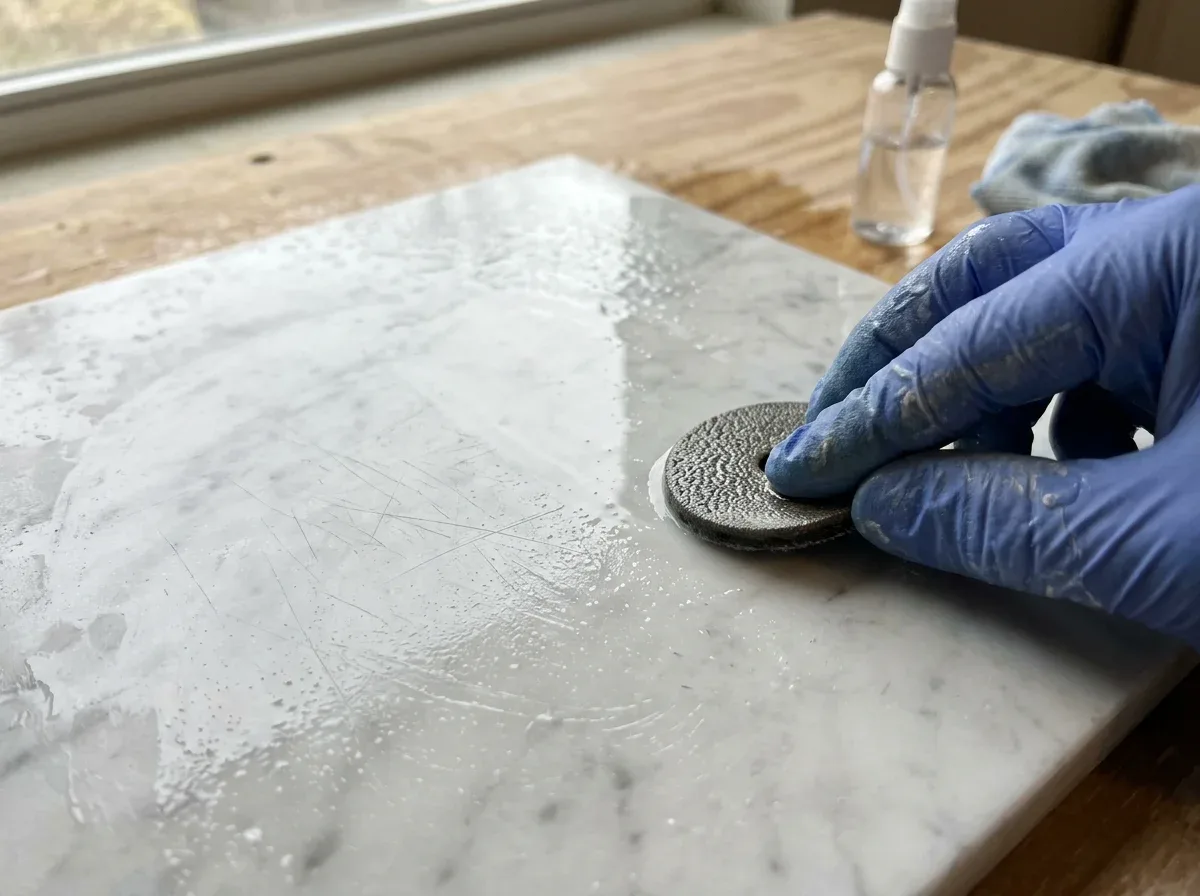
Once the source of the moisture has been eliminated, the stone needs time to dry; depending on how long the moisture persisted and on the structure of the floor, this can take several weeks. Some of the stains fade on their own as the stone dries. The remaining yellowing and brown stains are drawn out with suitable poultices; salt and mold in the joints are cleaned, and the joints are renewed if necessary. Finally, the surface is honed and polished, and once the stone is completely dry, a breathable impregnating sealer is applied.
What Not to Do
With moisture-related stains, the wrong intervention does not solve the problem and in most cases causes additional damage to the stone and the floor.
- Applying a non-breathable coating: Applying a non-breathable coating or polish while the moisture is still present traps the moisture inside the stone; the stains grow and the coating may blister.
- Using bleach or acid: Trying to lighten the stain with bleach or acid does not remove the source of the moisture; it erodes the surface of marble and travertine and leaves new marks.
- Removing or polishing without finding the source: Lifting or polishing the floor without finding the source is wasted effort; as long as the moisture continues, the stains reappear on the new slab or on the polished surface.
- Sealing before it has dried: Impregnating a newly laid floor before it has dried blocks the path of the moisture that needs to escape from the mortar and can cause the stains to become permanent.
Moisture-Related Stains in Alanya
In Alanya, we frequently encounter moisture-related stains in ground-floor apartments, basements, and rooms adjacent to bathrooms. In such jobs, we first assess the likely source from the appearance of the stain, and if plumbing or insulation problems are suspected, we refer you to the relevant specialist. Once the source is fixed and the stone has dried, we restore the floor with poultices, joint renewal, honing, and impregnation.
Order of Solution

- Finding and eliminating the source of the moisture,
- Waiting for the floor to dry,
- Poultice and cleaning for remaining stains,
- Honing and polishing if necessary,
- Suitable, breathable impregnation.
Our Scratch and Stain Removal Service in Alanya

We remove scratches, acid marks and stains that have penetrated the stone on marble, granite and travertine surfaces, using honing, poultice or spot repair depending on the type. We never start work without first identifying the source of the stain.
We tell you honestly, on site, which stains can be removed and which are permanent. Explore our Scratch Removal service.
Wiping away a stain that comes from below by cleaning the surface is like painting the inside of a leaking roof. First stop the water, then treat the stone.
Frequently Asked Questions
01Does honing remove moisture stains?
02Does impregnation stop moisture?
03When do stains disappear on a new floor?
04Do you locate plumbing leaks yourselves?
05Does impregnating a marble floor with moisture stains prevent the stain?
06When does the stain disappear once the moisture source is fixed?
Related Articles
- Salt and Moisture Migration in Concrete Floors
- How to Remove Yellow Stains, Rust Stains and Water Marks from Marble
- The Effect of Air Conditioner Condensation and Moisture on Marble
- Detecting Hollow (Debonded) Tiles on Marble Floors
- Types of Scratches and Stains on Marble: Which Ones Can Be Removed by Honing?