What Is Gloss Measurement? Understanding How Shiny a Floor Is
In short: "Mirror-like", "semi-matte", "silky sheen"… Many different expressions are used to describe the shine of a floor, and everyone understands them differently.
A gloss meter (glossmeter) provides a common language for this. In this article, we explain gloss measurement in simple terms and share practical ways to judge gloss by eye.
What Is Gloss?
Gloss is how evenly a surface reflects light. A smooth surface reflects light in a single direction and looks like a mirror. A rough surface scatters light in all directions and looks matte.
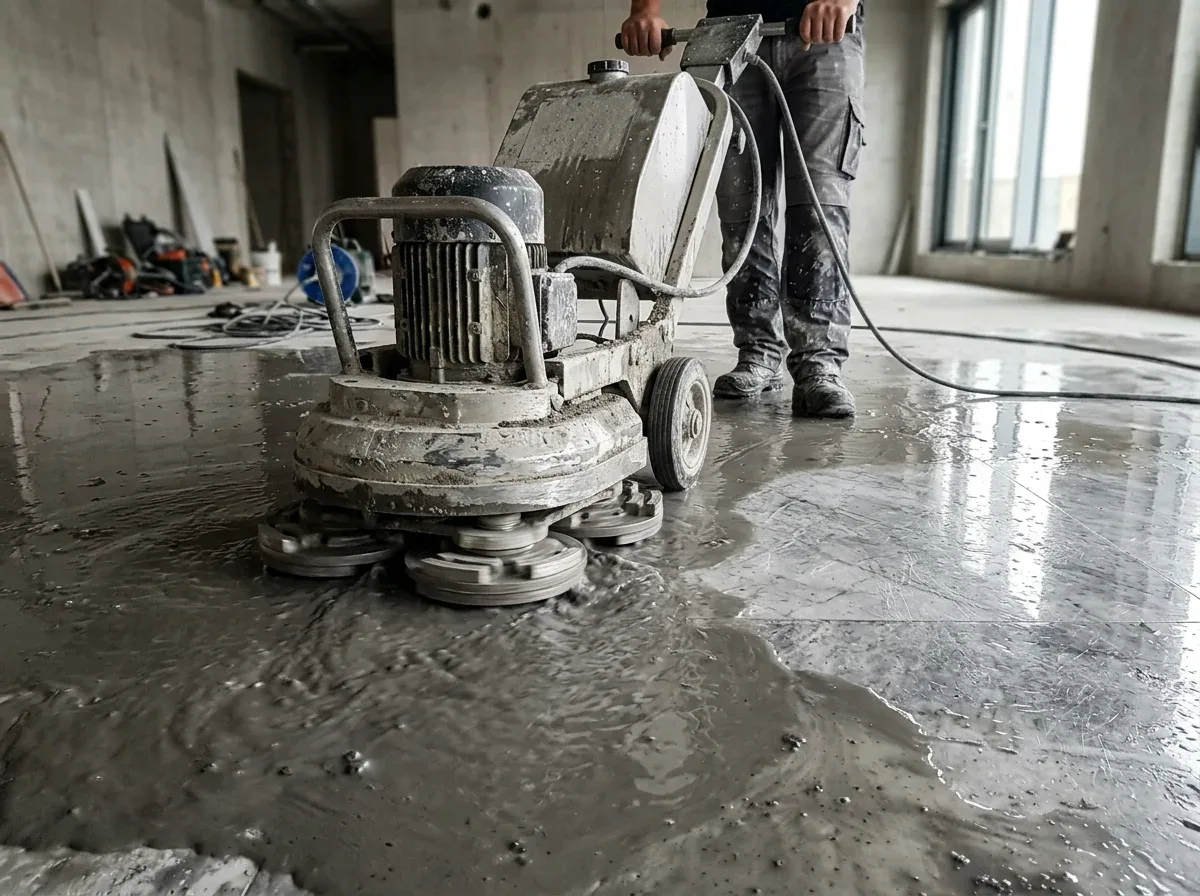
As the grit stages progress in honing and polishing, surface roughness decreases and gloss increases.
How Does a Gloss Meter Work?
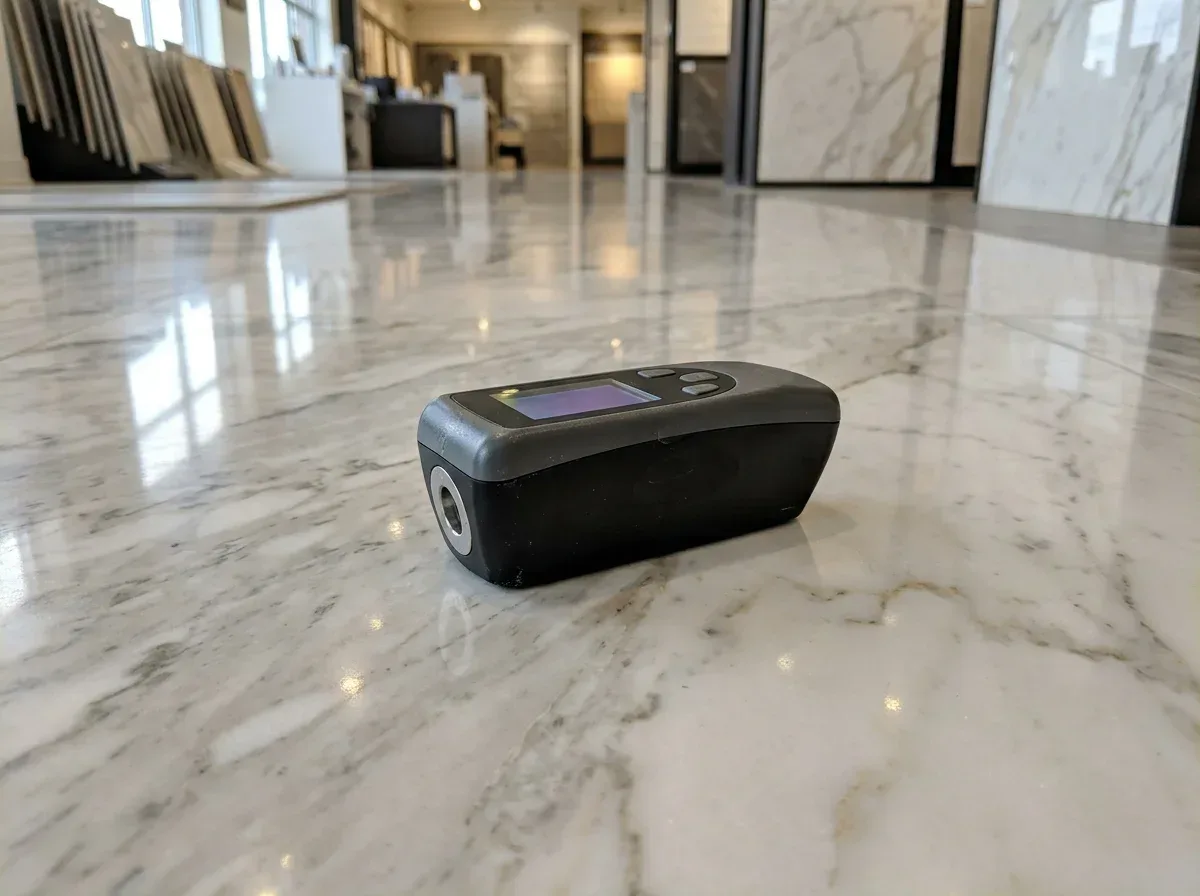
The device sends light onto the surface at a specific angle and measures how much of it is reflected at the opposite angle. The result is given in "gloss units" (GU).
Measurement Angles
On gloss meters, the angle at which light hits the surface is chosen according to how glossy the measured surface is.
- 60°: This is the most common general-purpose measurement angle; the first measurement is usually made at this angle to find out whether a floor is matte, semi-gloss or glossy.
- 20°: Used to distinguish very glossy surfaces; this narrow angle better shows the difference between two glossy floors that give close readings at 60°.
- 85°: Used for matte surfaces; this angle, close to a grazing view, reveals small gloss differences on honed, low-reflection floors.

The same surface gives different values at different angles; therefore, the angle must also be stated when a value is given.
What Do the Values Mean?
Exact ranges vary depending on the stone, the device and the measurement angle, but the general idea is as follows:
- Low values: Indicate a matte, honed surface; light scatters in all directions across the surface, no reflection is visible, and the floor has a soft, understated look.
- Medium values: Indicate a silky or semi-gloss surface; light is reflected clearly but blurry, and a lamp's image appears as a bright blotch rather than a sharp line.
- High values: Indicate a glossy, reflective surface; on stone whose roughness has been greatly reduced, images of lamps and windows appear on the floor like in a mirror.
The gloss that different stones can naturally reach also differs. For example, some granites reach very high values, while softer and porous stones have a lower limit.
Difference Between Gloss and Clarity
Even if two floors give the same gloss value, one may look "cleaner" than the other. This is because gloss has two separate characteristics. Skipping intermediate stages in polishing can leave a surface with a high value but a blurry reflection:
- Strength of reflection: How brightly does the light reflect? The number a gloss meter gives mainly shows this strength, but it does not by itself tell how sharp the reflection is.
- Sharpness of reflection: Are the edges of lamps and windows sharp or blurry? If intermediate stages are skipped, fine scratches remain and the reflection looks hazy even if the value is high.
Visual Assessment
You can assess gloss even without a device:
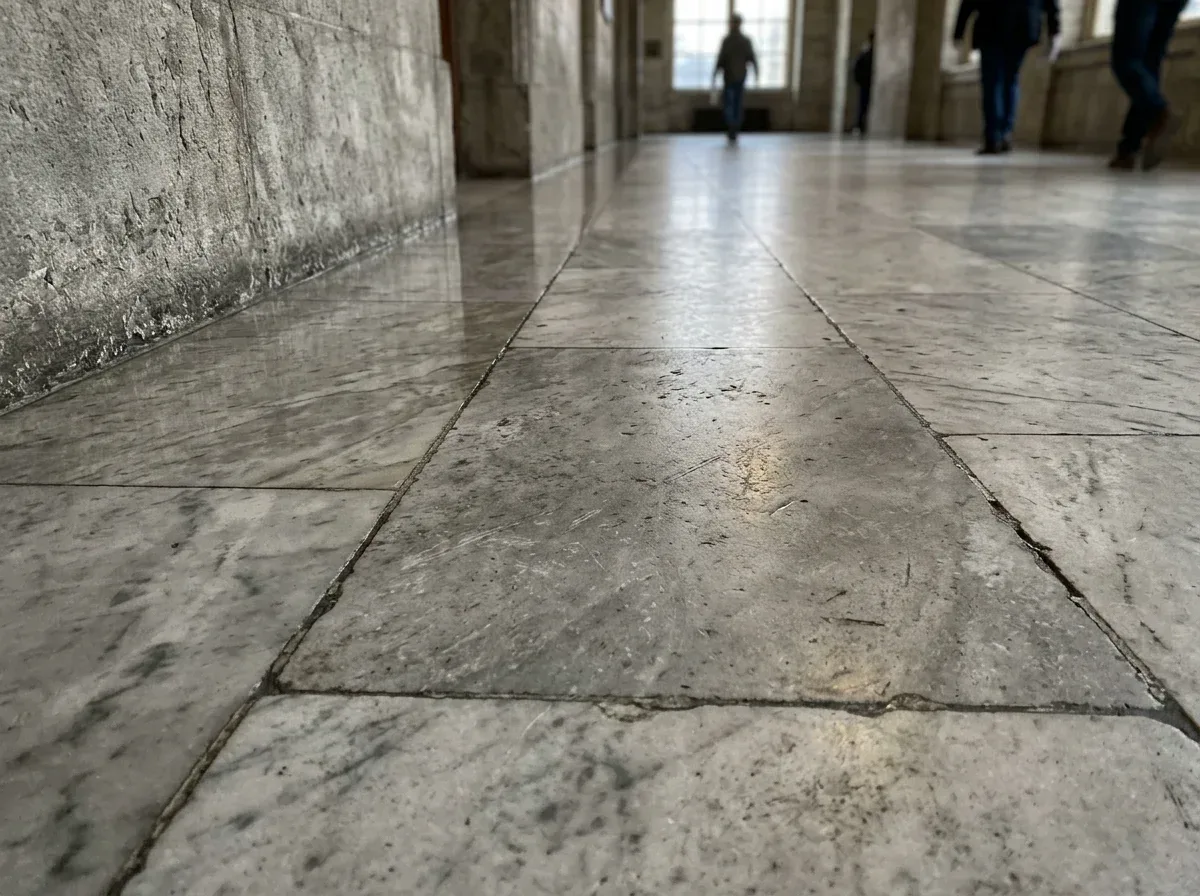
- View from a low angle: First kneel down and look across the floor from a horizontal angle; since the light grazes the surface, scratches, pad marks and matte areas become more noticeable.
- Lamp reflection: Then look at the reflection of the ceiling light; if its edges are sharp, the surface is well finished, and if they are scattered and hazy, the fine stages are lacking.
- Regional differences: Next, check whether doorways and traffic paths are more matte than the edges; the difference shows where wear is concentrated.
- Comparison: Finally, compare a rarely used area under furniture with a traffic path; the difference shows how much gloss the floor has lost.
Gloss Expectations by Stone
| Stone | Achievable gloss | Note |
|---|---|---|
| Granite | Very high | Hard stone, retains gloss for a long time |
| Dense marble | High | Can increase further with crystallization |
| Soft marble | Medium-high | Dulls more quickly |
| Travertine | Medium | Pores and fillers set the limit |
| Terrazzo | Medium-high | Depends on binder and aggregate |
| Polished concrete | Medium-high | Depends on the hardener and the number of steps |
When Is Measurement Useful?
Gloss measurement is especially useful in large areas such as hotel lobbies, stores and offices, to document the result of the work and to track changes over time. Values taken at specific points right after honing, when repeated at the same points a few months later, clearly show how much gloss has been lost along the walkways. This way, the timing of a refresh is based on measurement rather than guesswork. In homes, a visual assessment is usually enough.
Points to Watch When Measuring
For gloss measurements to be comparable, they must be taken under the same conditions and at the same points every time.
- Clean and dry surface: The surface must be clean and dry; dust, water or cleaner residue can change how light reflects and produce a reading different from the true value.
- Same angle: The same angle must be used for every measurement; values taken at different angles cannot be compared with each other and give a false impression of change.
- Multiple points: Measurements should be taken at several points and averaged; in natural stone, differences in veining and texture can make the value at a single point misleading.
- Note the measurement points: When the points are noted and the next measurement is taken at the same spots, gloss loss along the walkways can be tracked accurately over time.
Gloss Tracking in Alanya
In hotel lobbies and large commercial areas in Alanya, we document the condition of the surface after pre-season honing and crystallization, and we plan the refresh by tracking gloss loss along the walkways during the season. In residences, we evaluate the result at handover together with the homeowner, viewing it from different angles.
Why Is Measurement Useful?

Gloss measurement bases how shiny a floor is on numbers rather than the eye, and makes the work easier to inspect.
- Before and after polishing: Measurements taken at the same spot before and after the work show concretely how much the polishing has increased the gloss.
- Target gloss: If the desired gloss level is discussed beforehand and set by measurement, there will be no gap in expectations or dispute at handover.
- Monitoring gloss loss: Measuring at intervals as part of the maintenance plan shows how much the gloss has dropped and when a refresh is needed.
- Consistency across areas: In large areas, measurements taken from different zones reveal whether the floor has the same gloss everywhere.
Our Marble Grinding Service in Alanya

We restore marble floors that have become dull, scratched, or uneven between slabs using wet grinding, which keeps dust under control. From coarse grinding to polishing, we choose each stage according to the type of stone, and if needed we also repair cracks and joints as part of the same job.
We inspect your floor on site and tell you clearly whether it needs grinding or just polishing. Explore our Marble Grinding service.
A surface may show a high gloss value and still have a blurry reflection. How sharp the reflection is (clarity) drops with wavy or poor-quality polishing. When inspecting by eye, pay attention to two things: — Expert Note