Why Impregnating Is a Must After Honing Travertine
In short: Travertine looks like new after honing, but at this stage it is also at its most vulnerable.
Honing removes the dirty, sealed layer on the surface, but it also opens up the pores of the stone. In this article, we explain why impregnating after honing matters, how it is applied, and what to watch out for.
What Does Honing Do to Travertine?
Over the years, the surface of travertine becomes covered with dirt, detergent residue, and sometimes old sealers. This layer spoils the appearance, but it also blocks some of the pores.
Honing removes this layer and:
- The true color is revealed: Once the dirt, detergent residue, and old sealer layer are removed, the true color of the travertine, which has been covered for years, becomes visible again.
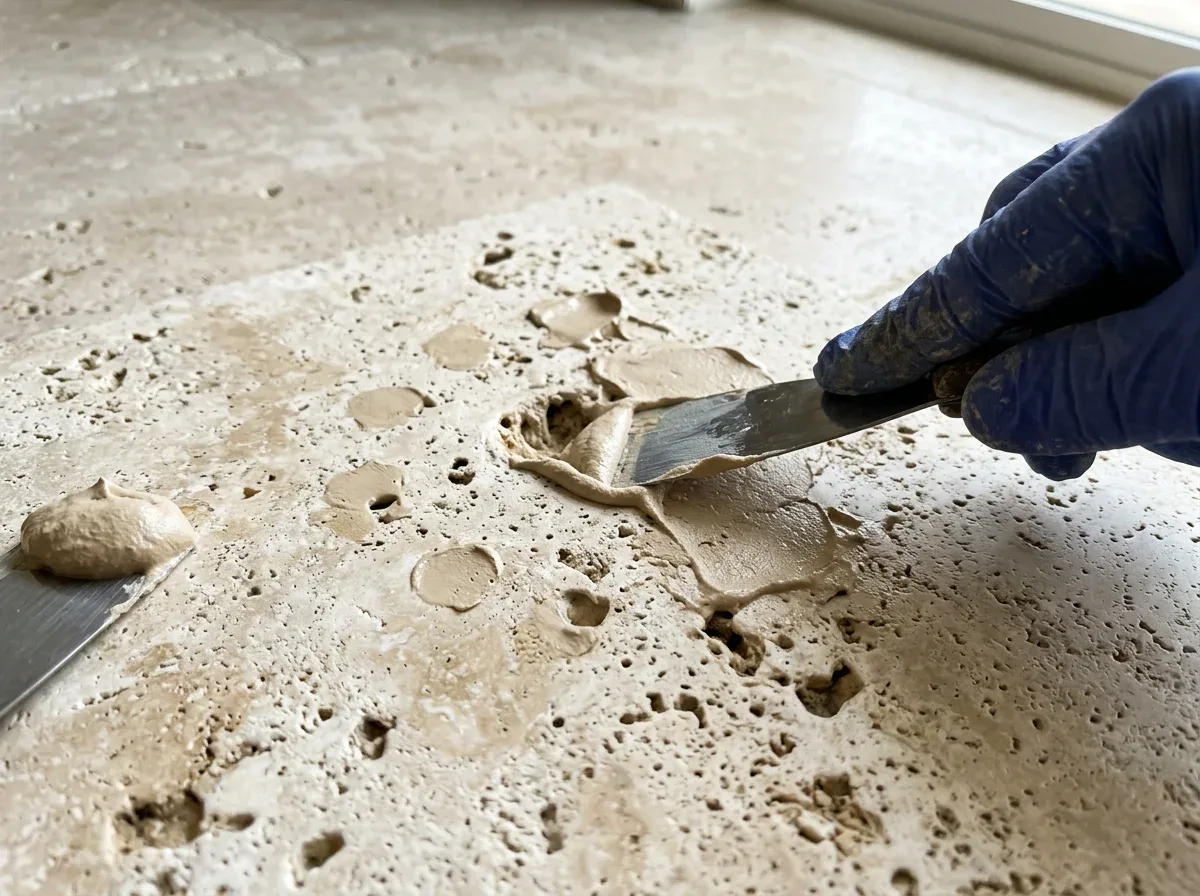
- Closed pores are opened: Honing opens the closed pores near the surface; if these pores are not protected, they absorb water, dirt, and stains directly.
- Absorbency increases: Because the layer that blocked the pores is gone, the stone's absorbency increases; spilled coffee or oil penetrates the stone faster than before.
For this reason, freshly honed and unprotected travertine can draw in spilled coffee, oil, or dirty water faster than before.
What Does Impregnation Do?
Impregnation (a penetrating sealer) is a protective product that penetrates the pores of the stone and makes the pore walls water- and oil-repellent.
- It does not form a film: The impregnator does not leave a layer on the surface; it works inside the pores, so the surface does not become slippery or look plastic-like.
- The stone breathes: It allows the stone to breathe; since moisture inside can escape as vapor, no blistering or staining occurs on the surface.
- The appearance usually does not change: It usually does not change the appearance; except for color-enhancing products, the natural tone obtained after honing stays as it is.
- Liquids penetrate slowly: It slows the penetration of liquids into the stone and makes cleaning easier; spilled liquid stays on the surface, leaving time to wipe it up.
What Does Impregnation Not Do?
- It does not protect against acids: Impregnation does not protect the stone against acids; lemon, vinegar, or limescale remover will still dissolve the travertine surface and leave a dull mark.
- It does not prevent scratching: Impregnation does not change the hardness of the surface; sand carried in on shoes and dragged objects can still scratch the stone.
- It does not completely prevent stains: It does not make staining completely impossible; it buys you time to wipe up, and a liquid left for a long time can still leave a mark.
Application Timing
Impregnation should only be applied when the stone is completely dry. After wet honing:
- Moisture remains inside: Even if the surface looks dry in a short time, moisture remains inside the stone; porous travertine holds water deep inside for longer.
- Product does not penetrate damp stone: Impregnator applied to damp stone cannot penetrate the pores sufficiently; the protection stays weak and loses its effect much sooner than expected.
- Waiting time varies: The waiting time varies with the temperature, ventilation, and season; in cool and enclosed spaces, the stone dries more slowly.
The applicator should not proceed to impregnation without being sure that the stone is dry.
Choosing the Right Product
The right impregnator is chosen according to the area where the travertine is used and the water, oil, and sun exposure it will face there.
- Indoor, dry areas: Water-based products that do not change the appearance are generally used; in living rooms and bedrooms, they reduce water and dirt absorption while preserving the stone's natural tone.
- Kitchen and dining area: Products with strong oil-repellent properties are chosen; oil splashed onto the countertop and floor can be wiped away before it soaks into the stone.
- Bathroom and wet areas: Breathable products with high water-repellent properties are used; they reduce limescale and soap buildup around showers and sinks.
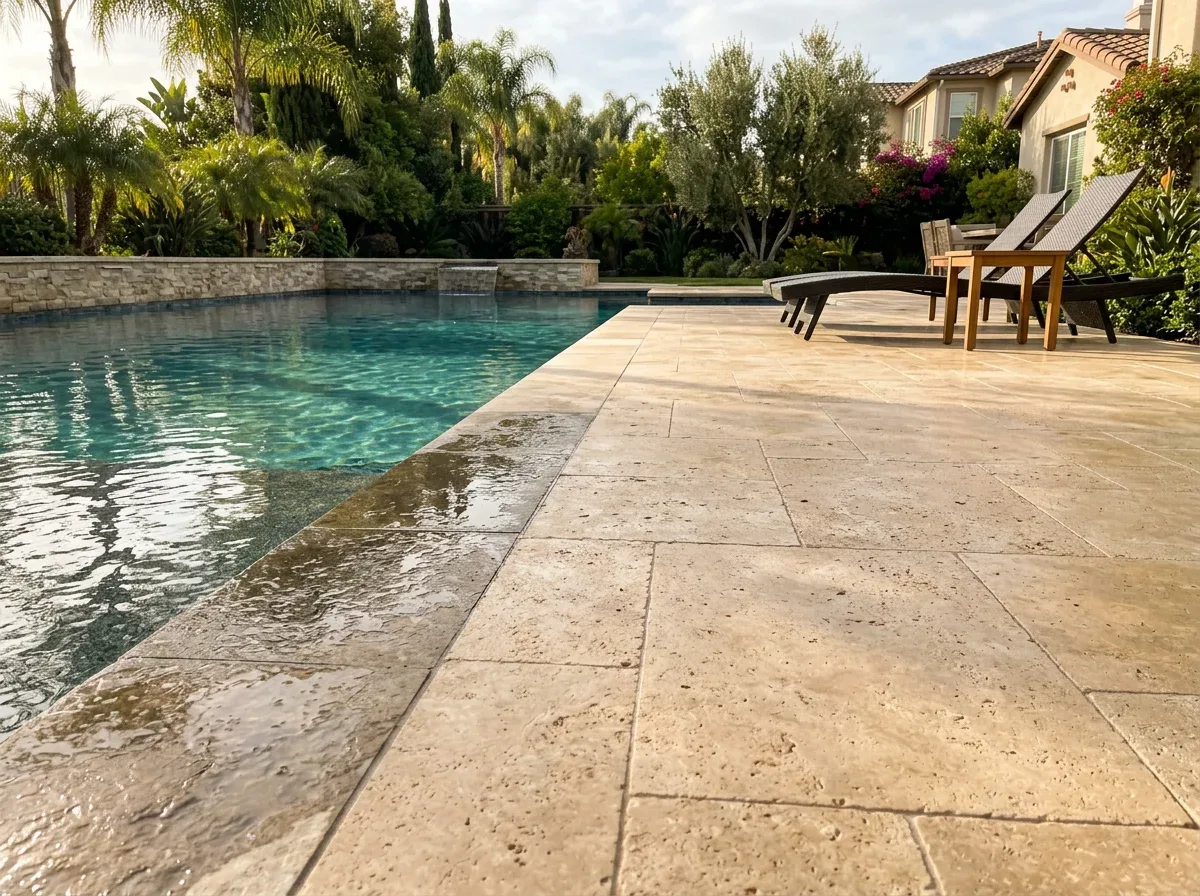
- Outdoor areas and poolsides: UV-resistant, breathable products that do not reduce slip resistance are chosen; they do not deteriorate in the sun and maintain safe walking with wet feet.
- Color enhancer: These are products that darken the stone's tone and give it a wet look; they are optional and should be tested first.

How Is It Applied?
The effectiveness of impregnation depends on applying the product to clean, dry stone in the right order and removing the excess in time.
- Clean, dry surface: The surface must first be clean and dry; remaining dirt gets trapped in the pores, while moisture prevents the product from penetrating the stone.
- Even application: The product is applied evenly with a brush, roller, or sprayer; areas that receive less product are protected less and stain first.
- Waiting for the absorption time: Then the product is left for the stone's absorption time; during this period, it penetrates the pores and makes the pore walls water- and oil-repellent.
- Removing excess product: Any excess product left on the surface must be removed before it dries; otherwise shiny, sticky or cloudy stains remain on the surface.
- Second coat if needed: If necessary, a second coat is applied; especially on highly porous travertine, the first coat may not be enough to saturate all the voids.
- No wet cleaning during curing: Finally, no wet cleaning is done during the product's curing time; water and detergent that come into contact too early disrupt the setting of the protection.
On porous travertine, it is important that the product penetrates well into the pores and joints.
Checking with the Drop Test
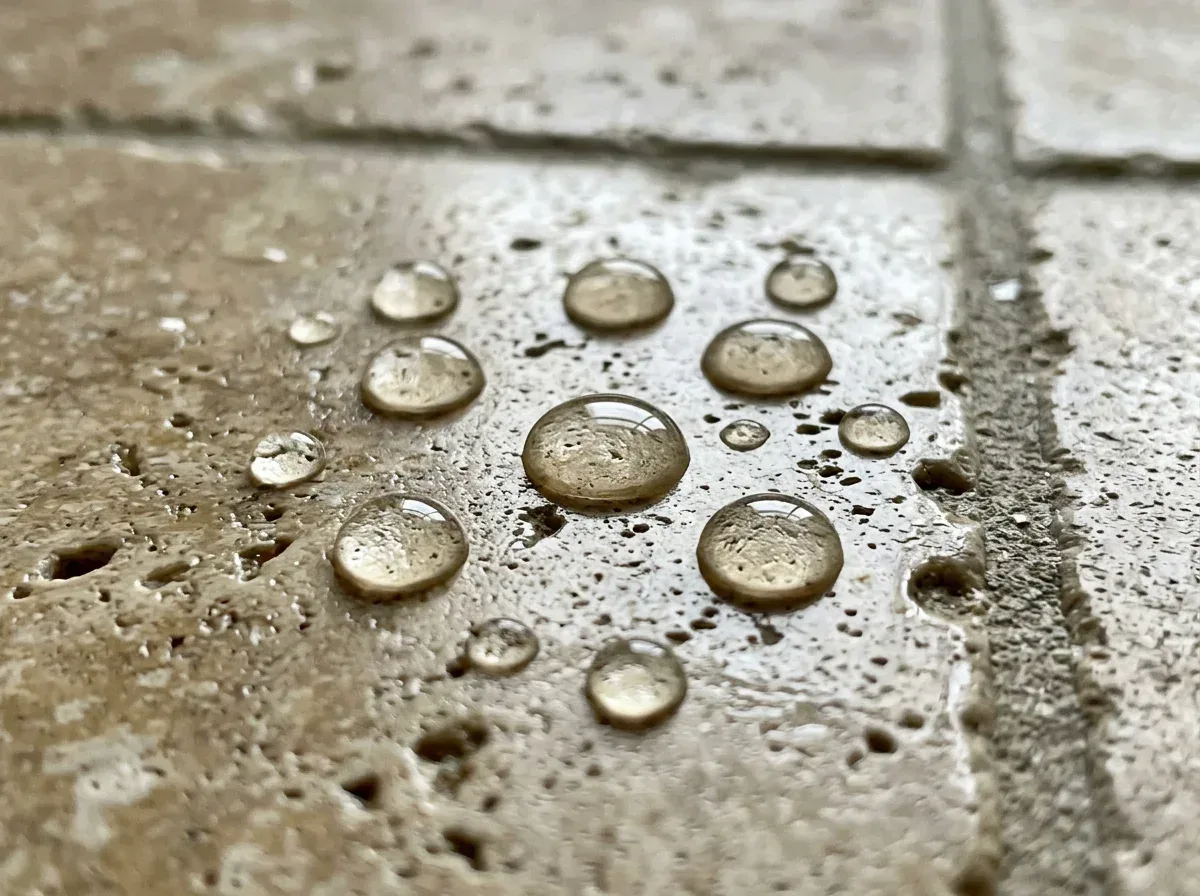
After curing is complete, place a few drops of water on the stone and a few drops of oil in a separate spot:
- Beading drops: If the drops stay beaded and the stone does not darken, the impregnation is working; the pores are not letting the liquid in.
- Darkening stone: If the stone darkens within a few minutes, the impregnation is insufficient or it is time to renew it; that area is vulnerable to staining.
What Happens to Travertine That Is Not Impregnated?
On travertine where impregnation was skipped after honing, problems usually begin to appear within the first few months:
- In the kitchen: Dark rings appear in areas where oil splashes, along with marks from the bottoms of pots and bottles; because the oil penetrates the pores, it cannot be removed by wiping.
- In the bathroom: Darkening on the shower floor, soap and limescale buildup around the joints, and the beginnings of mold in the pores are seen.
- At the entrance: As dirty water carried in on shoes penetrates the pores, darkening begins along walking paths and over time clear marks form on the floor.
- By the pool: Sunscreen stains, algae, limescale lines and fillers that get dirty quickly appear; unprotected stone absorbs pool water and oils directly.
Most of these problems can only be fixed with re-cleaning, poultice and sometimes a new honing. Impregnation is the cheapest safeguard against these costs.
Common Application Mistakes
| Mistake | Result | Correct approach |
|---|---|---|
| Applying to damp stone | The product does not penetrate, whitening | Wait for the stone to dry completely |
| Not wiping off the excess product | Sticky, cloudy surface that holds dirt | Remove the excess after the waiting time |
| Applying to a dirty surface | Trapping dirt inside the stone | Deep cleaning first |
| Using an interior product outdoors | Rapid weakening and yellowing in the sun | UV-resistant exterior product |
| Applying a film-forming polish | Slipperiness, flaking, inability to breathe | Penetrating impregnation |
Care After Impregnation
Impregnation is not a one-time job to be done and forgotten. The protection weakens over time with the cleaning products used and with foot traffic. To extend the life of the impregnation, use only pH-neutral cleaners suitable for natural stone; acidic and strongly alkaline products quickly damage the protection. Repeat the drop test once or twice a year, especially in high-use areas such as the kitchen, bathroom and poolside. If water no longer beads, it is time to renew; renewal can be done on clean, dry stone without the need for honing.
Travertine Protection in Alanya
Poolsides, terraces and bathrooms, where travertine is used most in Alanya, are also the places where impregnation is put under the most strain. Sun, salty air, pool water and high humidity wear down the protection faster than indoors. For this reason, we recommend checking the impregnation of outdoor travertine at the start of every season and, if necessary, renewing it before the season. On travertine floors that we hone, impregnation is planned as an integral part of the job.
How Often Should It Be Renewed?

The lifespan of impregnating sealer depends on product quality, intensity of use, cleaning products, and outdoor conditions. Rather than following a fixed schedule, the best approach is to perform the water drop test regularly and reapply based on the result. Acidic and harsh detergents shorten the lifespan of the sealer.
Our Travertine Grinding and Honing Service in Alanya

We grind travertine floors whose pores have opened up, or that have darkened or worn, and fill the voids with color-matched filler. For outdoor areas such as pool surrounds, terraces and gardens, we apply honed or brushed finishes that prioritize slip resistance over shine.
After grinding, we also recommend a suitable impregnating sealer to protect the travertine against stains. Explore our Travertine Grinding service.
After honing, travertine that hasn't been impregnated is like a fresh sponge; it draws the first spilled coffee deep down into the stone. Honing renews the stone, while impregnation protects that renewed stone. Without one, the other is incomplete.
Frequently Asked Questions
01What happens if the stone is not impregnated?
02Does impregnation change the color of travertine?
03Does impregnation make travertine glossy?
04Can I apply impregnation myself?
05How soon can the floor be walked on after impregnation?
06When should impregnation around the pool be renewed?
Related Articles
- What Is Natural Stone Impregnation, and Which Stones Need It?
- Water Drop Test After Impregnation: Is the Protection Working?
- Types of Impregnation: Water-Based and Solvent-Based Sealers
- Why Does Travertine Flooring Wear Down and Lose Its Shine?
- Impregnation, Crystallization, and Hardener: Which One to Use and When?