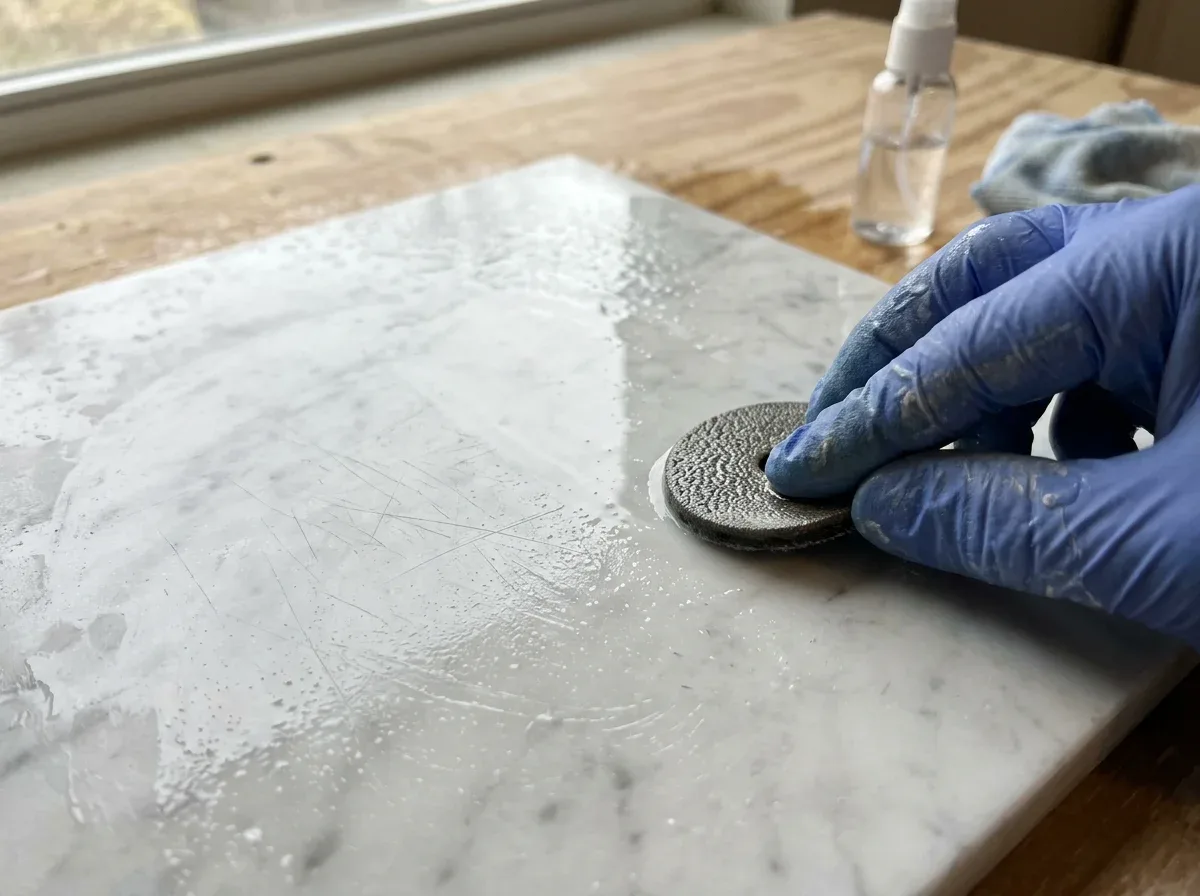
How to Remove Yellow Stains, Rust Stains and Water Marks from Marble
In brief: The yellow, brown and white stains seen on marble do not all come from the same source, so they cannot all be removed with the same method.
In this article, we explain how to tell apart the three most common types of stains, namely yellow stains, rust marks and water marks, and the right approach for each.
First, Understand What the Stain Is
The most common mistake in dealing with a stain is attacking it with a strong cleaner without understanding what it is. What we call a "stain" on marble can be one of three different things:
- A substance that has penetrated the stone: Such as oil, rust, tea or coffee. The stain is in the pores of the stone, so wiping the surface is not enough; you need a method that draws the stain out.
- A layer that has built up on the surface: Such as limescale, soap residue or old polish. The stain sits on top of the stone and can be removed with suitable cleaning or by stripping the layer.
- Damage to the surface itself: An acid mark or wear. There is no stain here; the stone's shine is gone and can only be restored by polishing or honing.

The solutions for these three cases are completely different. Read the stain types below with this in mind.
To work out which group a stain belongs to, you can do a simple check at home. Wipe the stained area with a damp cloth and look at it from a side angle in the light. If the color darkens and returns to its previous state once dry, the substance is inside the stone. If the surface feels rough and dull to your finger but there is no color difference, the problem is not a stain but an acid mark. If a white layer comes off when you lightly scratch it with a fingernail, there is buildup on the surface. This simple distinction keeps you from causing a second kind of damage to the stone with the wrong product.
Yellow Stains
Causes
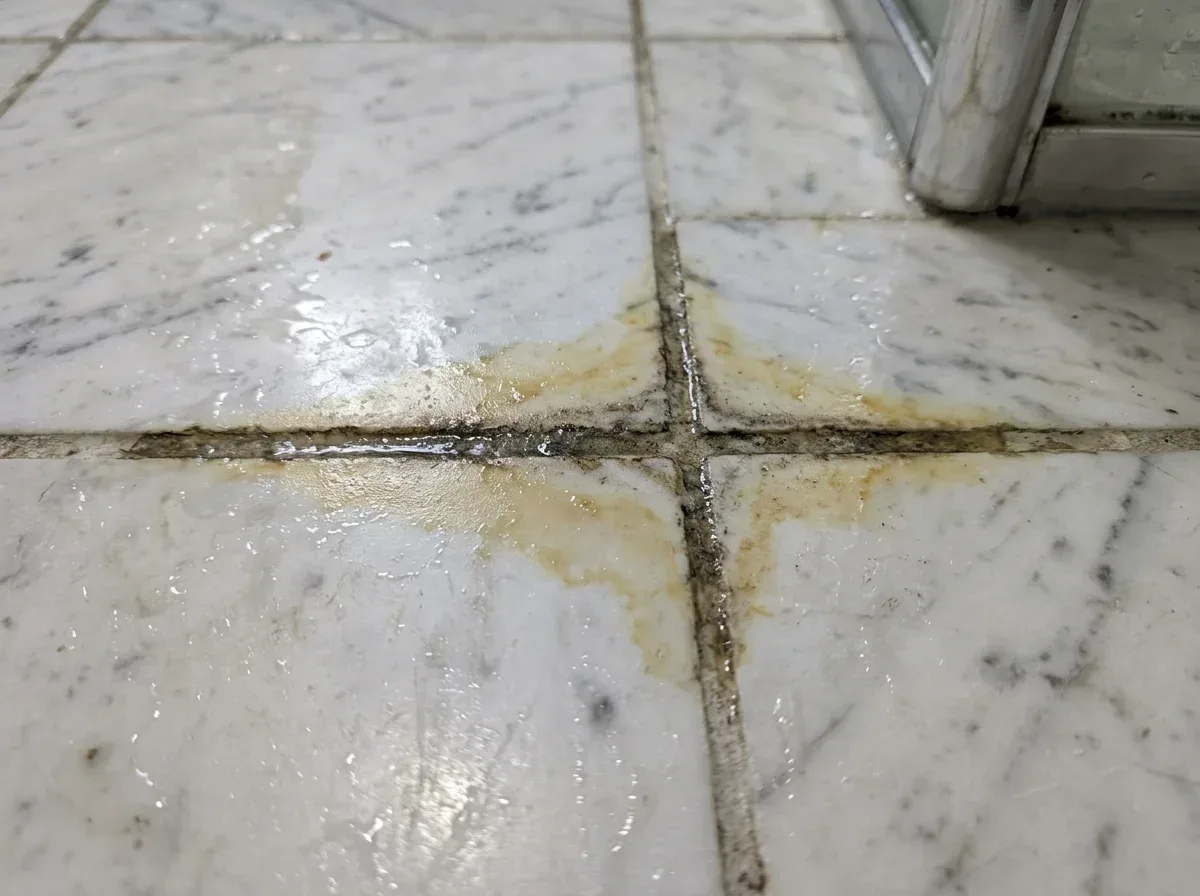
- Iron inside the stone: Some marbles contain iron-bearing minerals. When these minerals react with moisture and oxygen, they form yellow-brown stains. This is seen especially on white marble, in wet areas and on newly laid floors.
- Moisture from below: Moisture from the screed or adhesive carries minerals to the surface as it passes through the stone and leaves a yellow mark where it evaporates.
- Old polishes and coatings: Polishes applied to marble yellow over time; in this case the stain is not in the stone but in the film on top.
- Oil and organic substances: Oil and organic substances that have soaked into the stone can oxidize over time and leave a yellow tint; the stain is often seen in the place and shape of the spill.
What Can Be Done?
For a yellow stain, the solution depends on the source of the yellowing; cleaning done without eliminating the source will not be lasting.
- Old polish film is stripped: If the yellowing comes from an old polish film, the polish should be stripped and the stone mechanically polished; this removes the yellowed layer completely.
- First find the moisture source: For yellowing coming from inside the stone, the moisture source must be found first; otherwise the stain comes back.
- Poultice for iron-related yellowing: For iron-related yellowing, stain-drawing poultices suitable for the stone can be used. The result varies depending on the stone and the depth of the stain; sometimes it lightens completely, sometimes partially.
Rust Stains
Causes
A rust stain almost always comes from a metal object that has remained wet on or in the stone.
- Metal bases and feet: Metal plant saucers, furniture legs, umbrella stands and garden equipment rust with moisture and leave the rust on the stone at the point of contact.
- Wet cans and tubes: Metal cans, deodorant and spray cans left wet form orange rings in the shape of their bases, especially on bathroom countertops.
- Iron left under the stone: When nails, screws and iron pieces remain under the stone or in the grout lines, they rust with moisture and the stain rises from inside the stone to the surface.
A rust stain is usually orange-brown, has distinct edges and often takes the shape of the metal object.
What Can Be Done?
For rust stains, the safest way is acid-free products and patient poultice application; hasty methods cause permanent damage to the stone.
- Remove the source of the stain: Remove the source of the stain; do not leave wet metal objects on the stone, otherwise rust will form again on the cleaned area.
- Do not use acidic rust removers: Never use acidic rust removers. Even if the rust stain seems to disappear on marble, it leaves a permanent dull mark and etching in its place.
- Acid-free rust remover and poultice: Acid-free rust-removing products suitable for the stone and poultice application are the safest way. The application can be repeated several times.
- Honing for deep stains: For deep and old rust stains, light honing and polishing after the poultice may be needed; this removes the remaining mark and dullness from the surface.
Water Marks and Rings
Causes
Some of the white rings and marks are buildup, and some are acid damage that has formed on the surface of the stone.
- Limescale: Minerals left behind by the evaporation of hard water leave white rings and marks. It is very common around bathrooms, showers and sinks.
- Glass marks: Water condensing under a cold glass or a drink on it leaves a ring; as the water evaporates, the minerals remain on the surface as a mark.
- Acidic drink rings: The ring left by a glass of lemonade, cola or wine is often not a stain but an acid mark. The surface's shine is gone at that spot.
What Can Be Done?
For water marks, the right method is chosen depending on whether the mark is buildup or acid damage.
- No acidic solvents for limescale: Do not use acidic limescale removers on limescale marks. A neutral or mildly alkaline cleaner suited to the stone and a soft cloth may be enough; thick deposits require professional cleaning.
- Polishing for etch marks: Cleaning does not work on etch marks, because there is no dirt to remove. Light marks are removed with marble polishing powders, and deep marks with honing and polishing.
- Prevention is the easiest solution: Using coasters and drying the surface after showering is the easiest way to keep limescale and rings from forming at all.
What Is a Poultice?
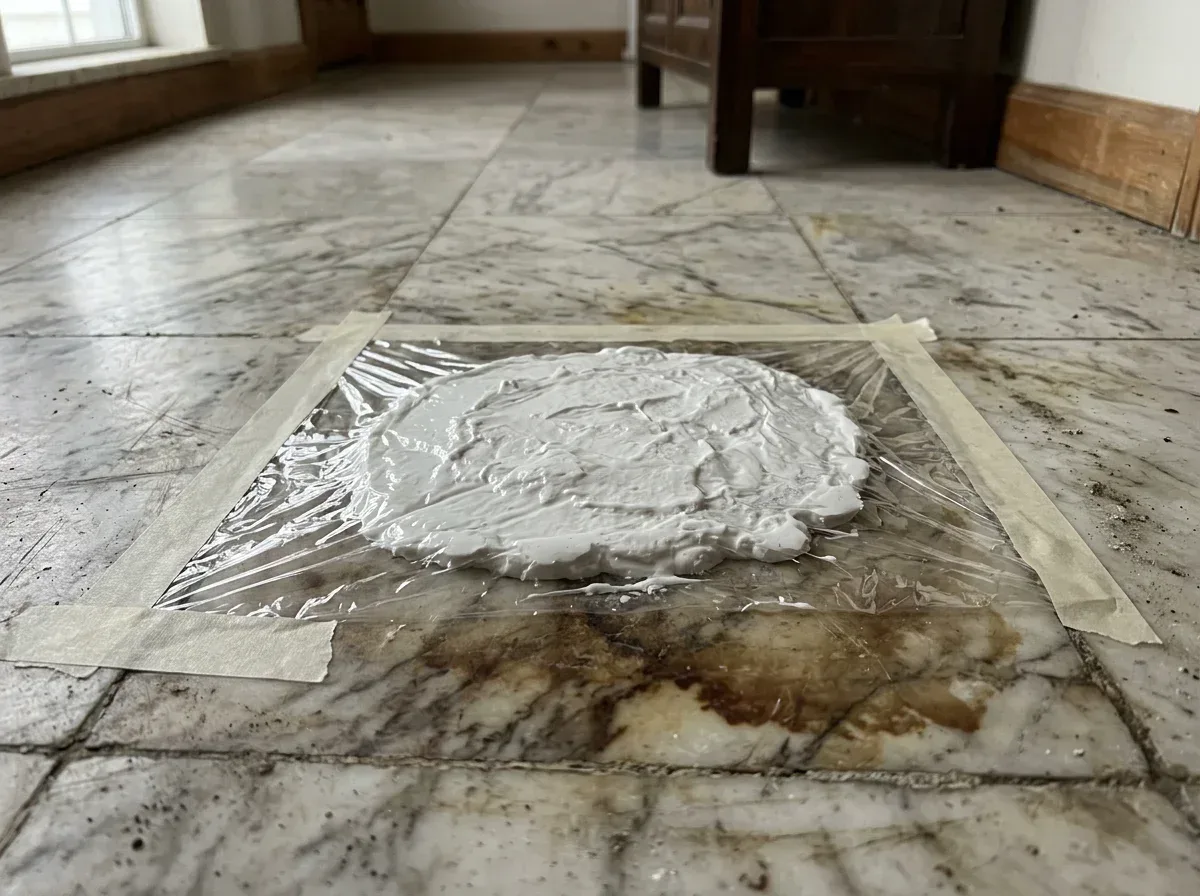
A poultice is a paste-like mixture used to draw a stain that has penetrated the stone out of it. An absorbent powder (clay, diatomite or a special poultice powder) is mixed with a solvent suited to the type of stain, applied over the stain at a thickness of a few millimeters and covered with plastic wrap. The solvent enters the pores of the stone and dissolves the stain; as the mixture dries, it draws the dissolved material into itself.
- Clean the surface: First, the surface is cleaned; a poultice does not work well on a dusty or polished surface, because the solvent cannot reach the pores of the stone.
- Prepare the mixture: Next, the mixture is prepared; it should have the consistency of peanut butter, because a mixture that is too runny will spread the stain.
- Apply and cover: Apply it so that it extends a few centimeters beyond the edge of the stain, cover it with plastic wrap and tape down the edges; this way the solvent does not evaporate right away.
- Let it sit: It is usually left for 24-48 hours; then the plastic is removed and the mixture is left to dry completely. During drying, the stain is drawn into the poultice.
- Remove and evaluate: Scrape it off with a plastic spatula and rinse the area with distilled water. If the stain has lightened but not disappeared, the application can be repeated.
The success of a poultice depends on choosing the right solvent: one solvent is used for oil stains, another for rust stains and another for organic stains. A wrong choice gives no result or may create a new problem in the stone.
Quick Table for Identifying the Type of Stain
The table below summarizes the marks we see most often on marble and what to do first for each:
| What you see | Likely cause | What to do first | Absolutely avoid |
|---|---|---|---|
| Yellow-brown cloud on white marble | Iron in the stone, moisture coming from below | Find the moisture source, suitable poultice | Bleach, acidic products |
| Orange stain with distinct edges | Metal foot, flowerpot, can | Remove the source, acid-free rust-drawing poultice | Acidic rust remover |
| White, crusty rings and marks | Limescale, hard water | pH-neutral cleaner, soft cloth | Limescale remover, vinegar |
| No color, surface dull and rough | Etch mark (lemon, cola, wine) | Polishing or honing | Struggling with cleaning |
| General yellowing on old polish | Aged polish film | Polish stripping and mechanical polishing | Applying new polish on top |
Safe Steps You Can Try at Home
When you come across a stain, here is what you can do without harming the stone:
- Blot, don't wipe: Do not wipe the spill; blot it up. Wiping spreads the stain and carries it over a wider area.
- pH-neutral cleaner and distilled water: Using only a pH-neutral cleaner suited to natural stone and distilled water prevents any new damage to the stone's surface while you deal with the stain.
- Test in an inconspicuous corner first: If you are using a product for the first time, try it first in an inconspicuous corner; if there is a change in the color or shine of the stone, you won't move on to the larger area.
- Don't leave metal wet: Do not leave metal objects wet on the stone; place plastic or felt under flowerpots and furniture legs.
- Dry wet areas: Dry the area around showers and sinks after use; limescale forms only when water evaporates.
If a poultice does not give results after two or three attempts, if the stain is very old, or if the surface has become dull and rough, it is best to have the stone examined by an expert rather than trying more chemicals.
Why Are Stains More Common in Homes in Alanya?
Water hardness along the coast, metal furniture used on balconies, salty air and humidity that lasts all summer speed up stain formation on marble. In salty air, metal feet rust faster and leave the rust on the stone. In homes with air conditioning, condensing moisture can trigger yellowing on white marble. In holiday homes that stay closed for months, the areas under rugs and furniture often remain a different tone from the rest. That is why the first step in dealing with stains in Alanya is to eliminate the source of the stain.
When to Consult a Professional

Home remedies are not enough for some stains; in the situations below, it is safer to have a specialist look at the stain.
- Stain spread over a large area: A stain covering a large area has usually penetrated into the stone, and spot cleaning will not give an even result.
- Stain that does not come out despite attempts: A stain that does not change after a few appropriate attempts is not on the surface but deep within the stone, and it calls for a different method.
- Dulling, pitting, or cracks: These signs seen together with the stain indicate that the stone itself is wearing away; polishing or repair may be needed instead of cleaning.
- Stain of unknown origin: Treating a stain without knowing whether it is rust, oil, or moisture can make the problem worse or damage the stone.
In these cases, seeing the stain on site helps both to choose the right method and to avoid damaging the stone.
Our Scratch and Stain Removal Service in Alanya

We remove scratches, acid marks and stains that have penetrated the stone on marble, granite and travertine surfaces using honing, poultice or spot repair, depending on the type of damage. We never start work without first identifying the source of the stain.
We tell you honestly, on site, which stains can be removed and which are permanent. Explore our Scratch Removal service.
A poultice is a mixture prepared by blending an absorbent powder with a suitable solvent to a paste-like consistency, which is applied over the stain in a thick layer. It is then covered and left to sit for a while. The solvent dissolves the stain within the stone; as the mixture dries, it draws the stain up out of the pores and into the powder. — Expert Note