Types of Scratches and Stains on Marble: Which Ones Can Honing Remove?
In short: Some of the marks you see on a marble floor are on the surface and disappear completely with honing; others sit deep in the stone, and honing alone is not enough.
In this article, we list the most common types of marks and explain how to recognize each one and which method removes it.
Why Does This Distinction Matter?
Honing removes a thin layer from the surface of the marble. Surface marks go away together with this layer. However, a stain that has penetrated millimeters into the stone will not disappear with the thin layer removed from the surface; it will only become lighter. Knowing this distinction helps you set the right expectations and choose the right method.
What Honing Removes
Surface Scratches (Fine Scratches)
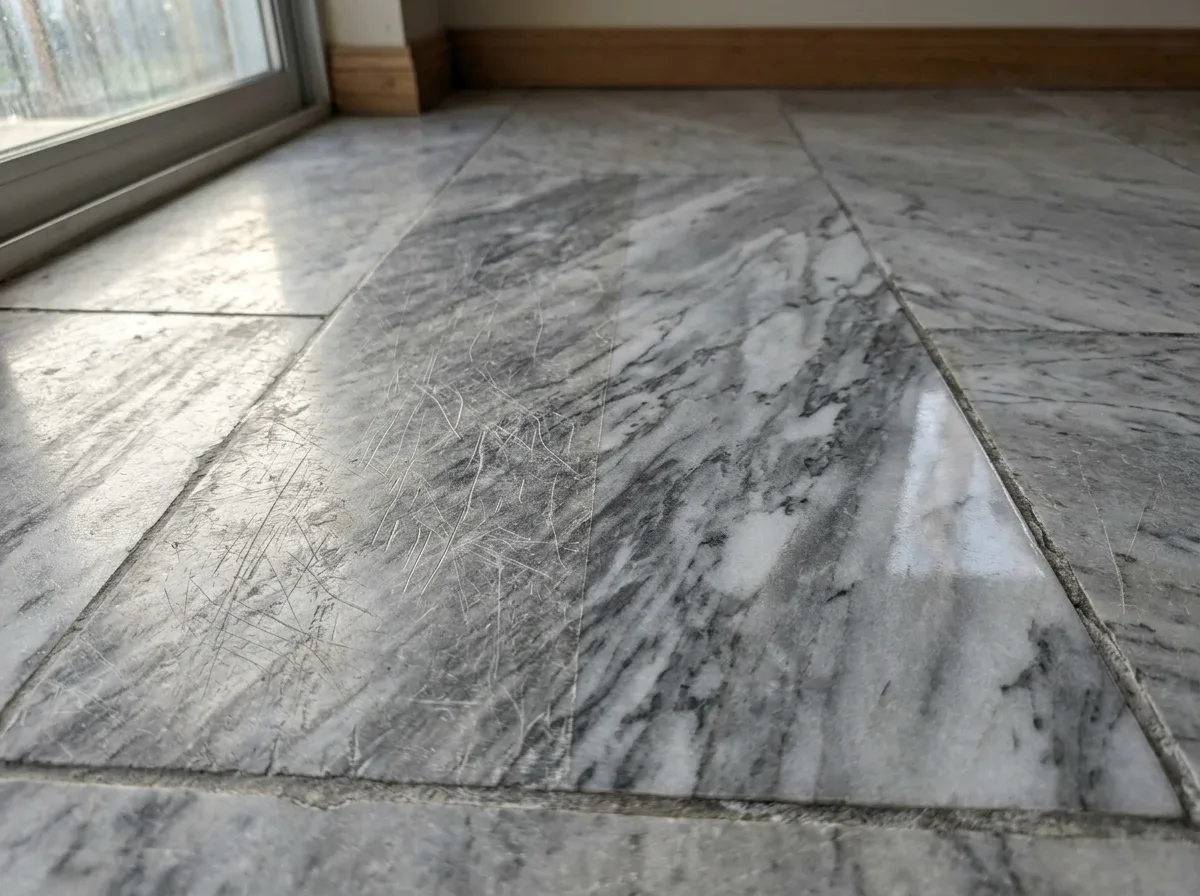
How to recognize them: Thin lines that are visible when you look against the light and cannot be felt with a fingernail.
Causes: Sand, dust, grit under slippers, light furniture movement.
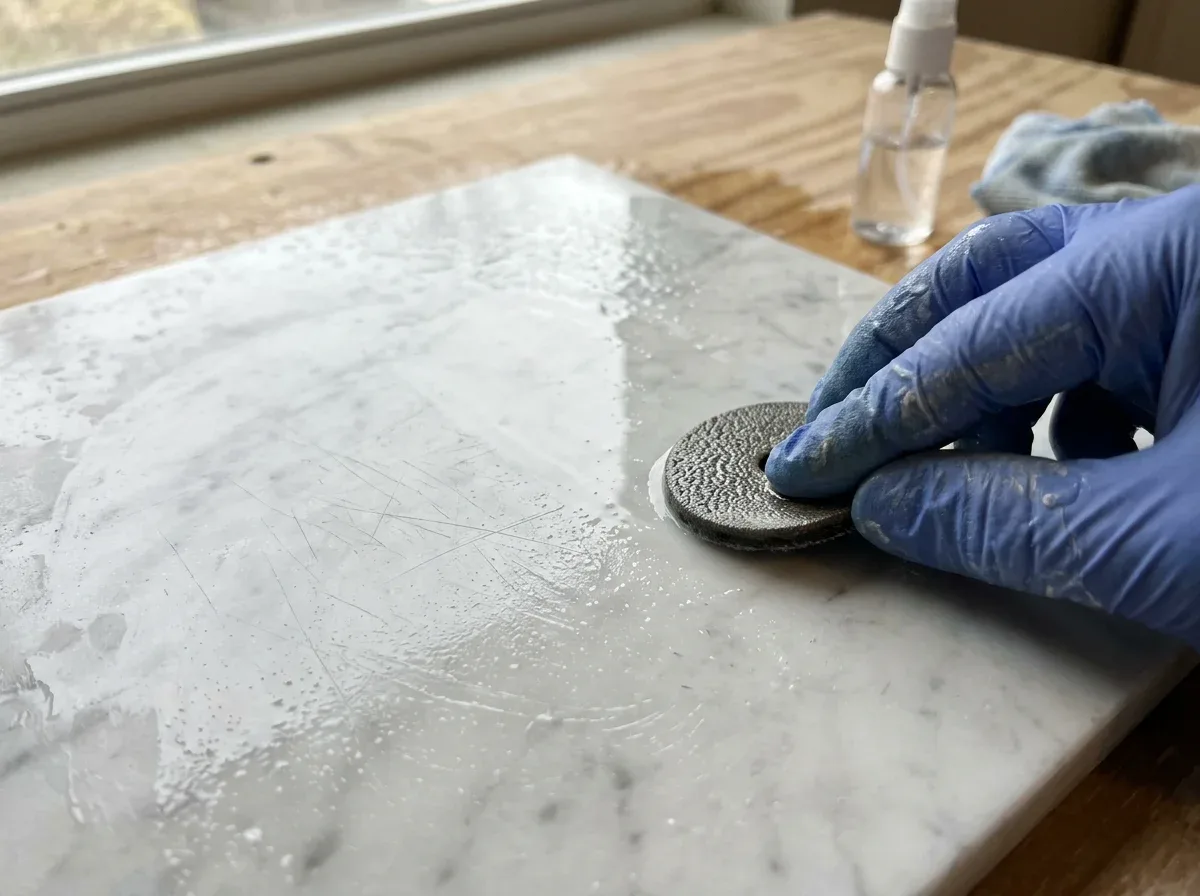
Solution: Polish refreshing or honing with fine grits.
Deep Scratches
How to recognize them: Distinct lines that catch your fingernail.
Causes: Heavy furniture dragged across the floor, sharp objects dropped on it, construction materials.
Solution: Honing starting with coarse grits. For very deep ones, filling may be done first.
Acid Marks (Etching)
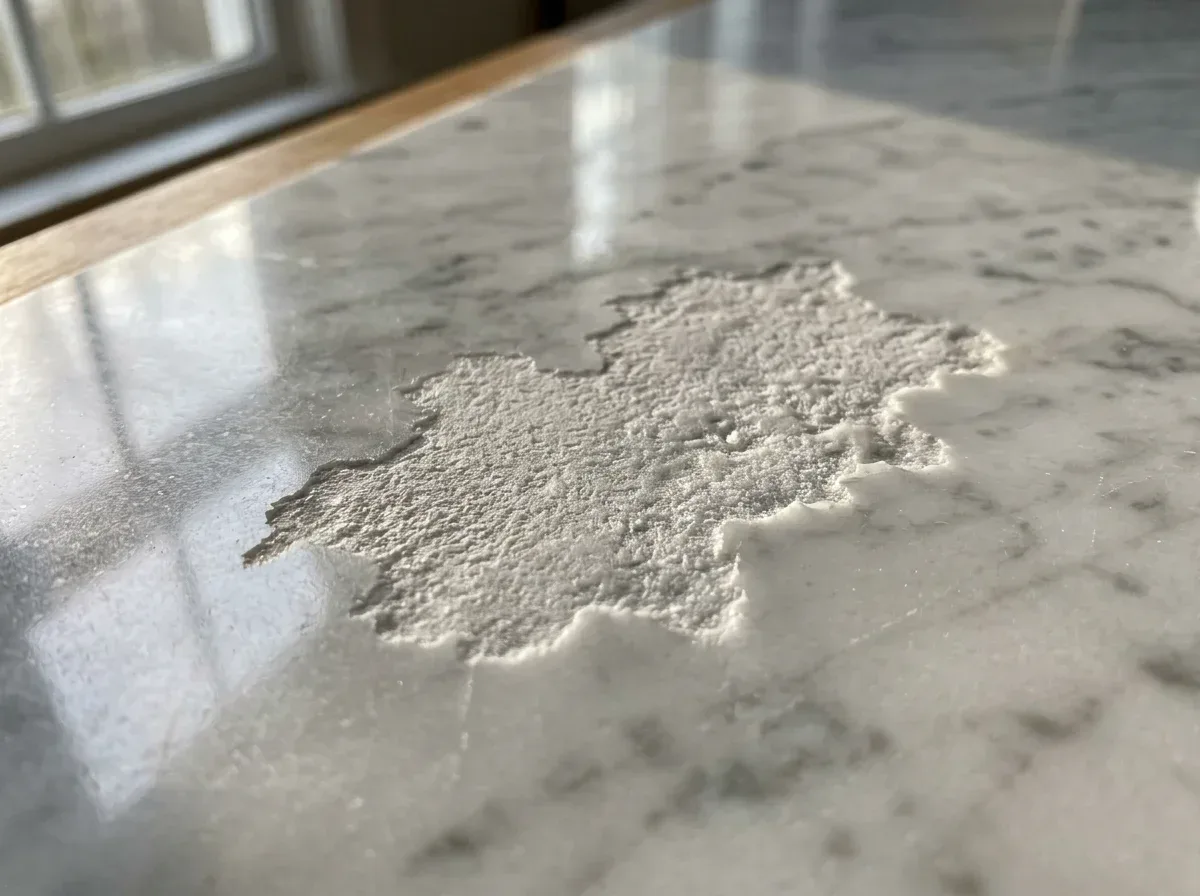
How to recognize them: Dull spots that have lost their shine where lemon, vinegar, cola, wine or limescale remover has touched the stone. They are seen as "dullness" rather than a color change; they may feel slightly rough to the touch.
Causes: Acid chemically dissolves the calcite in the marble.
Solution: Light marks are removed completely with polishing powders, and deep marks with honing. Stain removers do not work, because what you have is damage, not a stain.
Level Difference and Lippage
How to recognize them: Feet catching at slab joints, edges where light is refracted.
Solution: Coarse honing.
Film and Old Polish on the Surface
How to recognize them: Yellowed, stained, plastic-looking shine.
Solution: Stripping and honing.
What Honing Partially Lightens
Organic Stains (Coffee, Tea, Wine, Fruit)
How to recognize them: Brown, red or yellowish color stains. Fresh ones are close to the surface.
Solution: If fresh stains are on the surface, honing removes them. If they have penetrated the stone, they are first drawn out with a suitable poultice and then honed. Some organic stains may also fade on their own over time in sunlight.
Oil Stains
How to recognize them: Stains that darken the stone, with soft edges and a wet look.
Solution: Oil penetrates deep into the stone easily; honing alone is not enough. Oil-dissolving poultice applications are needed, sometimes with several repetitions.
Rust Stains
How to recognize them: Orange-brown stains, often taking the shape of the metal object.
Solution: Acid-free rust-drawing poultices. Deep and old rust may not come out completely.

What Honing Does Not Remove (The Source Must Be Fixed)
Moisture Stains From Below
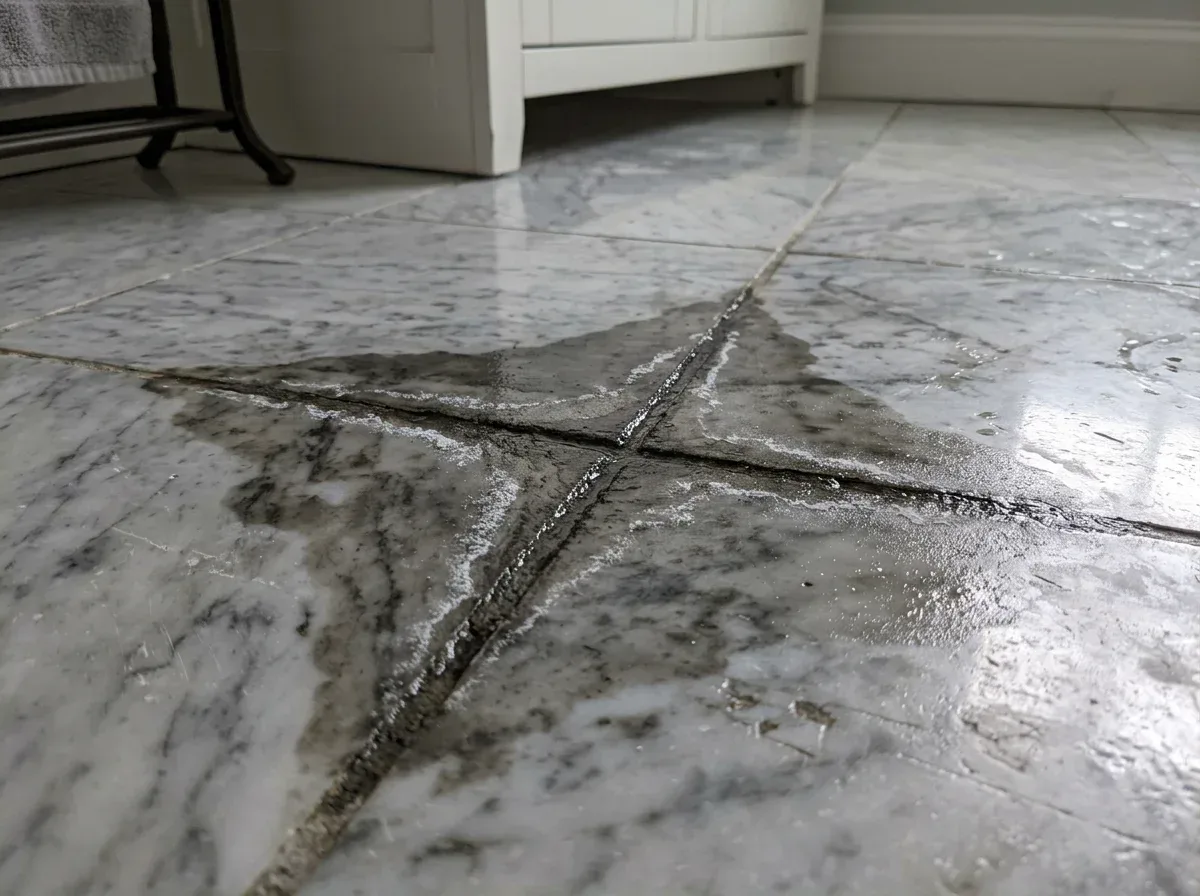
How to recognize them: Stains that spread from slab edges or joints, darken when moisture increases and lighten when dry. Sometimes white salt efflorescence accompanies them.
Solution: The moisture source (plumbing leak, screed moisture, groundwater) must first be found and fixed. Otherwise, the stain returns after honing.
Natural Color Variations of the Stone
How to recognize them: Yellowish or dark areas inside the stone, running along the veins.
Solution: These are not stains, but the natural structure of the stone. Honing does not change them; on the contrary, it may make them more prominent.
Cracks
Solution: Honing does not close a crack; it is first repaired with a color-matched filler, and then the surface is honed.
Mark Types at a Glance
| Mark | Where? | Result with honing | Additional treatment |
|---|---|---|---|
| Fine scratch | On the surface | Disappears completely | Not required |
| Deep scratch | On the surface, deep | Disappears with coarse grit | Filling if very deep |
| Etch mark | On the surface | Disappears completely | Not required |
| Lippage (height difference) | Slab joint | Removed by coarse grinding | Fixing if any slab has come loose |
| Old polish film | On the surface | Removed after stripping | Polish stripping |
| Organic stain | On the surface or inside | Partially | Poultice |
| Oil stain | Inside the stone | Partially | Solvent poultice |
| Rust | Inside the stone | Partially | Acid-free rust remover |
| Moisture stain | Beneath the stone | Temporary | Resolving the moisture source |
The Right Order: Stains First, Then Grinding
If a floor has both scratches and stains, the order of work directly affects the result. Stains that have penetrated the stone are drawn out first with a poultice, any moisture source is resolved, and cracks are closed with filler; grinding is done last. If grinding is done first and the stain is drawn out afterwards, the surface may have to be re-polished in the areas where the poultice was used. In addition, some stains can penetrate deeper into the surface that grinding has opened up.
Setting the Right Expectations
Grinding is one of the most effective restorations that can be done on marble, but it is not a process that erases every mark. Surface scratches, dullness, etch marks and lippage disappear completely with grinding. Old oil or rust stains inside the stone become noticeably lighter, but sometimes leave a faint shadow. The stone's own natural color variations, however, do not change. Before starting work, the best approach for both you and us is to inspect the floor together and discuss in advance which marks will disappear and to what extent.
A Quick Check on Your Own Floor

- Run your fingernail over the mark: if it catches, it's a deep scratch.
- Look at it against the light: is the color missing, or is it the shine? If the shine is missing, it's an acid etch or wear.
- Put a few drops of water on it: if the stain darkens, it's inside the stone.
- Look at the shape of the stain: if it has sharp edges and the shape of an object, it's rust or a flowerpot mark.
- Does it change with the season? If it grows and shrinks with humidity, it's moisture coming from below.
Our Scratch and Stain Removal Service in Alanya

We remove scratches, acid marks and stains that have penetrated the stone on marble, granite and travertine surfaces using honing, poultice or spot repair, depending on the type. We never start work without first identifying the source of the stain.
We tell you honestly on site which stains can be removed and which are permanent. Explore our Scratch Removal service.
Watch the Process on Video
Footage of marble surface restoration work carried out by our team in Alanya.
The easiest way to tell whether a mark will come out with honing is to touch it. If you can feel roughness or dullness with your finger, the problem is on the surface and honing will remove it; if the surface is smooth but the color is different, the stain is inside the stone and must be drawn out first.