Hotel Spa and Hammam Area Floor Maintenance Schedule
In short: The hotel spa is the area where guests walk barefoot and look at the floor most closely.
Here, dirty grout, limescale, or a slippery floor directly affects both guest satisfaction and safety. In this article, we suggest a practical maintenance schedule for the hotel spa and hammam area. The schedule should be adapted to the size of the hotel and its water conditions.
Defining the Zones
The spa area is not a single floor. When planning maintenance, each zone should be considered separately:
- Hammam: Because the central heated stone (göbek taşı), the basins (kurna), the benches, and the floor are in constant contact with hot water and soap, limescale, mineral buildup, and slipperiness are most common here.
- Around the sauna and steam room: Wet-foot traffic is heavy at entrances, exits, and showers; hot humidity speeds up darkening and mold in the grout.
- Around the indoor pool: Poolside stones, showers, and walkways are constantly wet with chlorinated water, which creates limescale bands and a slip risk.
- Changing rooms: Guests arriving with wet feet and traffic around the benches keep the floor frequently wet, so drying and slip resistance matter most here.
- Massage rooms and relaxation lounge: These areas stay drier, so maintenance is lighter; however, oil and cream spills can leave stains on the stone.
- Reception and corridors: In these areas, where traffic with and without shoes passes, sand from outside and moisture from the spa meet on the same floor.

Daily Maintenance
Before opening:
- Checking for puddles: Before opening, the floor is checked for puddles left overnight; puddles pose both a slip risk and a risk of limescale marks.
- Checking for slippery spots and broken tiles: Before guests arrive, slippery spots and broken tiles are inspected; if necessary, the area is marked and closed to use.
During the day:
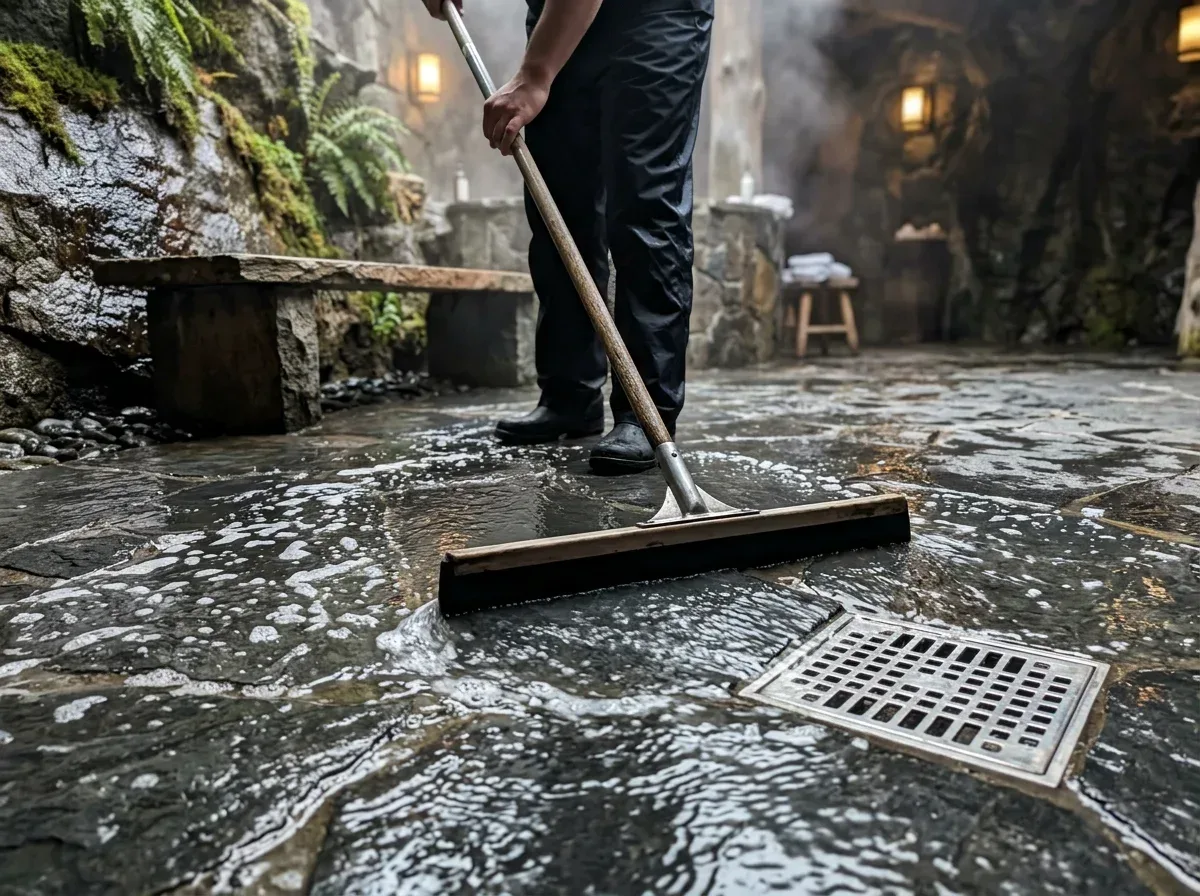
- Direct puddles toward the drain: In wet areas, accumulated water is pulled toward the drains with a squeegee; this reduces the slip risk and prevents limescale from evaporating water.
- Dry the areas in front of showers: If the floor in front of showers and in passageways is dried during the day, water carried by wet feet does not spread and slippery spots do not form.
- Rinse off soap foam: If soap foam left on the central stone and basins is not rinsed off, it dries and leaves a slippery layer and mineral buildup.
At closing:
- Cleaning with pH-neutral products: At closing, the floor is cleaned with pH-neutral products suitable for stone; these products remove dirt without dissolving marble and travertine.
- Rinse the central stone and basins: In the hammam, the central stone and basins are rinsed with plenty of water so that soap and cleaning product residues that built up during the day are not left on the stone.
- Lift and dry the mats: If wet mats are left on the floor, moisture is trapped underneath; when they are lifted and dried, neither the floor nor the mat develops mold.
- Run the ventilation: Keeping the ventilation running for a while after closing helps expel moisture, slowing mold and darkening in the grout.
Weekly Maintenance
Weekly maintenance regularly removes the soap, dirt, and mineral buildup that daily cleaning leaves behind over time.
- Deep cleaning of soap residue: Deep cleaning with products that are suitable for stone and dissolve soap residue removes the gray, slippery layer that builds up on the floor.
- Brushing the grout: If the grout is cleaned with a brush, dirt and mold are removed before they settle, preventing darkening from becoming permanent and avoiding early grout renewal.
- Checking buildup in showers and drains: Limescale and sediment that accumulate under shower heads and in drainage channels are checked; a clogged channel causes water to pool on the floor.
- Wash the poolside stones: When poolside stones are washed with fresh water, the buildup of salt and limescale left by evaporating chlorinated water slows down.
Monthly Maintenance
In monthly maintenance, in addition to cleaning, the condition of the protective layer and slip resistance is also checked regularly.
- Acid-free mineral cleaning: Spots prone to mineral buildup are cleaned with acid-free mineral cleaners; this removes limescale before it thickens, without damaging the stone.
- Detecting mold and darkening: If grout where mold and darkening have started is detected early, it can be restored with brushing; if delayed, it is added to the renewal list.
- Drop test for impregnation: Especially on travertine and marble, if water dripped onto the surface is absorbed, it shows that the impregnation has weakened and its renewal is planned.
- Slipperiness check: A walking test is performed on the wet floor and complaint records are reviewed; areas that have become slippery take priority in seasonal maintenance.
Seasonal (Once or Twice a Year)
Seasonal maintenance, carried out once or twice a year, addresses the wear and buildup that daily and monthly tasks cannot remove.
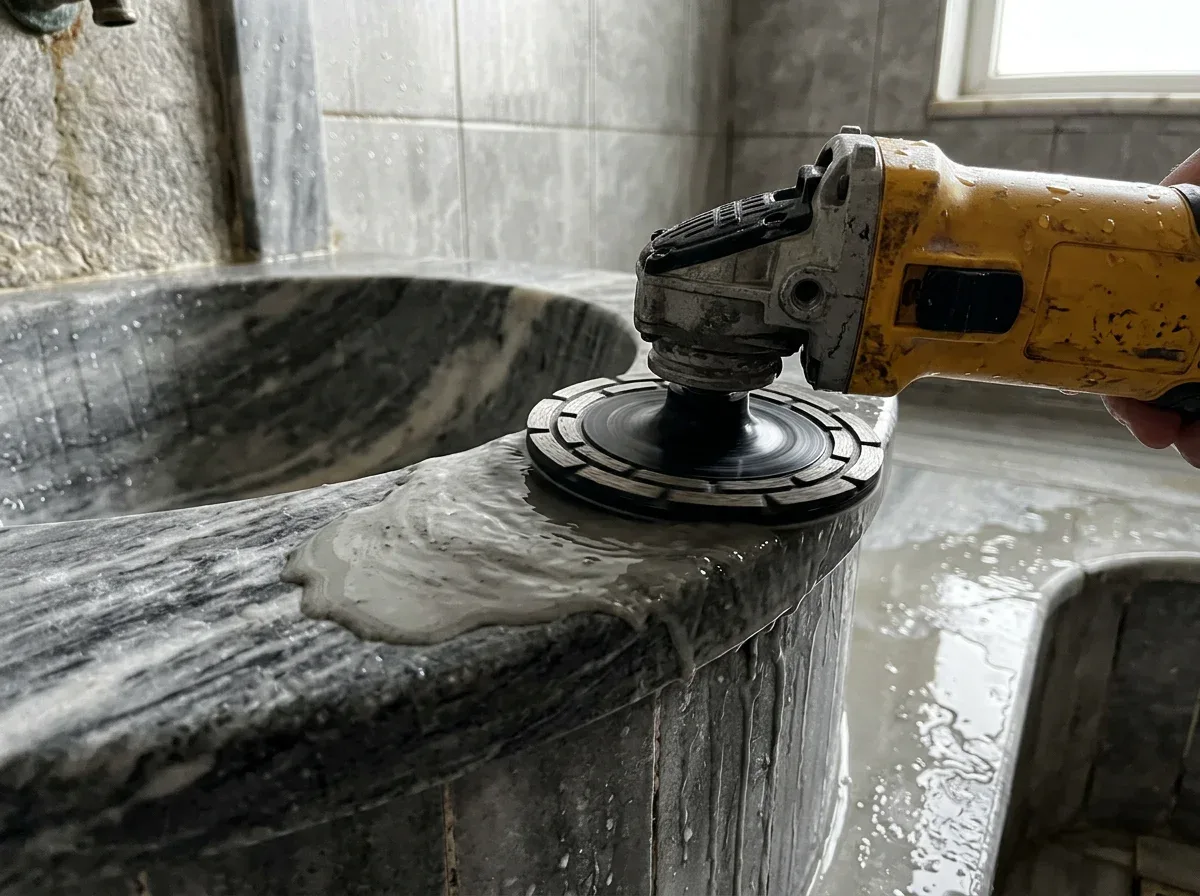
- Pre-season: The central heated stone and basins are wiped down and polished, limescale crusts are removed mechanically, grout joints are renewed, the surface is treated for slip resistance and the sealant is reapplied.
- End of season: Damage that occurred during the season is identified, broken and cracked slabs are repaired, and the winter work is planned based on these records.
In hotels that are open year-round, this work is scheduled for low-occupancy periods and night hours.
What Should Not Be Used
In spas and hammams, the wrong products and tools can quickly undo the benefits of regular maintenance.
- Acidic descalers: On marble and travertine, acidic descalers dissolve the stone's surface along with the limescale, causing the shine to disappear and the surface to become rough.
- Oily and waxy polishes: Oily and waxy polishes leave a thin film on the surface; on a spa floor walked on with wet, bare feet, this film creates serious slipperiness.
- Steel wire and abrasive sponges: Hard steel wire and abrasive sponges remove limescale but also scratch the stone; a scratched surface gets dirty faster and holds onto limescale.
- Heavily chlorinated products: Continuous use of products with a high chlorine concentration can weaken the sealant and leave the stone unprotected.
Schedule Summary
| Frequency | Hammam | Pool area and showers | Changing rooms and walkways |
|---|---|---|---|
| Daily | Rinsing the central heated stone and basins | Draining water, drying | Removing mats |
| Weekly | Cleaning soap residue | Rinsing with fresh water, checking drains | Grout brushing |
| Monthly | Acid-free mineral cleaning | Checking the limescale band | Checking for mold and darkening |
| Seasonal | Honing and polishing | Honed refinishing, sealing | Grout renewal, sealing |
Checklist for the Housekeeping Team
For the schedule to work, the team needs to know what to do and when, and to record it. Preparing a one-page checklist for each area helps ensure maintenance doesn't lapse during shift changes.

- Product list by area: If which product is used in which area is written down along with the product labels, the wrong product will not be used even when shifts change.
- Stone type by area: Since marble, travertine and granite react differently to acids, listing the type of stone in each area makes product selection easier.
- Who to notify: If it is clear who to notify when a slippery spot, a broken slab or a damaged grout joint is spotted, the problem is dealt with before it grows.
- Explaining the ban on acidic products: If new staff are told why acidic products leave permanent dull marks on marble and travertine, the most common mistake is prevented from the start.
- Recording water drop test results: When the monthly water drop test results are noted, you can track in which area the sealant is weakening and determine the renewal time more accurately.
Budget and Planning
Regular daily and weekly maintenance noticeably reduces the need for, and the cost of, seasonal honing. In a neglected hammam, removing thick limescale crusts, completely renewing the grout and repairing broken slabs can take several days, whereas in a well-maintained area the pre-season refresh is often completed in a day or two. That is why the healthiest approach is to fix seasonal work to the same period every year and add it to the budget in advance.
How We Work with Hotels in Alanya
Because the season in Alanya is concentrated between April and October, spa and hammam maintenance is largely carried out between November and March. We do a preliminary inspection with hotels at the end of the season, prepare a list of damage and needs, and plan the pre-season honing, grout renewal and sealing work according to that list. In facilities that are open year-round, we split the work across night hours and the weeks when occupancy drops.
Keeping Records

The most important part of a good maintenance plan is record keeping:
- Which area was cleaned, on which day, and with which product?
- Where were limescale, mold or cracks noticed?
- When was the impregnation applied, and what was the water drop test result?
- Where are guest complaints (slipping, odor, dirt) concentrated?
These records make it easier to determine the scope of the professional maintenance to be carried out before the season.
Our Marble Honing Service for Hammams and Spas in Alanya

We remove the layer of soap scum, limescale and minerals that builds up on the central heated platform (göbek taşı), basins (kurna) and hammam floors, and we renew worn marble by honing it. In wet areas, we care about slip resistance more than shine, and we finish the surface accordingly.
In hotel hammam and spa areas, we plan the work around the facility's schedule. Explore our Hammam Honing service.
In Alanya, most hotels operate according to the summer season. The periods just before and after the season are the best times for comprehensive maintenance: — Expert Note