Pre-Season Floor Renovation Plan for Hotels
In short: Most hotels in Alanya operate on a summer-season schedule and stay closed or run at low occupancy during the winter months.
This is the period when floor renovation work can be done most efficiently. In this article, we explain how hotel managers and technical directors can build a pre-season floor renovation plan.
Why Before the Season?
Winter is the best time for floor work, because the hotel is empty or only lightly occupied and work can be done without affecting guests.
- Empty or low-occupancy hotel: Because the hotel is empty or lightly occupied, work can be scheduled day and night, and large areas can be closed off and worked on in one go.
- Guests are not affected: Since there are no guests, restrictions such as the noise of grinding machines, dust and area closures do not lead to complaints or dissatisfaction.
- Detecting fresh damage: Dullness, stains and breakage that built up during the season can be spotted and recorded while still fresh, so no problem is forgotten.
- Best look from day one: When renovation is completed before opening, the hotel welcomes its guests from the first day with clean, shiny and safe floors.
Step 1: End-of-Season Assessment
As soon as the season ends, a list of all floors should be drawn up:
- Area name and square meters: If the name and square meters of each area are recorded, the amount of work, duration and cost can be calculated accurately when discussing with the supplier.
- Stone type and surface: If you know whether the floor is marble, travertine, granite or concrete, and whether its surface is polished, honed or brushed, the right method and product can be chosen.
- Problems: Problems such as dullness, stains, scratches, breakage, hollow tiles, deteriorated grout and slipperiness complaints are noted separately, area by area.
- Photos: A photo of each problem makes prioritization easier and allows you to compare the work done after the renovation.
Records from the housekeeping team and guest complaints during the season are added to this list.
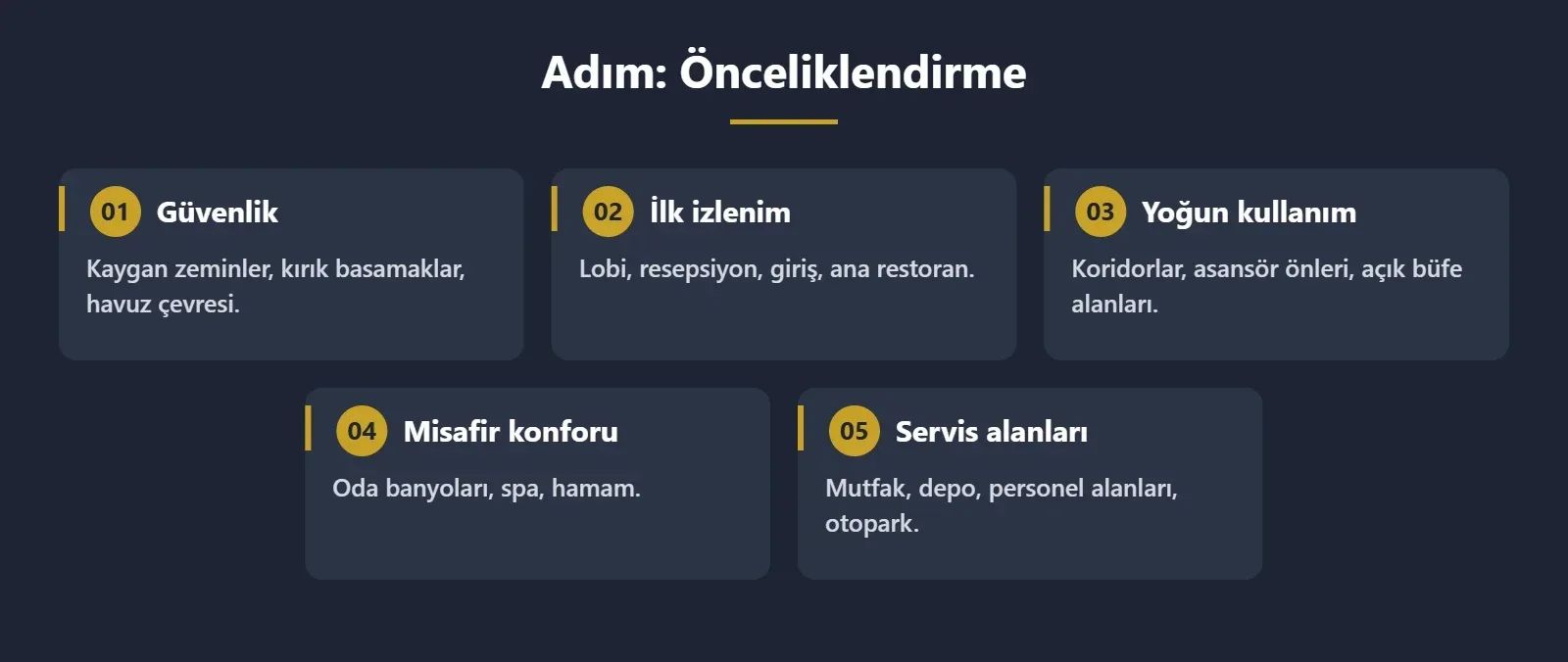
Step 2: Prioritization
Each area is evaluated in terms of guest perception and safety:
- Safety: Slippery floors, broken steps and the pool surroundings come first; problems in these areas carry a direct risk of accidents and liability.
- First impression: After safety, the lobby, reception, entrance and main restaurant are addressed, because guests form their first impression of the hotel in these areas.
- Heavy use: Next come corridors, areas in front of elevators and buffet areas; these routes wear out fastest, so damage grows if work is delayed.
- Guest comfort: Then room bathrooms, the spa and the hammam are addressed; these are the areas guests look at most closely and use barefoot.
- Service areas: Kitchens, storage, staff areas and the parking lot are planned last; even if guests do not see them, dusting and slipperiness affect operations.
Step 3: Work by Area
Lobby and Reception
Grinding, shine restoration or crystallization; grout and breakage repairs; review of the entrance mat system.
Restaurant and Buffet
Oil and acid stains, dullness; slip resistance in kitchen passages; marks from table and chair legs.
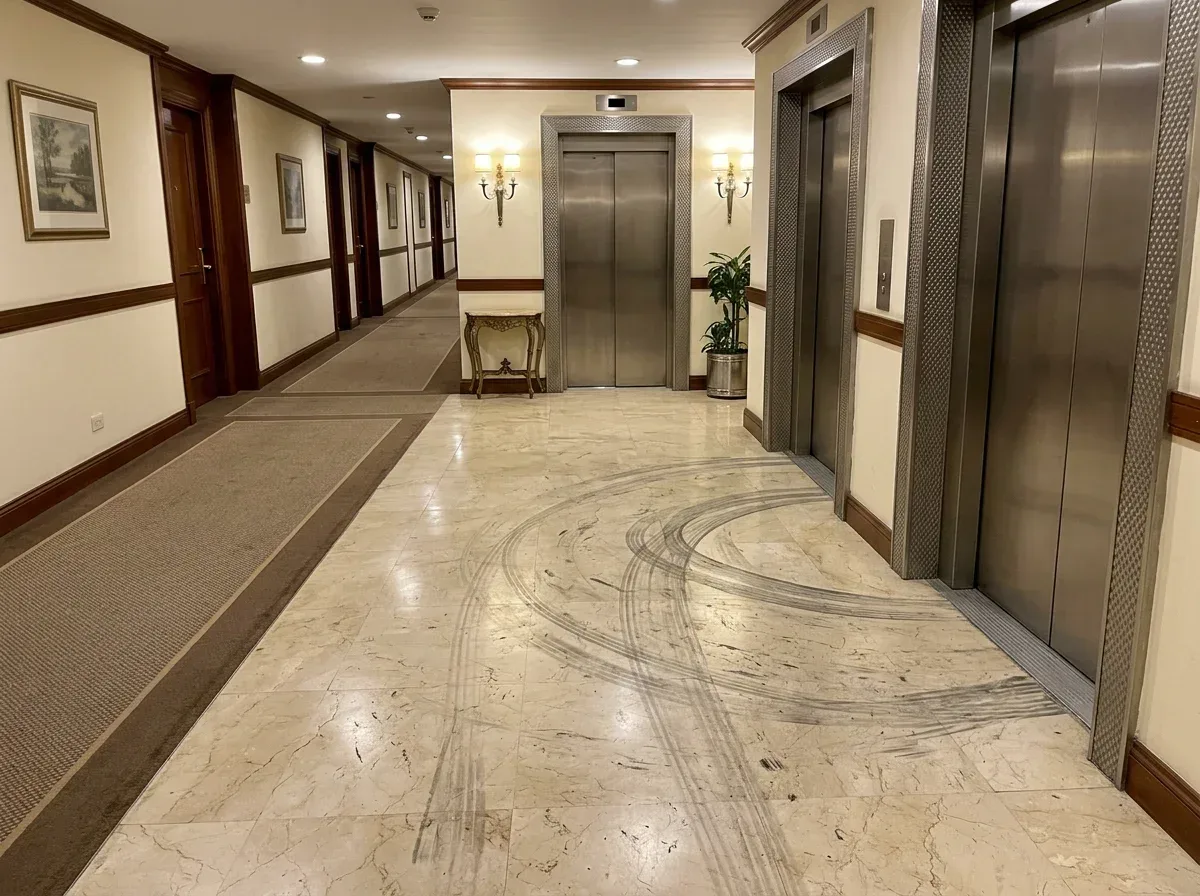
Corridors and Areas in Front of Elevators
Suitcase wheel marks, dullness along walking paths.
Room Bathrooms
Limescale marks, acid damage, grout darkening and mold; countertop stains.
Spa and Hammam
Central heated stone (göbek taşı) and basins, mineral buildup, slip resistance, grout renewal.
Pool Surroundings and Terraces
Limescale band, algae, salt, slip resistance, impregnation.
Service Areas and Parking Lot
Dusting on concrete floors, oil stains, grout cracks; concrete grinding and hardener.
Step 4: Schedule
A well-built schedule distributes the work across the closed weeks while leaving room for drying times and the final inspection.
- Spread work over low-occupancy weeks: Work is distributed across the weeks when the hotel is closed or occupancy is lowest, so no area is closed off while guests are present.
- Plan access and material routes: If it is decided in advance which corridor crews and materials will move through, newly finished floors will not be damaged during later work.
- Add drying times: If the drying and curing times of filler, repair mortar and impregnation are not written into the calendar, the area may be opened for use too early and be damaged.
- Leave time for a final check: A buffer left before opening gives enough time to fix any outstanding items and to clean up the residue left after polishing.
In hotels that stay open year-round, work is planned for night shifts and little-used wings.
Step 5: Budget
If the budget is limited, spending follows the order set during prioritization, starting with the most critical areas.
- Safety and first impressions first: The first share of the budget goes to slippery and broken floors, and to the areas guests see first, such as the lobby and reception.
- Then heavy-use areas: Next, the areas that wear out fastest, such as corridors and the areas in front of elevators, are addressed so that damage does not grow and carry over into the next season.
- Comfort and service with what remains: With the remaining budget, guest room bathrooms, the spa and service areas are renewed; if it is not enough, this work can be planned for the next season.
Spreading large renovations over several seasons distributes the budget burden.
Sample Pre-Season Calendar
| Period | Work |
|---|---|
| Late October - November | End-of-season assessment, photographing, prioritization, collecting quotes |
| December | Service areas and car park: concrete polishing, hardener |
| January | Spa and hammam: limescale removal, central heated marble slab (göbek taşı), joint renewal |
| February | Guest room bathrooms and corridors: block-by-block polishing and repair |
| March | Restaurant, pool surroundings and terraces |
| April | Lobby and reception: polishing, crystallization; final check and opening cleaning |
This order ensures that the most visible areas are done last, so that materials and equipment moved around during work in other sections do not damage the lobby.
Housekeeping Training
Protecting renovated floors throughout the season depends largely on the housekeeping team. At the start of the season, a short training session should explain which product to use in which area, why acidic products are prohibited, and how to deal with spills on marble and travertine. A one-page list of rules posted in each floor office also serves as a guide for staff who join during the season. This small investment noticeably shortens the list of damage found at the end of the season.
Points to Clarify with the Supplier
Points clarified with the supplier before work begins prevent surprises and disputes in the pre-season calendar.
- Scope of work, duration and price: If a separate scope of work, duration and price are written for each area, it is clear what will be done when and what to check upon handover.
- Working hours and noise: If the working hours and noise limits are agreed in advance for the period when the hotel is partially open, guest complaints are avoided.
- Dust, slurry and waste: How the polishing slurry and dust will be controlled and who will remove the waste should be determined from the start.
- Products to be used: If the products used in the application and the cleaning products recommended afterwards are known, the housekeeping team can perform maintenance suited to the new floor.
- Emergency response during the season: How quickly the team can arrive for a tile that breaks mid-season or a deep stain should be discussed in advance.
Planning with Hotels in Alanya
With hotels in Alanya, we usually carry out an assessment tour after the season closes and prepare a photographed needs list and priority order for each area. We spread the work over the months when the hotel is closed, and in facilities that are open year-round, over blocks and night hours. Before opening, we give the housekeeping team short maintenance training, and we remain reachable for emergencies throughout the season.
Step 6: In-Season Maintenance Plan

To keep the shine after restoration throughout the season:
- Housekeeping training: If the team is taught the right products and methods, the shine won't be lost quickly through the wrong detergent or pad.
- Daily and weekly checklists: Written maintenance checklists make clear which area is to be cleaned when and how, so no area is skipped.
- Mid-season shine refresh: A light refresh in heavily used areas such as the lobby helps maintain the shine until the end of the season.
- Sealer check: A check using the drop test reveals areas where protection is weakening before stains form.
Our Crystallization Polishing Service in Alanya

After honing, or on marble floors that have lost their shine but have no deep damage, we use crystallization polishing to increase the surface's gloss and durability. It is a method that extends the maintenance interval in heavily used areas such as hotel lobbies, shops, and apartment building entrances.
We show you on site whether crystallization polishing or honing is the right choice for your floor. Explore our Crystallization Polishing service.
In a pre-season renovation plan, the most visible area is done last. If the lobby is finished last, it welcomes guests spotless on opening day.